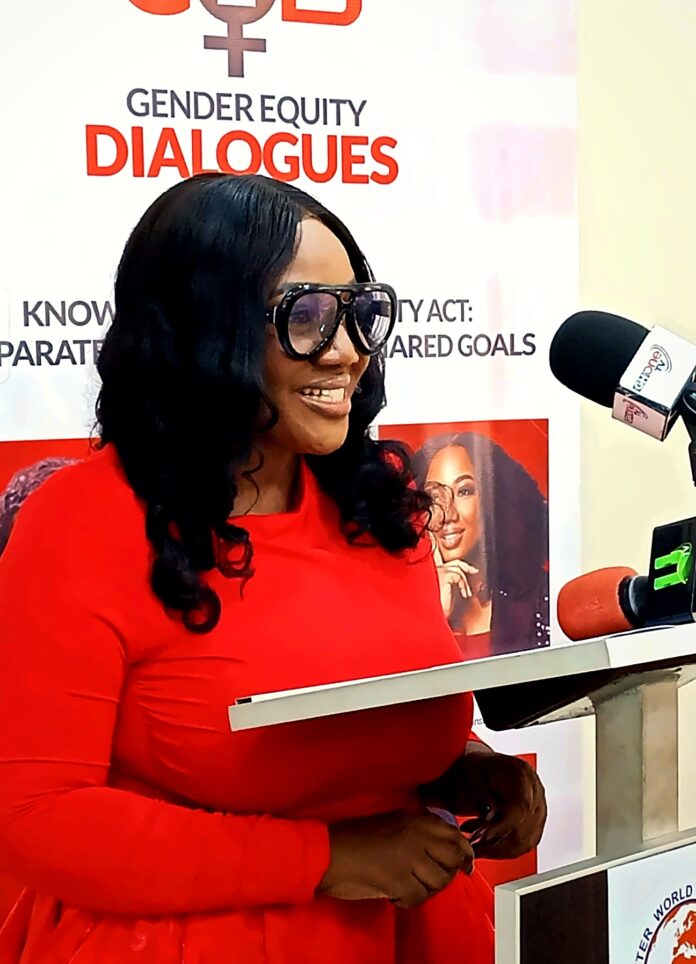

The Gender Equity Dialogues (GED) was officially launched on Friday, 11 September 2026, at Child Rights International in Accra, bringing together more than 30 participants.
The maiden edition of the planned biannual series was convened by gender advocate and media consultant Sangmorkie Tetteh.
The event coincided exactly with the second anniversary of former President Nana Akufo-Addo’s assent to the Affirmative Action (Gender Equity) Act, 2024 (Act 1121).
Welcoming guests, the convenor, Sangmorkie Tetteh, described the initiative as a platform built on a simple premise; a law cannot work for the people it is meant to protect until they know it exists, understand its provisions, and know how to use it.
She traced her own commitment to gender equity to her time as the second female SRC President in her university’s history, recalling being treated as an exception rather than the norm.
Present at the event was Her Eminence Mrs Joana Adzoa Opare, a pioneer of the Affirmative Action Act and former Chairperson of the National Technical Committee on the Affirmative Action Bill.
Also in attendance was Mercy Catherine Adjabeng, a communications and gender-and-development expert and convenor of the Alliance for Women in Media Africa (AWMA), who commended the Dialogues for deliberately bridging a generational gap in conversations on gender equality.
Speakers reminded the gathering that Act 1121 followed more than two decades of advocacy and sets clear representation targets for women in decision-making positions—30% by 2026, 35% by 2028, and 50% by 2034.
While the Gender Equity Committee has been constituted and a Legislative Instrument is being prepared, participants were told that implementation remains slow and underfunded.
They were urged to treat the law as a practical tool rather than a symbolic victory. Section 28 of the Act, which criminalises intimidation, victimisation and gender-based hate speech against women, including online, was highlighted as one of its key protections.
Strategy consultant and lecturer Dr Tetteh linked the law’s promise to individual choice, arguing that structural change follows deliberate action rather than chance.
Drawing on the pattern of women in student politics gravitating toward secretarial or deputy roles rather than the presidency, she told participants:
“What is wrong is not running at all, because if no woman contests, no woman can win, and the pattern simply repeats itself for another generation,” she said.
She extended the point beyond campus politics, noting that while women are well represented in gender studies research, they remain scarce in shaping conversations on security and governance.
Positioning oneself deliberately in such spaces, rather than waiting to be invited, is what intentionality looks like in practice, she said.
The Dialogues were held in partnership with the Affirmative Action Law Coalition and the Alliance for Women in Media Africa (AWMA), with support from Child Rights International.
Dromi Investments Limited and Ace Insurance sponsored the inaugural edition.
The Ghana Journalists Association (GJA), led by President Albert Kwabena Dwumfour, and Women of Valor, led by Nana Aba Anamoah, also endorsed the initiative.
The convenor Ms Tetteh emphasised that the Gender Equity Dialogues will continue as a recurring series, with the next editions expected in the coming year.