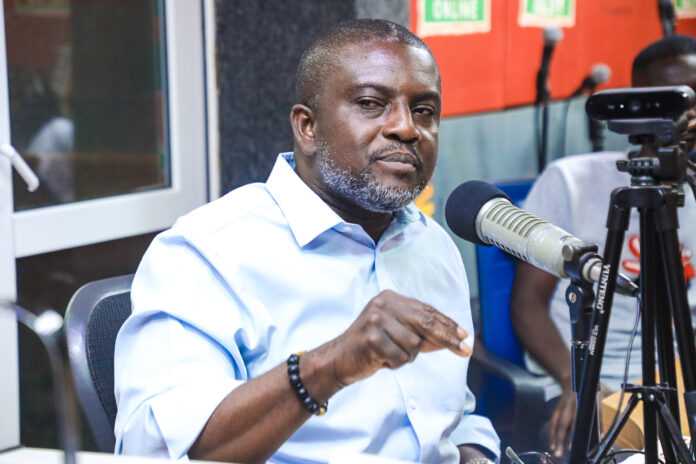

Former Deputy Director-General of the Ghana Education Service (GES), Dr Kwabena Bempah Tandoh, has attributed the difficulties surrounding the 2026 Senior High School (SHS) placement exercise to changes made to the established placement model.
Speaking on JoyNews’ Newsfile on Saturday, Dr Tandoh, who is also spokesperson for the NPP Policy Committee on Education, said the controversy was largely the result of changes to student selection, eligibility requirements and the number of Category A schools candidates could choose.
His comments come amid public concern over reports involving approximately 55,000 candidates in the 2026 placement exercise.
Dr Tandoh said Ghana’s secondary school placement system had historically been based on two key considerations: student choice and the availability of places in schools.
He explained that before the 1987 education reforms, pupils completed primary education and sat the Common Entrance examination, after which secondary schools admitted students based largely on their preferred schools and the capacity available.
The 1987 reforms introduced the JSS and SSS structure, which later evolved into the current JHS and SHS system. However, the challenge of limited spaces remained, making grading, merit and school capacity important components of admission.
According to Dr Tandoh, the introduction of the Computerised School Selection and Placement System (CSSPS) in 2005 modernised the process by using computers to replicate the work previously done manually by school authorities.
He stressed, however, that computerisation did not eliminate cut-off points because schools could only admit students according to their available capacity.
Dr Tandoh said the introduction of Free SHS in 2017 was accompanied by a deliberate effort to expand access to secondary education.
He noted that from 2017 to 2025, students who failed both English Language and Mathematics were generally the ones excluded from progression to SHS, with the number remaining within a relatively narrow range.
He cited 10,184 students in 2024 and 13,919 in 2025 as examples.
However, he said the eligibility rule was changed in 2026 without adequate communication, consultation and collaboration with stakeholders.
According to him, this contributed to the initial decision to classify 54,985 candidates as disqualified, before the Ministry of Education adjusted its position about 48 hours later and allowed the affected students to pursue self-placement.
Dr Tandoh argued that the reversal itself demonstrated the uncertainty created by the change in policy.
The former GES official also disputed the suggestion that Ghana’s placement difficulties were primarily caused by an overall shortage of SHS places.
He cited figures indicating that 859,828 places were available, while the number of candidates requiring placement was about 623,000.
He further pointed to claims that 1,132 infrastructure projects were undertaken between 2019 and 2025 to increase school capacity.
For Dr Tandoh, the figures indicate that the fundamental problem is not necessarily a lack of spaces nationwide, but the concentration of demand on particular schools.
“Choice and space availability” therefore remain central to understanding the placement challenge, he said.
Dr Tandoh identified the decision to allow students to select two Category A schools as one of the major changes that placed additional pressure on the system.
Under the previous arrangement, he said, a candidate could select only one Category A school, with other choices coming from Categories B and C.
Allowing two Category A choices meant that the same limited number of places attracted significantly more applications.
He said Category A schools had only about 76,417 available places, yet approximately 313,000 students selected Category A schools.
He described the change as poorly thought through, arguing that it created a substantial gap between demand and available capacity.
Dr Tandoh also criticised the communication that students with aggregates between six and 10 could access Category A schools.
He said the policy created expectations among students and parents without sufficiently accounting for the number of candidates likely to achieve those grades compared with the limited number of Category A places.
Dr Tandoh stressed that admission to SHS must ultimately balance choice with merit.
Using Presbyterian Boys’ Secondary School (Presec) as an example, he explained that a school could declare 1,300 vacancies overall while having only 200 places in a particular programme such as Science.
If 5,000 candidates selected that programme as their first choice, only the highest-performing 200 could be admitted because the school could not exceed its available capacity.
The remaining candidates would then be considered for their subsequent choices, depending on the placement rules.
Dr Tandoh therefore maintained that choosing a school does not guarantee admission to it, particularly where demand substantially exceeds capacity.
He argued that the 2026 crisis was ultimately driven by changes to the placement model, increased pressure on Category A schools and inadequate communication of the new rules, rather than simply a shortage of school infrastructure.
He called for greater consistency in education policy and stronger consultation with stakeholders before major changes are introduced to the SHS placement system.