
BoG must facilitate productive-sector financing — or enable a specialised value-chain industrial bank
Ghanaian banks are lending again, but where that money goes could determine whether the 24-Hour Economy delivers genuine industrial transformation or merely fuels another cycle of consumption and imports.
Total bank advances rose by 38.6% to GH¢124.3 billion in June 2026, from GH¢89.7 billion a year earlier, while private-sector credit expanded by 41.2%.
Yet the structure of lending raises concerns. The productive sectors expected to drive the 24-Hour Economy continue to receive relatively modest shares of private-sector credit.
At the end of 2025, manufacturing received about GH¢11.8 billion, representing 11.1% of outstanding private-sector credit, while agriculture, forestry and fisheries received just GH¢4.8 billion, or 4.5%. Commerce and finance accounted for approximately GH¢17.6 billion, while the broader services sector received about GH¢39.5 billion.
This allocation matters even more as falling interest rates reshape where banks deploy their funds.
The average lending rate declined from 27% in June 2025 to 15.64% in June 2026, while the 91-day Treasury bill rate fell from 14.74% to 5.27%.
With government securities offering significantly lower returns, banks now have a stronger incentive to seek alternative earning assets.
The concern is that capital could increasingly flow into consumer loans, personal credit and short-term commercial financing, while farms, factories, processors and exporters continue to struggle to secure appropriately structured capital.
Ghana could therefore achieve macroeconomic stability without achieving the productive transformation needed to sustain it.
The financing mismatch
A factory operating additional shifts needs more than workers. It requires raw materials, working capital, machinery, energy, packaging, inventory, logistics and distribution finance.
The financing requirement extends across the entire value chain.
Farmers need capital before planting. Plantations may require years of patient financing before maturity. Aggregators need procurement finance. Manufacturers need equipment and working capital, while exporters require funding between production and payment by foreign buyers.
Much of this cannot be adequately financed with short-term credit designed primarily for commercial transactions.
The issue, therefore, is not simply whether credit is available. It is whether Ghana’s financial architecture can match the tenor, risk profile and cash-flow cycles of productive investment.
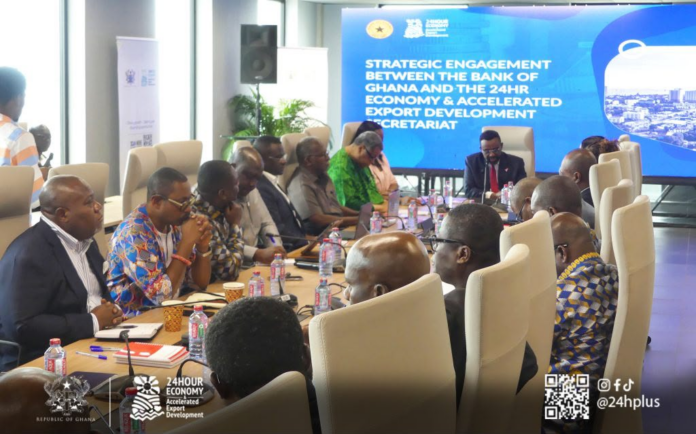
That is where the Bank of Ghana can play a catalytic role without becoming a direct lender.
BoG should facilitate, not lend
The Bank of Ghana does not need to become the government’s industrial bank or dictate which companies commercial banks should finance.
Its role should be to facilitate a regulatory and prudential environment that allows productive-sector financing to expand without compromising financial stability.
One option is to establish a dedicated Productive Sector and Value-Chain Finance Facilitation Unit that works with banks, development finance institutions, manufacturers, agribusinesses, exporters, insurers and pension funds.
Its focus could include long-term industrial credit, agricultural and biological-asset finance, equipment leasing, warehouse and receivables finance, purchase-order financing, export credit, guarantees and offtake-backed lending.
This would not require weaker lending standards. It would require better ways of assessing productive businesses.
Credit assessment should not depend overwhelmingly on land and buildings when viable businesses also possess machinery, receivables, purchase orders, supply contracts, export contracts and credible offtake agreements that can support repayment.
Ghana needs to move gradually from collateral banking to value-chain banking.
A specialised industrial bank
Where commercial banks cannot sufficiently adapt their funding structures, risk models and lending tenors, Ghana should also consider facilitating a specialised Value Chain Industries Bank.
Such an institution need not be wholly state-owned. Private investors, financial institutions, pension funds, industry associations, development partners and government could participate, with a mandate focused on financing productive value chains from agriculture and raw materials through processing, manufacturing and exports.
Commercial banks could participate through co-lending, guarantees and syndication, while the Bank of Ghana maintains regulatory oversight.
The two approaches are not mutually exclusive.
A BoG facilitation structure could address regulatory and financing constraints across the banking system, while a specialised institution could provide the patient, appropriately structured capital that conventional commercial banking may struggle to supply.
Credit must finance production
Consumer credit itself is not the problem.
The problem arises when credit expands domestic demand without a corresponding increase in domestic production.
If banks increasingly finance imported vehicles, appliances, electronics, furniture and other goods while local producers struggle for working capital, domestic finance risks supporting production abroad while increasing foreign-exchange demand at home.
That is precisely the imbalance Ghana’s economic reset should avoid.
Ghana has worked hard to bring down inflation, interest rates and Treasury yields. Those gains must now create the conditions for investment, production, employment and exports.
The challenge is to ensure that the rapid expansion in private-sector credit translates into productive investment rather than simply higher consumption and short-term commercial activity.
If more of this expanding credit reaches farms, factories, machinery, processing and exports, the banking system can become a powerful engine of the 24-Hour Economy.
But if productive businesses remain starved of suitable capital while finance gravitates towards consumption and short-term commerce, Ghana risks restoring macroeconomic stability without transforming the structure of its economy.
Government can create the policy environment. Industry can provide the productive capacity. Finance must provide the bridge between the two.
You cannot build a 24-Hour Economy with an eight-hour financing mindset.
Without a deliberate shift towards financing production, the existing banking model could draw a dagger through the 24-Hour Economy before the gains of Ghana’s economic reset reach the factory floor.