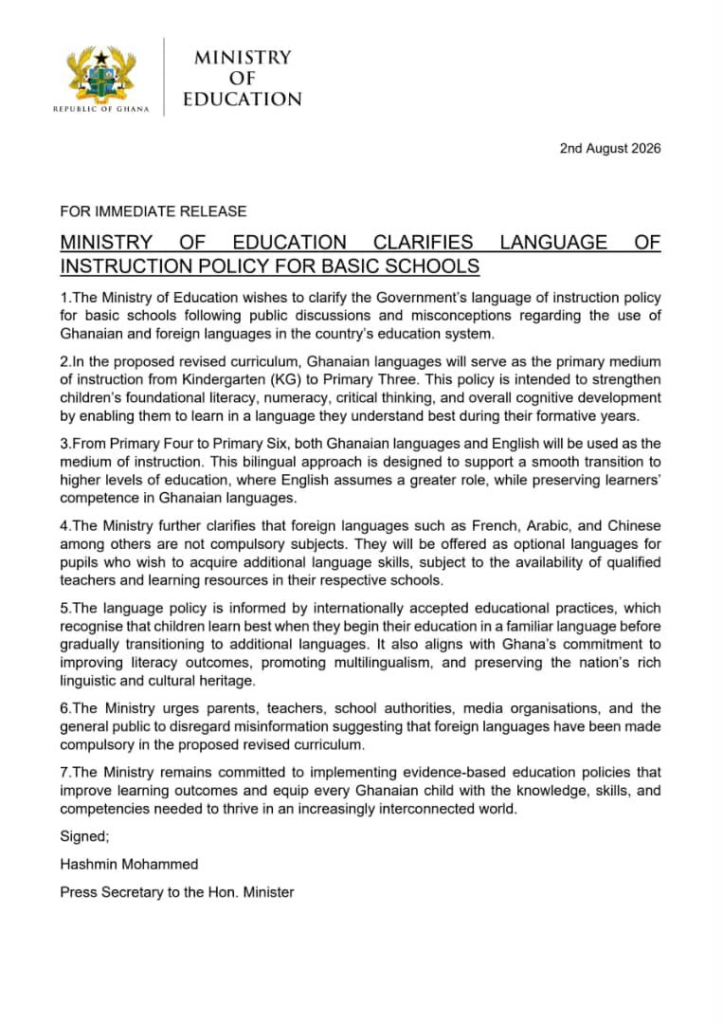

The Ministry of Education has clarified the government’s proposed language of instruction policy for basic schools, dismissing claims that foreign languages have been made compulsory under the revised curriculum.
In a statement signed by the Press Secretary to the Minister for Education, Hashmin Mohammed, issued on Sunday, the ministry said Ghanaian languages will serve as the primary medium of instruction from Kindergarten (KG) to Primary Three to strengthen children’s foundational literacy, numeracy, critical thinking and overall cognitive development.
According to the ministry, the approach is based on research showing that children learn more effectively when taught in a language they understand during their early years.
Under the proposed curriculum, pupils from Primary Four to Primary Six will be taught using both Ghanaian languages and English. The ministry said the bilingual approach is intended to ensure a smooth transition to higher levels of education, where English becomes the dominant language of instruction, while maintaining learners’ proficiency in indigenous languages.
The ministry also clarified that foreign languages, including French, Arabic and Chinese, will not be compulsory subjects. Instead, they will be offered as optional courses for pupils who wish to acquire additional language skills, depending on the availability of qualified teachers and learning resources in their respective schools.
It explained that the revised language policy aligns with internationally accepted educational practices, which recommend that children begin learning in a familiar language before gradually transitioning to additional languages.
The ministry said the policy is also aimed at improving literacy outcomes, promoting multilingualism and preserving Ghana’s linguistic and cultural heritage.
It urged parents, teachers, school authorities, media organisations and the general public to disregard misinformation suggesting that foreign languages have been made mandatory in the proposed curriculum.
The Ministry of Education reaffirmed its commitment to implementing evidence-based education policies that enhance learning outcomes and equip Ghanaian children with the knowledge, skills and competencies needed to succeed in an increasingly interconnected world.