
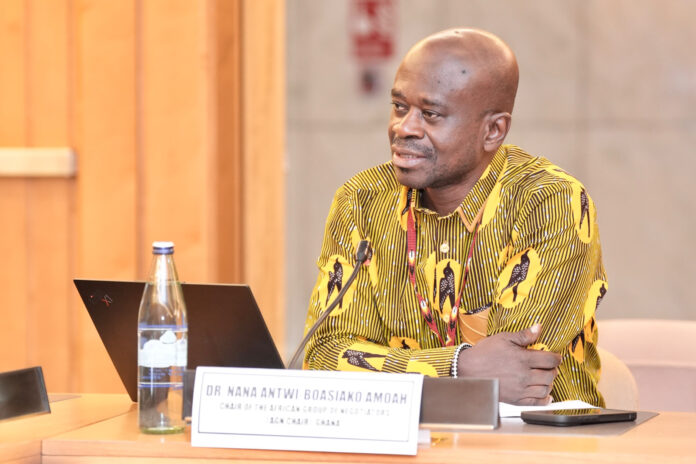

Chair of the African Group of Negotiators on Climate Change (AGN), Nana Dr. Antwi-Boasiako Amoah, has called for urgent and practical action to strengthen climate adaptation efforts across Africa, warning that millions of vulnerable people on the continent are already bearing the devastating impacts of climate change.
He said Africa can no longer afford fragmented and underfunded adaptation responses while communities continue to suffer worsening climate shocks.
Dr. Amoah made the remarks while delivering the opening statement remotely at the Pan African Coalition for Adaptation and Resilience (PACAR 2026) Workshop in Athi River, Kenya.
“For Africa, this sequence must be treated not simply as a calendar of meetings, but as a pathway to move adaptation from recognition to implementation; from general commitments to measurable progress; and from fragmented pilot projects to scaled, financed and country-owned resilience programmes,” he stated.
The three-day workshop, organised by Power Shift Africa, brought together civil society actors, researchers, youth groups, women’s movements and climate experts to discuss Africa’s adaptation priorities ahead of major global climate negotiations.
Dr. Amoah commended Power Shift Africa for consistently championing adaptation issues across the continent and acknowledged the organisation’s efforts in connecting grassroots realities to international climate negotiations.
Climate change already hurting ordinary Africans
In a deeply human-centred address, the AGN Chair highlighted the growing toll of climate change on ordinary Africans, especially farmers, fisherfolk, women, children and vulnerable communities already struggling with poverty and weak infrastructure.
“Climate impacts are already affecting African farmers, pastoralists, fisherfolk, urban households, women, children, persons with disabilities and communities in fragile settings,” he said.
Beyond environmental destruction, he noted that climate shocks are worsening food insecurity, damaging public infrastructure, straining health systems and increasing economic pressure on governments already battling debt and development challenges.
For many communities across Africa, the crisis is no longer theoretical. In northern Kenya, prolonged droughts continue to wipe out livestock and livelihoods. In West Africa, floods are destroying homes and farms, while urban settlements across the continent face mounting sanitation and disease risks linked to extreme weather.
“Drought is not only a water problem,” Dr. Amoah explained. “It is also a food price, nutrition, health and income problem. Flooding is not only an infrastructure problem; it is also a housing, sanitation, disease and local government finance problem.”
Call for integrated adaptation and accessible finance
Dr. Amoah argued that Africa must adopt integrated adaptation systems that simultaneously protect food production, water resources, public health, infrastructure and vulnerable ecosystems.
According to him, adaptation should no longer be treated as disconnected interventions but as a comprehensive development and resilience strategy.
“We need approaches that strengthen local institutions, build early warning systems, climate-proof infrastructure, expand social protection and support communities before disasters become humanitarian crises,” he said.
He also raised concerns about the accessibility and quality of climate finance available to African countries.
“Too much of what is counted as climate finance does not reach those carrying the greatest adaptation burden,” he stated. “Too much comes as loans, and too much is trapped in complex procedures that local institutions and community-based actors cannot access.”
Dr. Amoah insisted that adaptation finance for Africa must be predictable, grant-based or highly concessional, and directly accessible to local communities at the frontline of climate impacts.
“If adaptation is local in its impact, then finance must become more local in its delivery,” he added.
Africa’s voice ahead of COP31 and COP32
Looking ahead to upcoming global climate negotiations, including SB64, COP31 and COP32 expected to be hosted in Ethiopia, the AGN Chair urged African stakeholders to sharpen the continent’s adaptation narrative and push for stronger implementation commitments.
He encouraged participants to focus on practical outcomes that connect international negotiations to real action on the ground.
“Global decisions must translate into resources, institutions, programmes and accountability for communities,” he stressed.
Dr. Amoah said COP32 must become more than just another climate conference hosted on African soil.
“It must be a moment when the world confronts adaptation with the seriousness it deserves, and when African priorities shape the centre of the global climate agenda,” he stated.
He concluded by reaffirming the readiness of the African Group of Negotiators to work closely with civil society organisations and frontline communities to ensure Africa’s adaptation priorities are not only heard globally but acted upon decisively.
READ ALSO:
Volta Regional Minister commends ICAG for promoting ethical leadership
Free Zones CEO Mary Awusi petitioned over alleged misconduct
