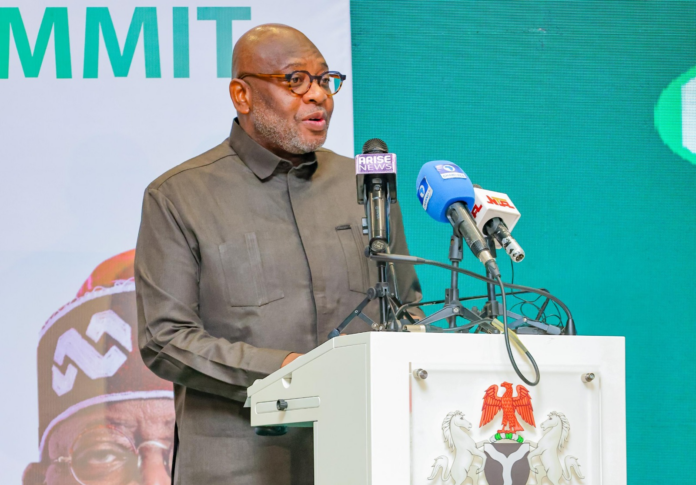

The Chief Executive Officer of the Ghana Cocoa Board (COCOBOD), Dr Ransford Abbey, has called on Africa’s leading cocoa-producing nations to unite to add value to cocoa locally and take collective control of global cocoa prices, insisting the continent can no longer afford to export raw materials while earning only a fraction of the industry’s wealth.
Speaking at the 2026 Cocoa Value Addition Summit in Abuja, Nigeria, under the theme “Moving Beyond the Bean: Unifying Africa for Value Addition and Price Sovereignty,” Dr Abbey said Africa produces between 75 and 77 per cent of the world’s cocoa beans but receives less than 10 per cent of the value generated by the global chocolate industry.
According to him, Ghana, Côte d’Ivoire, Nigeria and Cameroon account for about 75 per cent of global cocoa production, yet continue to earn only a small share of the industry’s value because most processing takes place outside the continent.
“This century-old economic contradiction must end. Africa must shift from exporting raw poverty to creating refined wealth right here on the continent,” he said.
Dr Abbey described the situation as a lingering colonial legacy that has kept African countries dependent on exporting raw cocoa beans while importing expensive finished chocolate products.
He said increasing local processing would create jobs, boost foreign exchange earnings, promote technology transfer and strengthen economic linkages across the continent.
The COCOBOD CEO disclosed that Ghana has adopted a policy to process at least 50 per cent of its cocoa beans locally, beginning with the 2026/27 crop season.
To support the policy, he said COCOBOD is introducing a new domestically financed funding model that will move away from restrictive offshore syndicated loans, giving the Board greater flexibility to supply cocoa beans directly to local processors.
He explained that the policy would improve access to cocoa beans, increase liquidity within the industry and enable processing factories operating below capacity to expand production.
Dr Abbey also announced plans to strengthen public-private partnerships to increase the production of cocoa liquor, cocoa butter and cocoa cake while leveraging international partnerships to access both traditional and emerging markets.
He further urged African countries to take advantage of the African Continental Free Trade Area (AfCFTA) by promoting tariff-free trade in processed cocoa products across the continent and encouraging greater local consumption.
On cocoa pricing, Dr Abbey said Africa must pursue what he described as “price sovereignty” by speaking with one voice rather than allowing international buyers to play producing countries against one another.
He cited the progress made under the Côte d’Ivoire-Ghana Cocoa Initiative, noting that the partnership successfully introduced the Living Income Differential (LID), which guarantees an additional US$400 per metric tonne to support cocoa farmers’ incomes.
Dr Abbey also referenced the June 16, 2026, Presidential Cocoa Summit in Abidjan, where President John Dramani Mahama and Côte d’Ivoire President Alassane Ouattara signed a declaration to harmonise farm-gate pricing, expand cocoa processing, strengthen scientific cooperation against cocoa diseases and broaden the cocoa initiative to include Nigeria and Cameroon.
He appealed to Nigeria and Cameroon to formally join the initiative, arguing that together the four countries would control about 75 per cent of global cocoa production, giving Africa greater bargaining power in the international cocoa market.
“The time to unite and command greater value is now. Together we can coordinate global supply, negotiate with multinational buyers with one voice and ensure our farmers receive fair compensation for their hard work,” he said.
Dr Abbey also criticised what he described as unfair sustainability demands imposed by some Western markets, saying African countries remain committed to environmental protection but deserve fair prices in return for complying with increasingly stringent standards.
“As Ghana prepares to host the 2027 World Cocoa Foundation Partnership Meeting in Accra, we will carry this message of origin-led resilience to the global stage. Our strength internationally, however, depends on our unity here in Africa,” he said.
He concluded by urging African leaders to build a united cocoa bloc capable of processing more cocoa locally, protecting farmers’ livelihoods and ensuring the continent derives greater economic benefits from one of its most valuable agricultural commodities.
“We do not need charity; our farmers deserve equity. Let us process our own wealth, protect our own farmers and take rightful control of the value of our blood and sweat,” he added.
READ:
Samreboi trial: Wontumi jailed for 20 years
Hundreds storm Manhyia Palace to celebrate fifth Akwasidae with Asantehene and…