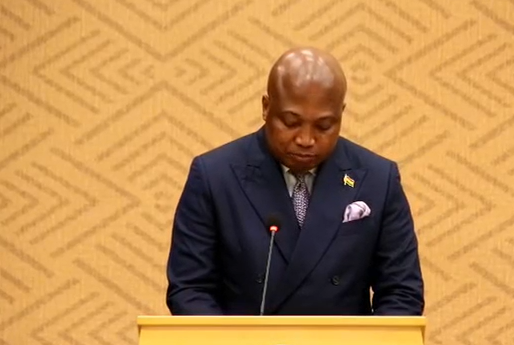

Foreign Affairs Minister Samuel Okudzeto Ablakwa has urged Ghana and other African countries to avoid being drawn into geopolitical rivalries and instead pursue partnerships that advance their own interests.
Speaking at a diplomatic side event in New York, Mr Ablakwa said Africa’s growing importance in the global supply of critical minerals placed the continent in a stronger position to negotiate beneficial agreements with major powers.
“We don’t have to choose,” he said. “We will not be boxed into a corner. We will play smart.”
The minister drew on Ghana’s history as a founding member of the Non-Aligned Movement, citing former President Kwame Nkrumah’s position that Ghana should look “neither east nor west” but “forward”.
According to him, the continent must also have a central role in conversations about emerging technologies, particularly artificial intelligence, renewable energy and advanced manufacturing, all of which depend heavily on critical minerals.
“For us in Africa, because of all of this new AI dispensation and the critical minerals required to drive that, you can’t have this discussion without Africa,” he said.
Mr Ablakwa said Ghana would assess potential agreements based on the country’s interests and values, the level of trust between partners and the terms being offered.
“We will look at who offers the best deal for the people we serve,” he stated.
He further encouraged African countries to take advantage of competition among prospective partners to secure agreements that offer better terms.
“We come to the table as equal partners,” he said. “If you don’t like our terms, there’s competition. There is another partner who will at least be more respectful and will be willing to negotiate and bargain properly with us.”
The Foreign Affairs Minister also renewed Ghana’s call for reforms to the United Nations Security Council, particularly the inclusion of Africa as a permanent member.
He argued that the current structure of the Council no longer reflects global realities, noting that most African countries were still under colonial rule when the United Nations was established in 1945.
“When the UN was created in 1945, a lot of us were colonies. We were not countries, independent states. We were not there. And you have kept this same structure for more than 80 years,” he said.
Mr Ablakwa said the failure to reform the Security Council was also affecting confidence in other UN processes, including the selection of the next Secretary-General.
He cited the African Union’s admission to the G20 during India’s presidency as an example of how existing global institutions could be restructured to reflect changing realities.
“India did it. So the UN can do it,” he said.
Mr Ablakwa also advocated the abolition of the Security Council’s veto power, arguing that it had hindered the UN’s ability to respond effectively to conflicts.
“Because of the veto, it has crippled this organisation,” he said. “Democratising the UN and abolishing the veto. It’s as simple as that.”
READ ALSO:
Teachers strike: ‘Bring all the input forms and we’re ready to pay’ – CAGD tells GES