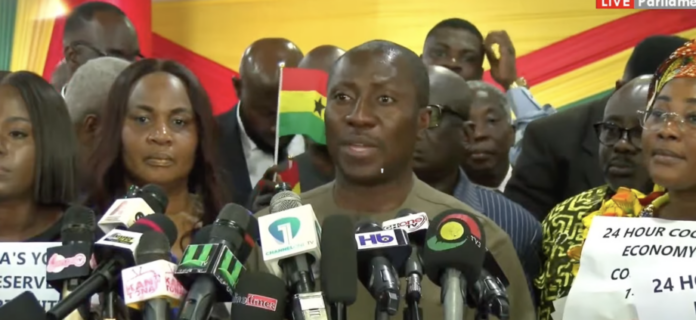

The Minority in Parliament has vowed to pursue its demand for a parliamentary inquiry into major narcotics seizures linked to Ghana, rejecting Speaker Alban Bagbin’s decision to declare its motion inadmissible.
Minority Leader Alexander Afenyo-Markin said the Speaker erred by relying on ongoing criminal proceedings to determine whether Parliament could investigate the circumstances surrounding the seizures.
Speaking at a press conference in Accra on Tuesday, September 29, Mr Afenyo-Markin said the ruling had denied the Minority an opportunity to make its case before the House.
“Mr Speaker therefore got it wrong by using existing pending criminal proceedings to determine the scope and manner of the inquiry,” he said.
The motion, filed by First Deputy Minority Whip and Tolon MP Habib Iddrisu, sought the establishment of an Ad Hoc Committee to investigate how major narcotics consignments linked to Ghana were processed, inspected, cleared and exported.
Speaker Bagbin rejected the motion during Parliament’s emergency sitting, arguing that the proposed inquiry overlapped with matters before the courts and could prejudice the interests of parties involved in the ongoing proceedings.
Mr Afenyo-Markin, however, insisted that the Minority would not abandon its call for accountability.
“We will not let this matter rest. Unfortunately, the Speaker denied the Minority the opportunity to be heard,” he said.
He also criticised the Majority for supporting the ruling, accusing it of resisting parliamentary scrutiny of the narcotics seizures.
“The 24-hour economy has turned into 24-hour cocaine, and the Majority is not at all interested in scrutiny; we will not rest,” he said, using the phrase in reference to the government’s 24-hour economy policy.
The Minority Leader said his caucus would explore the options available under the Constitution and Parliament’s Standing Orders to keep the matter on the national agenda.
“We will do what we have to do, and at the right time, we will brief the people of Ghana. We act in the national interest. We act for the good of our democracy and not partisan interest,” he stated.
The proposed inquiry was intended to examine several narcotics seizures, including the interception of nearly 3.9 metric tonnes of cocaine by French Customs at Dunkirk on September 10, 2026.
It also cited the seizure of 320 kilogrammes of methamphetamine by Australian authorities in June 2026, as well as cocaine interceptions at Takoradi and Pedu in Cape Coast in March 2025.
The committee would have investigated the procedures used to process and clear the consignments, the ports from which they departed and the intelligence profiling, scanning and physical inspections conducted before export.
It was also expected to examine the roles of companies and state agencies involved, the effectiveness of Ghana’s port security systems and the status of investigations, arrests and prosecutions connected to the seizures.
Mr Afenyo-Markin maintained that the motion was designed to examine institutional processes rather than determine the guilt or innocence of individuals facing criminal proceedings.
“The motion we filed before the House does not seek to try any accused person. It does not ask Parliament to determine criminal liability, pronounce upon the guilt or innocence of any person, assess the credibility of prosecution witnesses, or decide upon evidence that is properly before a court,” he said.
He argued that Parliament could investigate possible weaknesses in the country’s security and enforcement systems without taking over the role of the courts.
The Minority Leader described the Speaker’s decision as a setback for parliamentary oversight and accountability.
“Today is a sad day for our democracy and parliamentary oversight. The majority has once again used its supermajority, with the support of the Speaker, to weaken Parliament,” he said.
He further alleged that the ruling reflected the government’s unwillingness to face scrutiny over the issue. Those assertions represent the Minority Leader’s position and were not findings established by Parliament.
Mr Afenyo-Markin warned that restrictions on parliamentary scrutiny could weaken institutional checks on executive power.
“When Parliament is weakened, accountability is weakened, and the institutions of state are left with fewer checks on the exercise of power,” he said.
“A supermajority must never become an excuse to weaken the minority, silence scrutiny, or diminish Parliament’s duty to oversight.”
The Majority supported the Speaker’s ruling, after which Parliament was adjourned until further notice.
Mr Afenyo-Markin said the Minority would announce its next steps at the appropriate time, maintaining that the scale of the narcotics seizures required scrutiny of Ghana’s port controls, customs procedures, intelligence gathering and drug enforcement systems.
READ ALSO:
Bagbin rejects Minority motion for probe into narcotics consignments linked to Ghana
‘Give caucus leaders adequate time to speak before ruling’ – Afenyo-Markin to Bagbin