Ghanaian dancehall artiste and creative industry stakeholder Charles Nii Armah Mensah Jr., popularly known as Shatta Wale, has called for a balanced legal and regulatory framework to address defamation, harassment and abuse on social media without undermining freedom of expression.
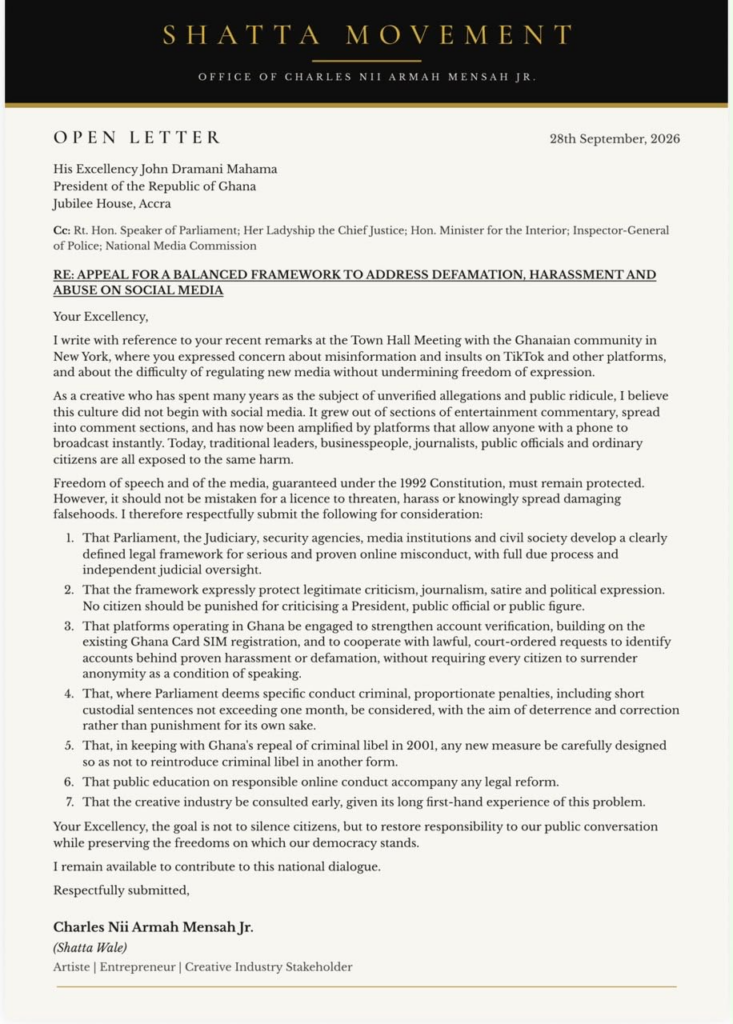
In an open letter to President John Dramani Mahama dated September 28, 2026, Shatta Wale said the growing misuse of social media platforms required a national response that protects citizens while ensuring accountability for harmful online conduct.
Shatta Wale said his own experience of being subjected to what he described as unverified allegations and public ridicule had given him a personal understanding of the problem.
He argued that freedom of speech and media freedom guaranteed under the 1992 Constitution should remain protected but should not be interpreted as a licence to threaten, harass or knowingly spread damaging falsehoods.
Among his proposals is for Parliament, the Judiciary, security agencies, media organisations and civil society groups to develop a clearly defined legal framework for serious and proven online misconduct, with due process and independent judicial oversight.
He also called for any framework to expressly protect legitimate criticism, journalism, satire and political expression, stressing that citizens should not be punished simply for criticising the President, public officials or other public figures.
Shatta Wale further proposed that social media platforms operating in Ghana be engaged to strengthen account verification, while cooperating with lawful, court-ordered requests to identify accounts involved in proven cases of harassment or defamation.
He said such measures should not require every citizen to surrender anonymity as a condition for participating in public discourse.
On possible sanctions, the artiste suggested that Parliament could consider proportionate penalties for specific conduct it deems criminal, including short custodial sentences of not more than one month, with the emphasis on deterrence and correction.
He also cautioned against any new legislation effectively reintroducing criminal libel, noting Ghana’s repeal of criminal libel in 2001.
Shatta Wale called for public education on responsible online behaviour to accompany any legal reforms and urged authorities to involve the creative industry in the consultation process.
He said the objective should not be to silence citizens but to promote responsibility in public discourse while preserving democratic freedoms.
“The goal is not to silence citizens, but to restore responsibility to our public conversation while preserving the freedoms on which our democracy stands,” he said.
Read the open letter below:
READ ALSO:
Shatta Wale promises 2 years of free performances for UPSA SRC week
‘Don’t copy my lifestyle, copy my thinking’ – Shatta Wale lectures UPSA students