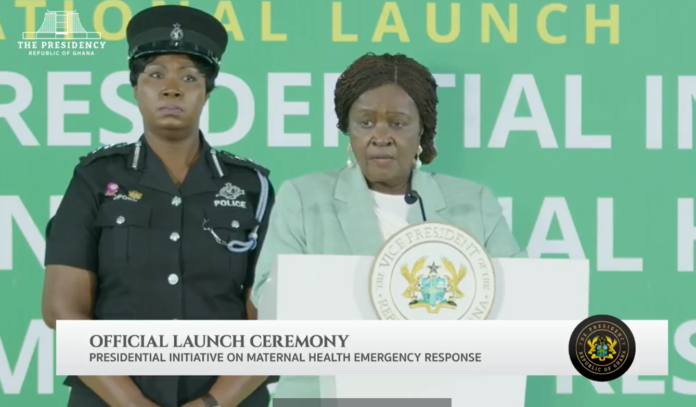

The government has launched a five-year multisectoral programme aimed at addressing persistent challenges affecting maternal and newborn healthcare across Ghana.
Known as the Presidential Initiative on Maternal Health Emergency Response (PRIMER), the programme will focus on critical gaps in emergency referrals, transportation, staffing, blood supplies, medicines, essential medical equipment and health data.
Vice President Professor Jane Naana Opoku-Agyemang said PRIMER was designed to address challenges that individual health facilities could not tackle independently.
Speaking at the national launch of the initiative on Monday, September 14, 2026, she said the programme would bring together government agencies, local authorities, traditional and religious leaders, civil society organisations, the private sector and communities to improve maternal and newborn health outcomes.
“PRIMER is to help address obstacles that no single health institution can remove, whether in financing, infrastructure, staffing, procurement, data or community mobilisation,” she said.
The Vice President explained that the initiative would strengthen coordination across the health sector while complementing programmes already being implemented by the government and its development partners.
PRIMER will operate around three key areas: political leadership and social mobilisation; institutional accountability and evidence-based interventions; and sustainable domestic financing supported by responsible external assistance.
The programme will also prioritise maternity and newborn care, referral and transport systems, access to blood and essential medicines, medical equipment, community participation and the effective use of health data.
Prof. Opoku-Agyemang said the initiative would strengthen maternal and perinatal death surveillance and response systems, improve the quality and timeliness of health data, and clearly define institutional responsibilities.
She added that regular high-level reviews would be conducted to assess progress, while successful interventions from regions and health facilities performing well would be replicated in other parts of the country.
“PRIMER cannot succeed as a stand-alone programme nor duplicate the work already underway across government,” she cautioned.
The Vice President stressed that improving maternal survival required collaboration beyond the health sector because issues such as transportation, communication, water and energy also influence access to timely healthcare.
She therefore called on families and communities to support pregnant women to seek medical attention early, identify danger signs and obtain the necessary assistance during pregnancy and childbirth.
Prof. Opoku-Agyemang said the success of PRIMER would ultimately be determined by the survival of mothers and their babies rather than simply the number of women who visit health facilities.
“It is not enough for many more women to enter our health facilities. They must return home safely with their babies to their families,” she said.
The government expects PRIMER to provide a coordinated national response to longstanding maternal and newborn health challenges as Ghana intensifies efforts to reduce preventable maternal deaths and achieve the Sustainable Development Goal target of fewer than 70 maternal deaths per 100,000 live births by 2030.
READ ALSO:
UNFPA calls for incentives to retain health workers in underserved communities
Free Primary Healthcare programme gets over 24,000 pieces of medical equipment