
President John Dramani Mahama went to Jamaica talking about history, family and the old ties binding Africa to the Caribbean.
But somewhere between Kingston’s harbour and Tema’s coastline, history acquired an economic proposition.
After visiting the Port of Kingston during his August 2026 visit, Mahama reflected on Tema’s emergence as an important maritime hub for Ghana, West Africa and the Gulf of Guinea, where larger vessels discharge cargo for onward redistribution through feeder services.
Then came perhaps the most consequential question of the maritime part of his visit: “We have two hubs.
What is left is to connect the two hubs together?” It was more than diplomatic poetry. Mahama publicly indicated that the Foreign Ministers and heads of the maritime authorities of Ghana and Jamaica should serve as contact points for examining how that connection could be advanced.
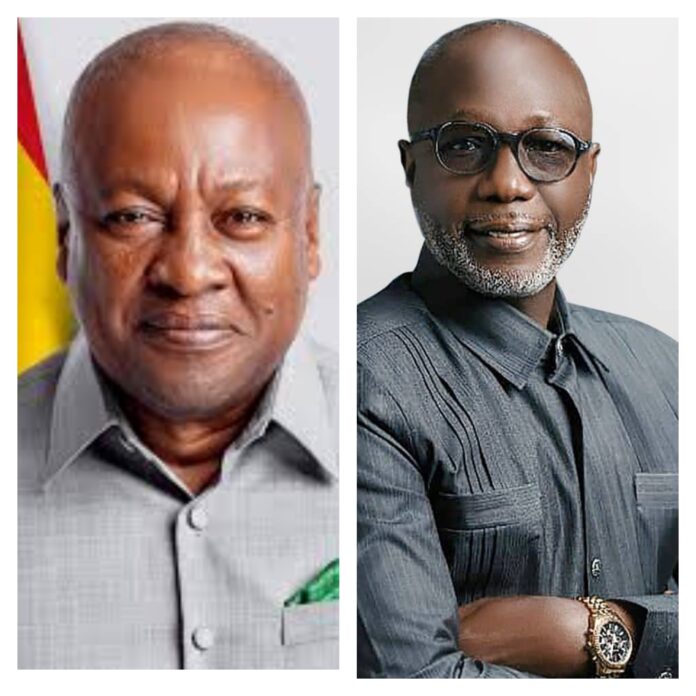
On Ghana’s side, that brings together Foreign Affairs Minister and Member of Parliament for North Tongu, Hon. Samuel Okudzeto Ablakwa, and Dr. Kamal Deen Ali, Director General of the Ghana Maritime Authority.
The pairing makes institutional sense. Hon. Ablakwa carries Ghana’s diplomatic machinery. Dr. Ali carries the maritime regulatory and technical mandate.
One must work the diplomatic corridor while the other interrogates the maritime corridor. Neither succeeds without the other.
The proposition also has more economic substance than first appears. Ghana and Jamaica are not starting from zero.
In 2023, Jamaica exported approximately 78.59 million kilograms of aluminium oxide to Ghana worth US$26.35 million, making Jamaica Ghana’s largest supplier of that commodity that year.
Then, on August 10, 2026, Jamaica announced discussions with Ghana around reviving their longstanding bauxite relationship, identifying an initial business opportunity estimated at approximately US$60 million.
The existing mineral trade should not, however, be confused with proof of an established Kingston Tema container service. Jamaica’s mineral exports involve specialised facilities and bulk shipping.
What the figures prove is simpler and more important: significant cargo already crosses the Atlantic between the two countries.
The challenge is diversification.
That is where Dr. Ali’s assignment becomes particularly consequential.
The Ghana Maritime Authority must establish what already sails, through which ports, at what cost and with what frequency. It must then determine what else can realistically sail.
Ghana recorded approximately US$5 billion in non traditional exports in 2025, providing a potential pool of cocoa derivatives, processed foods, pharmaceuticals, tuna, textiles, shea products, aluminium manufactures and other goods.
But export capacity is not the same as Caribbean demand. Product by product analysis must establish what Jamaica and neighbouring markets will actually buy after freight, insurance, duties and other costs are added.
Hon. Ablakwa’s task begins where that technical work encounters another government.
Foreign Affairs must explore customs cooperation, standards, regulatory coordination, trade facilitation and whatever lawful bilateral arrangements can reduce commercial friction.
Hon. Ablakwa already has an active channel: on May 25, 2026, he received Jamaica’s Minister of
Foreign Affairs and Foreign Trade, Senator the Honourable Kamina Johnson Smith, in Accra.
President Mahama’s instruction now gives that diplomatic relationship a specific economic assignment.
The larger proposition is not simply Ghana trading with Jamaica. Tema’s attraction is bigger than Ghana, just as Kingston’s attraction is bigger than Jamaica.
Tema can potentially aggregate West African cargo while Kingston offers connectivity into Caribbean and wider Americas networks.
Ghana’s hosting of the AfCFTA Secretariat strengthens the strategic proposition, but it must not be exaggerated. Jamaican goods do not acquire AfCFTA
preferences merely by entering through Tema, just as Ghanaian goods do not automatically acquire CARICOM preferences by landing in Kingston.
Geography creates opportunity. It does not erase tariffs or rules of origin. Nor should anybody rush to announce a direct ship. A dedicated liner service requires sufficient and predictable cargo, preferably in both directions.
That case has not yet been established.
The commercially intelligent solution could initially be improved transshipment, a slot arrangement, feeder connectivity or another structure built around existing carrier networks.
Dr. Ali and Hon. Ablakwa should therefore bring shipping lines into the conversation early and ask the question governments cannot answer for them: what volumes, frequency, transit times and prices would make the connection commercially viable?
The same discipline must apply to claims about jobs and savings. Additional maritime activity could create opportunities for Ghanaian seafarers, logistics operators and businesses, but those benefits should follow the evidence rather than precede it.
Neither can anyone credibly declare today that a Kingston Tema connection will necessarily be cheaper or faster.
That requires live freight quotations, port charges, insurance costs, transit times and landed cost comparisons. Anything less is promotion masquerading as feasibility.
Mahama has therefore opened a door worth walking through, but the measure of success cannot be another memorandum, delegation or photograph beside containers.
Hon. Ablakwa must help construct the diplomatic architecture. Dr. Ali must establish the maritime
economics. Ports, Customs, trade agencies, exporters, freight forwarders, carriers and thei Jamaican counterparts must supply the commercial reality.
Nearly 79 million kilograms of one important commodity have already demonstrated that goods can cross this Atlantic relationship at scale. The question is no longer whether Ghana and Jamaica can trade across the ocean.
It is whether they can transform a concentrated commodity relationship into a diversified commercial corridor.
Mahama has supplied the political handshake. Kingston and Tema supply the ports. Hon. Ablakwa and Dr. Ali have been handed the harder assignment: connect the cargo.
If they succeed, President Mahama’s Jamaica visit may be remembered for something larger than reconnecting two peoples with a common past. It may have helped give that history a maritime and commercial future.