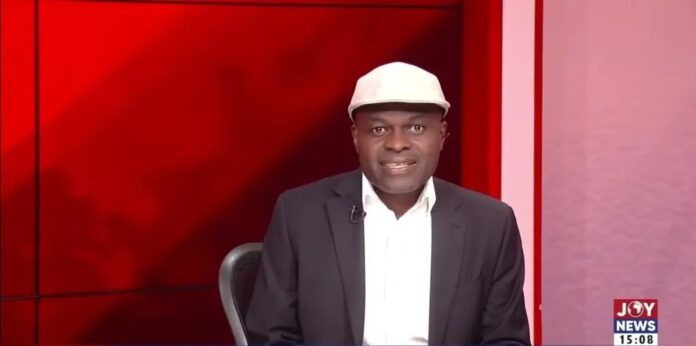

Private legal practitioner Martin Kpebu has urged the Ghana Bar Association (GBA) and the Association of Judges and Magistrates to engage in negotiations to resolve the growing disagreement over the observance of the legal vacation.
His call follows an appeal by the GBA to Chief Justice Paul Baffoe-Bonnie to ensure that judges respect the established rules and traditions governing the legal vacation.
However, Deputy Attorney General Dr Justice Srem-Sai has argued that a lawyer’s foremost responsibility is to the client, stressing that the interests of litigants must come before a lawyer’s desire to take a break.
The disagreement has deepened after the Chief Justice rejected a request by lawyers representing former National Signals Bureau (NSB) Director-General Kwabena Adu-Boahen and former National Food and Buffer Stock Company Limited (NAFCO) Chief Executive Officer Hanan Abdul-Wahab to have their cases postponed until after the legal vacation.
The legal teams, which include former Attorney General Godfred Dame and former Defence Minister Samuel Atta Akyea, had cited prior commitments during the vacation and requested that the cases be adjourned until October.
Speaking on Accra-based Citi FM, Mr Kpebu said the issue should not be allowed to escalate into a public confrontation, particularly because the legal vacation is not expressly guaranteed as a right under the law.
“I’m in the middle ground. Middle ground being that we should negotiate. We should try to find an amicable settlement,” he said.
Mr Kpebu explained that under the current arrangement, individual lawyers would have to approach the judges handling their cases to seek an accommodation.
He said this could create challenges because lawyers and judges have different personalities and approaches to such negotiations.
“The Chief Justice’s explanation means that each lawyer should go and fight his own fight, but I know we have different fighting skills and different strengths,” Mr Kpebu said.
He therefore proposed that the GBA engage directly with the Association of Judges and Magistrates to agree on a uniform arrangement for lawyers whose cases fall before judges sitting during the vacation.
One possible arrangement, he suggested, could allow lawyers to work during part of the two-and-a-half-month vacation and take the remaining period off.
Alternatively, lawyers could reach agreements with individual judges to complete hearings within a shorter, concentrated period.
According to him, such an arrangement would ease the pressure on individual lawyers who would otherwise have to negotiate separately with different judges.
On whether the case involving Kwabena Adu-Boahen could proceed in the absence of his defence lawyers, Mr Kpebu acknowledged that, under the current interpretation of the law, a judge sitting during the legal vacation could proceed with the case.
“If you don’t, you, the accused person, do the cross-examination; if you don’t do it well, it means that you don’t intend to do it. I would discharge the witness, then the prosecution bring next witness,” he said.
Mr Kpebu maintained that the disagreement would be better addressed through institutional dialogue rather than prolonged public exchanges.
“Nobody is ever saying that a lawyer cannot get an adjournment. No, no, that’s not the main thing. But it’s about how we go about it,” he said.
Also read: