
What began as an ordinary morning on August 6, 2025, quickly turned into one of Ghana’s darkest days, plunging the nation into mourning.
A Z-9 military helicopter carrying gallant and selfless servants of Ghana crashed near Adansi Akrofuom in the Ashanti Region, claiming the lives of two Cabinet ministers and six others.
The victims included former Defence Minister, Dr. Edward Omane Boamah, Minister for Environment, Science, Technology and Innovation, Dr. Ibrahim Murtala Mohammed; Deputy National Security Coordinator Alhaji Mohammed Muniru Limuna; NDC First Vice Chairman Dr. Samuel Sarpong, Deputy NADMO Director Samuel Aboagye.
The rest were three military crew members: Squadron Leader Peter Bafemi Anala, Flying Officer Manin Twum-Ampadu, and Sergeant Ernest Addo Mensah, whose lives and work left a legacy of patriotism.

The tragedy, one of the deadliest aviation disasters, plunged the nation into mourning and prompted an outpouring of grief from citizens, political leaders, religious bodies and the international community.
Today, August 6, 2026, exactly one year later, the memories remain vivid. While official duties have continued and government business has moved on, the lives lost and the questions raised by the crash continue to resonate.
A mission that never reached its destination
The helicopter, a Ghana Air Force Z-9, departed Accra at 9:12 am and was on its way to Obuasi for the launch of the Responsible Cooperative Mining and Skills Development Programme (rCOMSDEP) aimed at tackling illegal mining and promoting sustainable practices.
However, the journey ended abruptly when the helicopter crashed in the Dampia Range Forest Reserve near Sikaman in the Adansi Akrofuom District of the Ashanti Region.

A nation in mourning
Within hours of the tragedy, tributes poured in from across the political divide.
Flags flew at half-mast as the government declared a period of national mourning. Churches and mosques held special prayers, while Ghanaians used social media to share messages of condolence and memories of the victims.
Political differences gave way to a rare moment of national unity as leaders called for solidarity with the bereaved families.
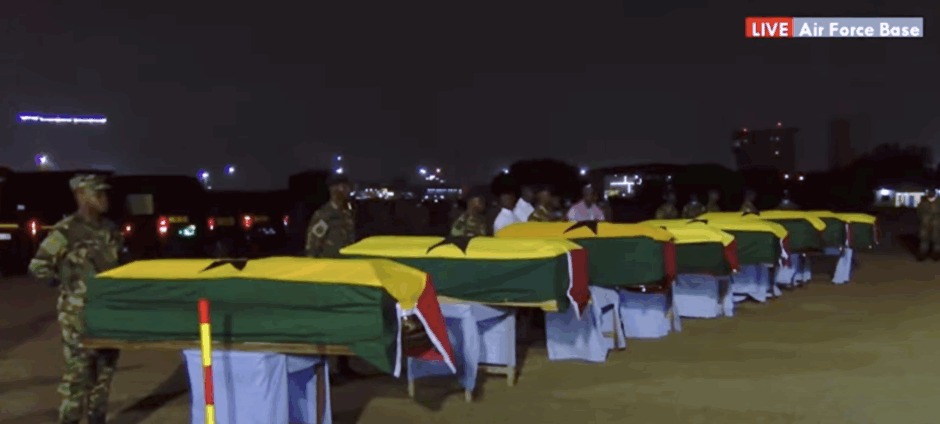
State funerals later brought together thousands of mourners, including traditional rulers, diplomats, security chiefs, and ordinary citizens, all paying their final respects.
The aftermath: A tragedy beyond recognition
The scale of the devastation became even more apparent in the days following the crash. The impact of the accident and the resulting fire left the bodies of all eight victims so badly charred that visual identification was impossible.
Although the 37 Military Hospital in Accra was initially expected to conduct the autopsies and identification, authorities opted to send samples of the victims’ remains to South Africa for DNA analysis to enable quicker and more accurate identification.
The decision sparked public discussion about Ghana’s forensic capabilities.
However, President of the Ghana Academy of Forensic Sciences, Dr Pet-Paul Wepeba, clarified that the move was not because Ghana lacked qualified forensic experts but because the country does not yet have the advanced equipment needed for complex DNA analysis within a short period.
According to Dr Wepeba, South Africa has sophisticated genetic analysers and next-generation DNA sequencing technology that can produce faster and more precise results.
He noted that the urgency was particularly important because the victims’ remains had been severely burnt, and families, including those with Islamic burial requirements, were awaiting identification so burial arrangements could proceed without unnecessary delays.
He added that the country’s forensic infrastructure challenges extend beyond human identification.
Advanced forensic laboratories are also essential in investigations such as market fires, where forensic chemistry helps determine the origin and cause of a blaze by analysing physical evidence recovered from the scene.
For the bereaved families, the wait for DNA confirmation prolonged an already painful period of uncertainty.
For many Ghanaians, the need to send the samples abroad underscored not only the horrific nature of the crash but also the broader need to strengthen the country’s forensic science capacity.
The human cost beyond the headlines
While the nation mourned prominent public officials, the tragedy also left families grappling with profound personal loss.
Spouses lost partners, children lost parents, while colleagues lost mentors and friends.
Behind every official portrait displayed during the funerals was a family forced to rebuild life after an unimaginable tragedy.
One year on, that grief has not disappeared. For many relatives, anniversaries serve as painful reminders of lives interrupted and futures forever altered.
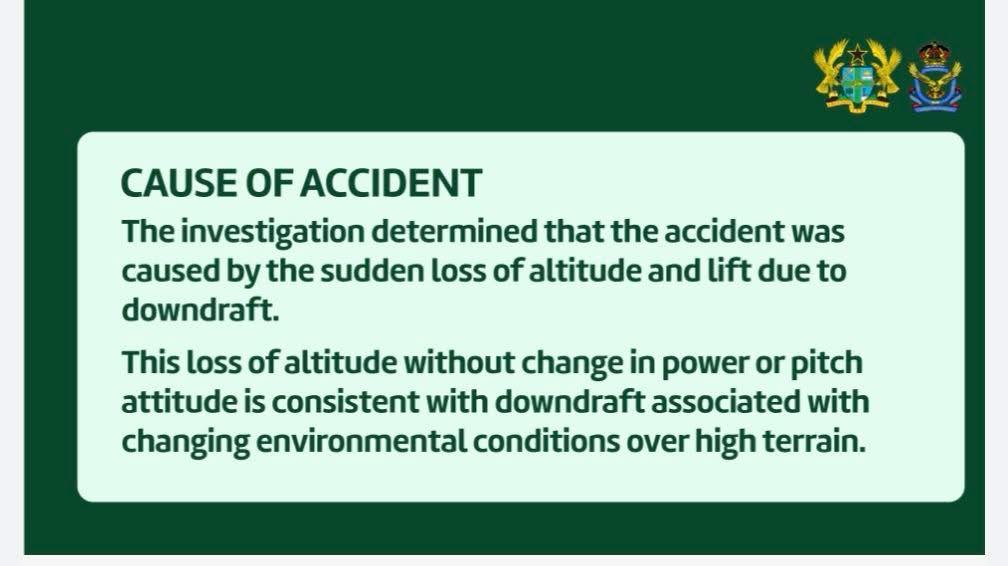
Investigations revealed that the tragic incident was caused by a sudden loss of altitude and lift due to a powerful downdraft.
Aviation expert and leader of the investigative committee, Captain Paul Forjoe, while presenting the report during a public broadcast on Tuesday, November 11, explained that the aircraft encountered a rapid downward current while flying over high terrain, resulting in a sudden drop in altitude that the crew could not recover from.
Captain Forjoe also confirmed that the helicopter was airworthy and met all basic safety requirements before the crash, though it lacked some advanced safety enhancements.
He added that the crew, who had completed three previous flights that same day, were fully qualified, medically fit, and well-rested before the incident.
Lessons for aviation safety
The crash also reignited discussions about the safety of military and government aircraft operations.
Experts and citizens alike questioned aircraft maintenance, operational procedures, and emergency preparedness.
Although investigations sought to establish what caused the accident, the tragedy underscored the importance of continual investment in aviation safety, maintenance systems and risk management.
For many observers, the disaster became a reminder that public servants entrusted with national responsibilities also deserve the highest possible standards of operational safety.
Carrying forward a legacy
The two ministers left behind records of public service that continue to shape conversations in their respective sectors.
Their colleagues have pledged to continue the projects they championed, while many citizens believe the best tribute is to ensure that their work and that of the other victims are not forgotten.
Beyond policies and programmes, the tragedy also highlighted the dedication of the military personnel who routinely undertake official missions with little public attention.
A mission beyond remembrance
The anniversary has also renewed calls for the government to demonstrate meaningful progress in the fight against illegal mining, the very mission the delegation was undertaking before tragedy struck.
In a statement marking the first anniversary of the crash, the opposition New Patriotic Party (NPP) noted that the eight victims had been travelling to Obuasi on a national assignment aimed at tackling illegal mining and protecting Ghana’s forests and water bodies.
The party argued that the most fitting tribute to those who lost their lives would not be limited to memorial services and commemorative events but should be reflected in tangible gains in the country’s anti-galamsey campaign.
It therefore called on the government to provide an update on the state of Ghana’s rivers and forest reserves, outline the progress made in curbing illegal mining over the past year, and account for the impact of measures introduced since the tragedy.
The NPP also urged authorities to release a comprehensive update on the official investigation into the helicopter crash, including its findings, recommendations and the steps taken to improve aviation safety and prevent a similar incident.
The calls have reignited public conversations about whether the sacrifices of the eight have translated into renewed momentum in addressing one of Ghana’s most pressing environmental challenges.
A year later
Time has softened the immediate shock but not erased the memories.
The crash remains etched in Ghana’s national consciousness as a solemn reminder of the fragility of life and the sacrifices often made in public service.
One year after the Adansi Akrofuom helicopter crash, the nation continues to mourn the eight lives lost in the line of duty.
But beyond the grief and tributes lies a broader question: Has Ghana advanced the cause for which they made their final journey?
For many, the true measure of remembrance will be seen not only in memorial ceremonies but also in cleaner rivers, restored forests, safer skies, and a renewed commitment to public service.