
The Environmental Service Providers Association (ESPA) is urging government to abandon what it describes as “knee-jerk” responses to Accra’s perennial flooding and instead invest in long-term waste management infrastructure, warning that the capital currently has no disposal site for its daily waste.
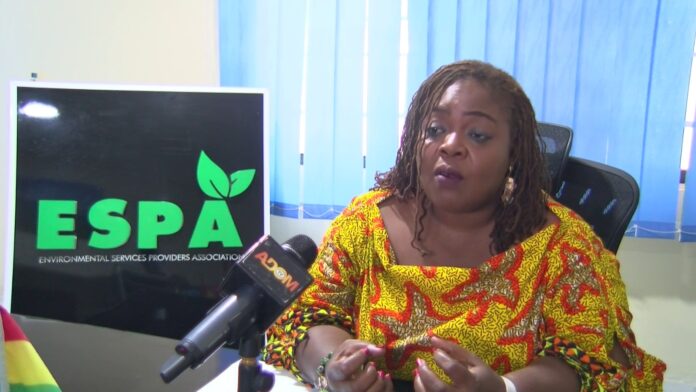
The Executive Secretary of ESPA, Ama Ofori Antwi, in an interview with Adom News said that the recent floods, which submerged parts of Accra, once again exposed deep-rooted challenges in the city’s sanitation and waste management system.
According to her, emergency clean-up exercises after every major flood are not enough to prevent future disasters.
“Waste management is a daily affair. It cannot be treated as an emergency only after floods occur,” she stressed.
Ama Ofori Antwi revealed that Accra generates approximately 4,400 tonnes of waste every day, the equivalent of about 4,400 ‘aboboyaa’ loads, with each resident producing between 0.5 and 1 kilogram of waste daily.
Despite the enormous volume of waste generated, she said the Greater Accra Metropolitan Area has no final waste disposal site, forcing refuse trucks to travel to Nsawam to offload collected waste.
She explained that deteriorating road conditions along the route have significantly reduced operational efficiency, with waste trucks now able to make only one trip a day instead of three, slowing waste evacuation and allowing refuse to accumulate across the city.
According to the ESPA Executive Secretary, the situation has been worsened by the suspension of public cleansing activities and stalled desilting exercises over the past two years.
She believes these lapses contributed to the recent flooding by allowing drains to become choked with waste and silt.
One week after heavy rains inundated several communities, many residents are still dealing with heaps of rubbish left behind by the floodwaters.
In communities such as Railway Quarters, Alajo and parts of Circle, floodwaters washed plastic bottles, food containers, household waste and silt onto roads and into residential areas, leaving behind a foul stench and raising fears of disease outbreaks.
Although clearing of waste from some of the hardest-hit communities using loaders and refuse trucks, Madam Ofori Antwi says lasting solutions require more than post-disaster clean-up campaigns.
She is calling for stronger collaboration between metropolitan, municipal and district assemblies and private waste management companies, arguing that waste management should be driven by an effective public-private partnership rather than relying almost entirely on local assemblies.
“The assemblies cannot do it alone. The private sector has the expertise and capacity to support effective waste management if given the necessary partnership and investment,” she said.
She also called for sustained public cleansing programmes, regular desilting of drains, improved road infrastructure to waste disposal facilities, and the establishment of engineered disposal sites within the Greater Accra Metropolitan Area.
She warned that until these structural deficiencies are addressed, Accra will continue to experience recurring floods, with emergency responses offering only temporary relief.
For ESPA, the solution lies not in reacting after every flood, but in building a waste management system capable of preventing the next disaster.
ALSO READ: