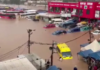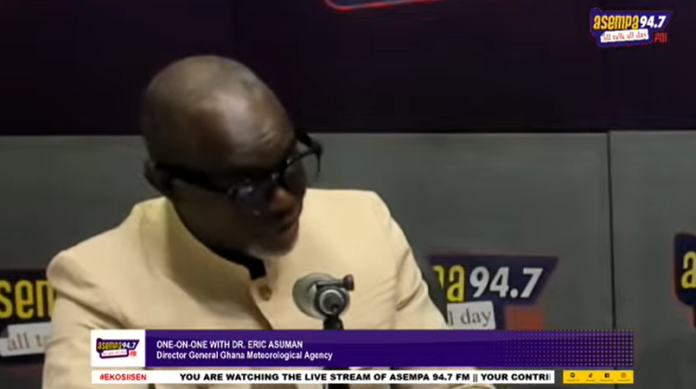

The Director-General of the Ghana Meteorological Agency (GMet), Dr Eric Asuman, has said that the recent heavy rains that caused flooding in parts of the country did not come as a surprise, as the agency had forecast above-normal rainfall for 2026 months earlier.
Speaking in an interview on Asempa FM’s Ekosii Sen show, Dr Asuman said GMet had communicated its seasonal forecast to government and key stakeholders as early as February this year.
“We were not surprised by the recent rainfall because we had long predicted that this year would experience heavier rains than in previous years. We communicated this forecast to the Minister for Communications well in advance,” he said.
According to him, the agency issued its seasonal forecast during a public presentation led by the Minister for Communications, Digital Technology and Innovation, Samuel Nartey George, which was attended by the media and other stakeholders.
“In February 2026, we presented the seasonal forecast for this year. It was presented by the Communications Minister, Sam George, and we invited the media and others. We informed them that there would be a lot of rain,” he explained.
Dr Asuman said the forecasts are based on long-term climate data collected over three decades.
“We look at rainfall data over 30 years and determine the long-term average. That tells us whether rainfall will be normal or above normal, and we announced in February that there would be above-normal rainfall,” he stated.
He noted that GMet had specifically warned that the southern part of the country would experience increased rainfall during the season.
“We forecast and announced that there would be more rains in the southern sector,” he added.
The Director-General explained that the agency provides weather forecasts at different intervals, including daily, weekly, three-day and seasonal forecasts, to support planning and emergency preparedness.
“We have daily forecasts which are updated every six hours. We also have three-day forecasts, weekly forecasts and seasonal forecasts,” he said.
Dr Asuman stressed that GMet’s responsibility is to provide weather forecasts, while agencies such as the Ghana Hydrological Authority are responsible for monitoring the impact of rainfall and flood levels.
He disclosed that weather information is shared directly with key institutions, including the National Disaster Management Organisation (NADMO), the Ghana Hydrological Authority and the security services.
“When it comes to forecasting, that’s our job, but once it rains, that is the responsibility of the Ghana Hydrological Authority.
“When we issue forecasts, institutions like NADMO, the Hydrological Authority, the Police, the Military and others receive the information directly,” he explained.
Dr Asuman also revealed plans to improve coordination among agencies by establishing a joint operations centre where GMet, NADMO and the Ghana Hydrological Authority can work together.
“I am even looking to get an office where NADMO, the Hydrological Authority and GMet will all be together so that forecasting and coordination can be done from one place,” he said.
READ ALSO:
Ministry of Health opens recruitment for medical and dental officers
President declares July 10 and 11 as national general cleaning days after floods