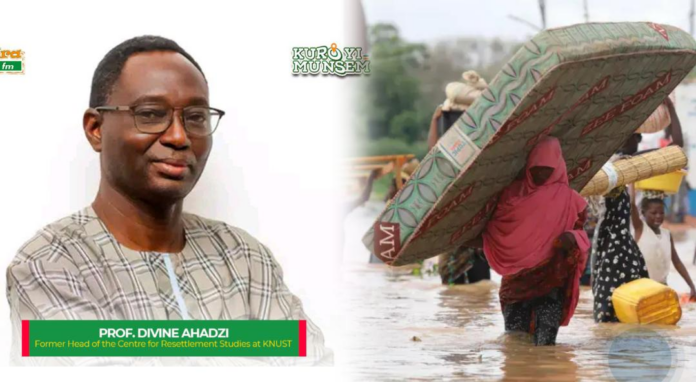

A professor of construction and human settlements development has warned that Ghana’s flood crisis is being worsened by a silent but growing trend of fully paving residential compounds in urban areas.
Prof. Divine Kwaku Ahadzie, former Vice-Dean of the Faculty of Built Environment and Head of the Centre for Settlement Studies at KNUST, said many urban residents have paved their entire compounds with concrete or tiles, eliminating all permeable surfaces.
He noted that the practice prevents rainwater from infiltrating the soil and forces runoff directly into already overloaded drainage systems.
His comments come in the wake of recent torrential rains that caused widespread flooding across the Greater Accra and Central Regions. Homes, shops and major roads were submerged, leaving many residents stranded.
At least 13 deaths have been reported in Accra following the downpours.
Speaking on Nhyira FM’s Kro Yi Mu Nsem on Wednesday, July 1, 2026, Prof. Ahadzie said urban development patterns are part of the problem.
“A lot of people have paved all the compounds of their houses, especially in the cities. When there is no soil or green space for water to percolate, all the rainwater runs off at once into drains and streets. That’s what overwhelms the system within minutes,” he told host Barima Kofi Dawson-Akokoa.
He urged homeowners and developers to deliberately retain unpaved or grassed sections within compounds to allow natural infiltration and reduce surface runoff.
Prof. Ahadzie has therefore called on Metropolitan, Municipal and District Assemblies to establish an incentive fund for landlords who remove concrete or tile paving from their compounds.
According to him, such a fund would not only support property owners to restore permeable surfaces but would also motivate other residents to adopt flood-resilient practices.
“If we reward people who unpave and create green or soil spaces around their homes, others will be encouraged to follow suit,” he said. “It is a practical way to reduce surface runoff and ease pressure on our drains during heavy rains.”
He argued that financial or tax incentives could be a more effective approach than enforcement alone, especially in densely built urban areas where most compounds are now fully paved.
He also identified construction on wetlands as another major contributor to flooding nationwide, in addition to poor sanitation practices.
“Choked drains from household waste make it worse. But we must also stop building on wetlands. We have chosen to fill land instead of using modern technology to develop without causing flooding,” he argued.
Urban planners have long flagged wetland encroachment as a key driver of Accra’s flooding, with many homes and commercial structures now sitting on natural drainage paths.
Meanwhile, Engr. Dr. Mrs. Miriam Eduful, President of the Ghana Institute of Safety and Environmental Professionals (GhISEP), has expressed concern over widespread public non-compliance with flood safety measures.
She said that despite months of intensive public awareness campaigns, including Ghana Meteorological Agency’s heavy rain alerts issued in April, many residents continue to disregard official advisories.
“We have done a lot of sensitisation on radio, television and social media, telling people what to do when GMet issues a heavy rain warning. But the compliance level remains very low,” she stated.
According to Engr. Eduful, the continued disregard for safety alerts contributes significantly to the loss of lives and property during seasonal floods.
She cited examples of residents driving or wading through flooded streets, and others sheltering in structures located in known flood-prone zones.
“Early warnings only work if people act on them. Ignoring them puts families, commuters and emergency responders at unnecessary risk,” she warned.
Engr. Eduful is therefore urging local assemblies, traditional authorities and community leaders to intensify local enforcement and public education ahead of the peak rainy season.
ALSO READ:
Gov’t condemns killing of Ghanaian in South Africa, demands justice
South Africa: One Ghanaian shot dead during mass xenophobic protests