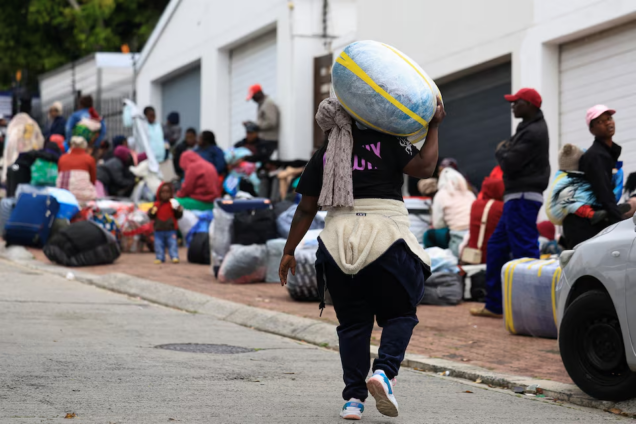

Thousands of Malawian migrants queued for processing at a makeshift camp in the South African city of Durban this week while hundreds of Zimbabweans slept on the pavement outside their consulate in Cape Town.
All had the same goal: to leave South Africa before nationwide anti-immigrant protests on Tuesday, which many fear will descend into violence.
“We are scared because you never know what people are planning to do to you. It’s not right to wait and see what will happen,” Ebrahim Moosa, 37, said.
He was with his wife in a snaking line of people, some with babies on their backs, hoping to catch a bus to Malawi from Durban.
South Africa has been gripped by a wave of xenophobic protests and sometimes deadly attacks in recent weeks, forcing many foreigners to flee or be chased from their homes.
Anti-immigrant groups have set June 30 as a deadline for all undocumented migrants to leave. Several cities are bracing for unrest, even as the government has pleaded with citizens not to take immigration enforcement into their own hands.
“We are appealing to all those who will be marching to respect the police,” said Phumelele Makoba, acting police commissioner for KwaZulu-Natal province, which is expected to be one of the hotspots.
Police have promised a massive deployment to ensure stability. President Cyril Ramaphosa said on Thursday: “Our security forces are ready.”
March and March, the main organisation behind the protests, has said that it is not calling for violence. But it has added it will not take responsibility for anything bad that happens on June 30.
COUNTRIES STRUGGLE TO BUS EVERYONE HOME
Xenophobic violence is a recurring issue in South Africa, where some blame immigrants — mostly from other African countries — for everything from crime and unemployment to crowded public health facilities.
Ramaphosa has warned citizens not to make foreigners scapegoats for these problems, which he attributed mainly to the legacy of apartheid.
South Africa remains deeply unequal, and economic growth has been sluggish for years. But it still has the largest economy in Africa and draws job seekers from neighbouring countries.
Mozambican Antonio Njive, who had done odd jobs in South Africa since 2019, left on June 1 after his house was burned down in a spate of violence that killed five of his compatriots.
“I left home without clothes. Everything was burned,” he said by phone from Chibuto, Mozambique.
Njive, his wife and 6-year-old daughter were among hundreds of citizens whom Mozambique repatriated by bus. Malawi and Zimbabwe are doing the same, but have struggled to keep up with demand.
“We are sleeping outside waiting for buses. Everyone just wants to go home,” Amina Chiwoko, 30, said outside the Zimbabwean consulate in Cape Town.
ASYLUM SEEKERS HAVE NOWHERE TO GO
Many foreigners have nowhere safe to go.
Leanne Sefu, 25, is an asylum seeker from Democratic Republic of Congo who came to South Africa at the age of three.
“The entire world knows that there’s a war in Congo, so me going back, it feels like going back to death,” she said.
After being attacked at the nail salon where she worked in Durban and chased from her home, she is now camping outside the Home Affairs office.
“What I’m hoping is that maybe the government can help us find a shelter. From yesterday we’ve been hearing people are being attacked and they’re coming here,” she said, sitting on a mattress on the pavement with dozens of people.
“There’s no safety here.”
ALSO READ: