
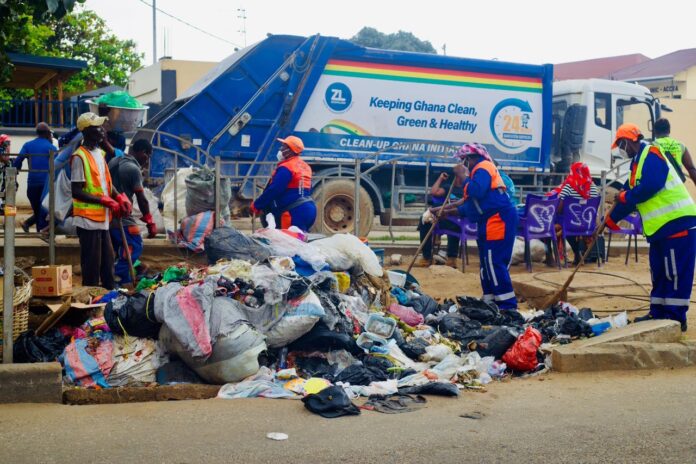

Every rainy season, Ghanaians watch a familiar tragedy unfold. Streets become rivers. Drains overflow with plastic waste. Businesses shut down. Families lose property. In the worst cases, lives are lost.
The floods that have recently hit parts of the country are not merely acts of nature. They are also symptoms of a deeper sanitation crisis that Ghana has struggled to overcome for decades.
At the centre of the debate is the decision by the government not to renew the Youth Employment Agency’s street-sweeping contract with Zoomlion Ghana Limited.
The Presidency recently confirmed that the contract, which had expired in 2024, would not be renewed as part of broader reforms to sanitation service delivery.
The decision was welcomed by critics who argued that the sanitation model required restructuring. Yet one important question remains unanswered: who is performing the work that thousands of sweepers and sanitation workers were previously undertaking?
For months, many communities have complained about growing heaps of refuse, choked gutters and declining sanitation standards. The expectation was that Metropolitan, Municipal and District Assemblies would quickly establish effective alternatives.
Unfortunately, evidence from several parts of the country suggests that the transition has been far from seamless. The reality is that sanitation is not managed through policy declarations alone. It requires boots on the ground, equipment, logistics, supervision and consistent financing.
While government officials have promised reforms and improved remuneration for sanitation workers, the ordinary Ghanaian judges success by what they see in their neighbourhoods, markets and drainage systems.
The recent flooding episodes have once again exposed the weaknesses in our sanitation management system. Choked drains remain one of the biggest contributors to urban flooding. When drains become dumping grounds for plastic waste and refuse, heavy rainfall quickly transforms into a national emergency.
This is not an argument that Zoomlion is perfect. Like every large public contractor, the company has faced criticism and scrutiny over the years. Some critics have argued that assemblies should directly manage sweepers instead of relying on an intermediary. Others have called for greater transparency and accountability in sanitation contracts. These concerns deserve attention and should not be dismissed.
However, it is equally important to acknowledge reality. For nearly two decades, Zoomlion built a nationwide sanitation infrastructure that reached communities across Ghana. The company deployed personnel, equipment and operational systems that many local assemblies are still struggling to replicate at scale.
The issue before Ghana today should not be whether Zoomlion wins a political argument. The issue should be whether Ghana wins the battle against filth and flooding.
If assemblies have developed a superior model capable of delivering cleaner communities and reducing flood risks, then the results should be visible by now. If they have not, government must be willing to reassess its approach.
Rather than excluding experienced sanitation operators, Ghana should embrace a competitive system that allows capable organisations including Zoomlion to bid transparently for sanitation contracts while being held to strict performance standards and accountability measures.
Floodwaters do not care about political positions. Refuse-filled drains do not respond to ideological arguments.
What matters is whether our cities are cleaner, our drains are flowing and our citizens are safer.
The lesson from the recent floods is clear. Ghana needs effective sanitation management more than it needs political battles.
If Zoomlion possesses the expertise, workforce and logistical capacity to help address the crisis, then the national interest demands that it be part of the solution.
In the fight against floods and filth, results not politics must guide our decisions.
The writer, Shadrach Kofi Assan, is the lead producer for Adom FM’s morning show, Dwaso Nsem.
