
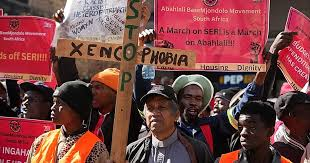

The West Africa Centre for Counter-Extremism (WACCE) has strongly condemned the renewed wave of xenophobic violence targeting African nationals in the Republic of South Africa.
In April and May 2026, the groups March and March and Operation Dudula reportedly organised violent demonstrations in Pretoria, Johannesburg, and Durban, during which foreign-owned businesses were attacked and African migrants were harassed in their homes, workplaces, and public spaces.
WACCE described the acts as unlawful, extremist, and a betrayal of pan-African ideals of solidarity and dignity that underpin the African Union (AU) and the African Continental Free Trade Area (AfCFTA).
The organisation said these actions, often framed as law enforcement, have promoted ultranationalist sentiments and deepened hostility toward African non-South Africans.
“These are elements of violent extremism in which individuals are using economic grievances as a cover for ethnic persecution,” WACCE stated.
The group said the situation represents a crisis that requires a response commensurate with its scale.
WACCE also commended the Government of Ghana for what it described as swift and decisive action in evacuating affected Ghanaian nationals.
A Pattern Of Recurring Violence
WACCE noted that the current attacks are part of a long-standing pattern of xenophobic violence in South Africa spanning nearly three decades.
It cited incidents including the 1998 Johannesburg killings, the 2008 nationwide attacks that left more than 60 people dead and over 100,000 displaced, the 2015 violence that required military intervention, and the 2025 blockades of public health facilities by extremist groups.
According to the organisation, the repeated failure to ensure accountability has emboldened further attacks.
WACCE stressed that non-nationals in South Africa are protected under several legal frameworks, including Articles 3, 4, 5, 12, 14 and 28 of the African Charter on Human and Peoples’ Rights; Article 4(h) of the AU Constitutive Act; the AU Free Movement of Persons Protocol (2018); and ILO Conventions Nos. 97 and 143 on migrant workers’ rights.
It said systematic violence against African migrants requires continental accountability and stronger enforcement of existing frameworks.
The organisation therefore called on the African Union and ECOWAS to take coordinated action through diplomatic engagement, crisis mediation, and deterrent mechanisms.
WACCE’s Call To South African Authorities
WACCE urged the Government of South Africa to take immediate action based on six key priorities:
- Investigate all reported incidents promptly, thoroughly, and impartially.
- Prosecute perpetrators, including those who incite or organise attacks, and ensure victims receive justice and compensation.
- Dismantle vigilante groups operating as unlawful enforcement networks.
- Strengthen protection for vulnerable communities through increased security and reporting systems in high-risk areas.
- Address xenophobia at its roots through public education and awareness campaigns targeting misinformation and underlying causes.
- Ensure law enforcement agencies uphold human rights standards in all operations.
WACCE also called on the African Commission on Human and Peoples’ Rights, which issued a statement on April 27, 2026, to move beyond condemnation by establishing an independent committee of inquiry with a clear timeline, assessing South Africa’s compliance with the African Charter, and placing the xenophobia crisis on the agenda of the next AU Summit as a continental governance issue.
