
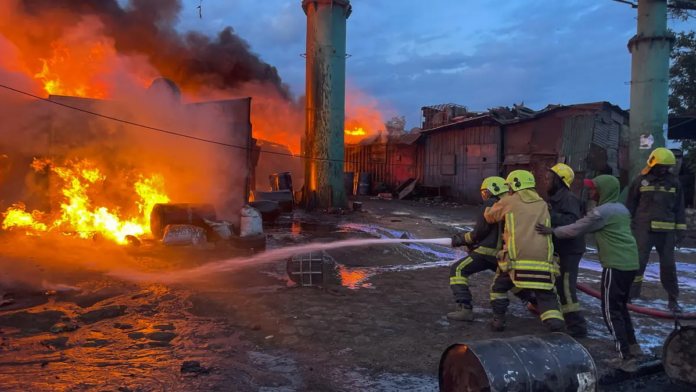

Eight students have been arrested in connection with a suspected arson attack at a Kenyan girls’ school that left 16 pupils dead, police have said.
The fire, which broke out in the early hours of Thursday at Utumishi Girls Academy in Gilgil, about 120km north-west of the capital, Nairobi, destroyed the upper floor of a dormitory that housed 135 bunk beds.
Following interviews with students and staff, as well as a forensic review of CCTV footage, the National Police Service said eight pupils were identified as “persons of interest in connection with the planning and execution” of the fire.
Investigations are ongoing to determine the exact cause of the blaze.
Police said the students were detained for questioning after being traced to their homes and brought back to the school, while others who had remained in the area were also picked up for questioning. The eight were among 30 students initially recalled by detectives probing the deadly incident.
On the aftermath of the fire, Education Minister Julius Ogamba said preliminary findings pointed to multiple breaches of safety regulations at the school, including overcrowded dormitories and a locked exit door.
“In particular, there was congestion in the dormitory and one exit door was locked, contrary to the prescribed safety requirements,” he said.
He has since dissolved the school’s board of management and ordered action against the headteacher, adding that appropriate disciplinary and legal measures would be taken against anyone found culpable.
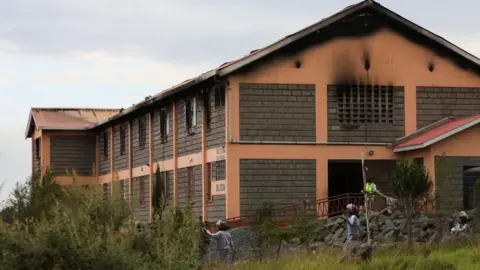
As investigators continued their work at the site, distraught parents and relatives searching for their loved ones were seen in tears. Security has been heightened around the school as growing crowds demand answers and accountability.
“I arrived at the school at 07:00, and three hours later I still don’t have any information,” Njuki Nthimba, who is looking for his niece, told the BBC on Friday morning.
“Some officers came from the school and asked the parents to group themselves into three categories. Group one is for parents whose children have been arrested in relation to the incident, group two is for parents whose children died, and group three is for parents who do not know where their children are.
“I handed them my niece’s name, and I am now waiting to be told information about her.”
Samuel Githua, who went to the school in search of his sister, also expressed distress over the uncertainty surrounding her whereabouts.
“I don’t know where my sister is. We’ve been told some children are in hospital, some in the mortuary… Our mother died when we were young, so I took care of her like both a father and a mother. She has been like my child,” he said.

As well as the fatalities, the fire resulted in injuries to 79 pupils – some as a consequence of jumping from the first floor.
Seven of those injured were transferred to Nairobi on Thursday for specialised medical care, while the rest have been treated and discharged.
The bodies of those who died have been taken to the nearby mortuary for preservation and DNA identification.
Kenya has had a long history of school fires – just two years ago at least 21 people died in a dormitory fire in central Kenya.
Many fires reported in boarding schools have been the result of arson, with disgruntled pupils – angry about the discipline and living conditions – accused of being responsible, while others were caused by accident.
Overcrowding in dormitories and the failure to follow safety guidelines, such as keeping exits clear and windows unlocked, have frequently been blamed for the high number of casualties.
