
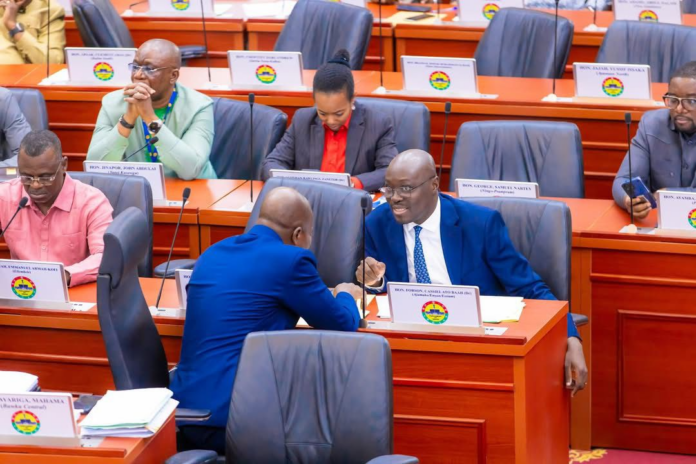

- Rt. Hon. Speaker, I come before this House to provide an update on the substantial progress we have made in restoring macroeconomic stability and debt sustainability ahead of the original timeline.
- This address will also announce a new chapter in Ghana’s engagement with the International Monetary Fund.
- Mr. Speaker, this is a consequential moment in President Mahama’s Reset Agenda and, indeed, in the life of our nation.
- It signifies Ghana’s passage from crisis management to stability, from dependence on financial bailout to partnership in reform, and from uncertainty to renewed confidence in our economic future.
- Mr. Speaker, to appreciate the significance of this moment, we must briefly recall the gravity of the crisis Ghana faced in 2022.
- On 1st July 2022, the previous administration turned to the IMF for a financial bailout after what Dr. Forson described as gross mismanagement of the economy had driven the country into fiscal, balance of payments and debt crises.
- President Mahama, the then NDC flag bearer, acknowledged the decision as necessary, though a belated intervention to arrest the decline and ease the severe hardship being borne by the Ghanaian people.
- The scale of the crisis was profound, if not traumatic:
• The cedi came under intense pressure;
• inflation rose to painful levels while investor confidence deteriorated sharply;
• external reserves were strained; and
• Ghana lost access to the international capital market.
- As a result, credit rating agencies responded by repeatedly downgrading Ghana’s sovereign rating in 2022 to levels never seen in the country’s history:
• In February 2022, Moody’s downgraded Ghana to Caa1;
• In August, S&P downgraded Ghana to CCC+;
• Again in August, Fitch downgraded Ghana to CCC;
• In September, Fitch further downgraded Ghana to CC; and
• In October 2022, Ghana lost access to the international capital market as Eurobond spreads widened to an all-time high of 3,400 basis points.
- This further deepened the economic and financial crisis to the point that COCOBOD was unable to secure a syndicated loan for the first time in many years.
- Some domestic commercial banks also struggled to obtain external funding or establish letters of credit because international banks declined to confirm those instruments.
- Mr. Speaker, on 5th December 2022, following the announcement that Ghana could not meet its maturing domestic debt obligations, the previous administration introduced the Domestic Debt Exchange Programme (DDEP), imposing significant haircuts on domestic bondholders.
- On 13th December 2022, Ghana formally requested debt treatment under the G20 Common Framework to restructure its bilateral debt portfolio of more than US$5 billion.
- On 19th December 2022, Ghana also defaulted on the servicing of its external commercial debt obligations.
- The far-reaching haircuts affected:
• The Bank of Ghana;
• commercial banks;
• non-bank financial institutions;
• pension funds;
• insurance companies;
• individual bondholders; and
• pensioners.
- Mr. Speaker, ordinary Ghanaians bore the heaviest burden of that crisis. The consequences were felt across households, businesses and institutions through:
• rapid depreciation of the cedi;
• runaway inflation exceeding 50 percent;
• erosion of disposable incomes and savings;
• painful haircuts on domestic bondholders, including pensioners;
• punitive interest rates that constrained private sector activity;
• the imposition of taxes including the E-Levy, Betting Tax, COVID-19 Levy and Emissions Tax;
• job losses, business distress and weakened investor confidence; and
• rising poverty and economic insecurity.
- Rt. Hon. Speaker, despite the hardships imposed on Ghanaians, the government of the day remained bloated, inefficient, and riddled with waste and corruption.
- By December 2024, those responsible had also undermined the IMF programme they signed onto by missing targets and commitments under the programme.
- That, Dr. Forson said, was the depth of the crisis inherited by the Mahama administration.
- Mr. Speaker, he stressed that recounting the crisis was not to dwell on the past but to remind the country of the heavy price of fiscal indiscipline and economic recklessness.
- Rt. Hon. Speaker, some painful experiences cannot be taught. They must be lived to be understood. But once experienced, they should never be repeated.
- “Never again! Never again!! Never again!!!”
- Mr. Speaker, upon assuming office, President Mahama’s administration moved swiftly to reset the economy and bring the IMF-supported programme back on track.
- According to Dr. Forson, the IMF programme was recalibrated to ensure fairer burden-sharing and deeper structural reforms.
- Among the principal measures undertaken were:
• introduction of the Public Financial Management (PFM) commitment authorisation system to control expenditure;
• auditing of government arrears and payables to eliminate recycled IPCs and overpayments;
• ending the misuse of the tax refund account to finance schemes such as SML;
• amendments to the PFM Act to institutionalise a 1.5 percent primary surplus target and a 45 percent debt-to-GDP ceiling by 2034;
• introduction of GOLDBOD to strengthen foreign exchange stability and reserve accumulation;
• operationalisation of the Sinking Fund with dedicated cedi and US dollar buffers to manage future debt maturities;
• removal of taxes such as E-Levy, Betting Tax, Emissions Levy and VAT on motor insurance;
• establishment of the Office of Value for Money to improve public expenditure efficiency;
• establishment of the Independent Fiscal Council to monitor compliance with fiscal rules;
• renegotiation of Independent Power Producer agreements, generating savings of more than US$250 million while clearing over US$1 billion in legacy arrears;
• reduction in the number of ministers from 123, later revised to 88, to 60; and
• reduction in the number of ministries from 30 to 23.
- Mr. Speaker, Dr. Forson said the measures have produced “clear and measurable results”:
• Real GDP growth reached 6.0 percent in 2025, marking the highest expansion in the post-pandemic period;
• Non-oil GDP growth climbed to 7.6 percent, the highest in 14 years;
• Ghana’s economy crossed the US$100 billion threshold for the first time in 2025;
• Ghana became the eighth-largest economy in Africa;
• Per capita income rose to US$3,385 for the first time;
• The primary balance recorded a surplus of 2.5 percent of GDP in 2025;
• Public debt-to-GDP ratio declined from 61.8 percent in 2024 to 44.7 percent by the end of 2025;
• Ghana achieved the 45 percent debt-to-GDP target ahead of schedule;
• Debt service-to-domestic revenue ratio declined from 55.7 percent in 2022 to 28.8 percent in 2025;
• Ghana moved from a high risk to a moderate risk of debt distress;
• Inflation declined from 23.8 percent in December 2024 to 3.4 percent in April 2026;
• The 91-day Treasury bill rate declined from 28.4 percent in January 2025 to 4.8 percent in April 2026;
• The 2-year, 3-year and 5-year bonds traded within the range of 11.0 percent to 12.6 percent compared to 20 percent previously;
• The monetary policy rate declined from 27 percent in January 2025 to 14 percent in April 2026;
• The current account balance recorded a surplus of 8.3 percent of GDP in 2025; and
• The cedi appreciated by 40.7 percent against the US dollar in 2025.
- Mr. Speaker, Dr. Forson maintained that the results affirm the importance of fiscal prudence and discipline.
- He argued that macroeconomic stability is the foundation for jobs, incomes, investor confidence and national prosperity.
- According to him, the lessons from the 2022 crisis must guide Ghana’s future economic management.
- “Prudence does not mean we are failing to spend. We can only spend what we have. Prudence is the difficult road to wealth creation,” he said.
- Recalling remarks by President Mahama at the 77th Annual New Year School on 6th January 2026, Dr. Forson quoted the President as saying:
“It is my hope that this will be the very last time we will ever go for a bailout from the IMF… It must be the 17th and the last time that Ghana goes for a bailout from the IMF.”
- President Mahama also stated:
“We’ll continue our collaboration with the IMF under Article 4 and other instruments… But it will definitely be the last time we go on our knees to beg for a bailout.”
- Dr. Forson consequently declared that no further IMF financial bailout would be required in the foreseeable future.
- “We have evolved from a position of ‘supplicant’ to one of ‘partner’,” he stated.
- The Finance Minister further announced that Ghana had successfully concluded the final review of the current IMF bailout programme, pending approval by the IMF Executive Board.
- Mr. Speaker, Ghana’s engagement with the IMF will now transition from the Extended Credit Facility to a reform-focused, non-financing Policy Coordination Instrument (PCI).
- Dr. Forson explained that the PCI is designed for countries that no longer require IMF financing but seek a credible framework for reforms, regular policy reviews and stronger signals to investors and development partners.
- He said the transition marks an important shift from seeking financial bailout to engaging the IMF as a credible reform partner.
- According to him, the PCI will help Ghana leverage the IMF’s regular policy assessments and expertise to strengthen investor confidence and improve the country’s credit ratings.
- “In other words, Ghana has moved from the intensive-care unit (ICU) to the wellness center,” Dr. Forson declared.
- Mr. Speaker, to build on the foundation of stability, the Mahama administration has also designed a new economic programme known as “The New Economy,” to be unveiled in the 2027 Budget.
- The programme, according to the Finance Minister, will move Ghana from stabilization to transformation with emphasis on sustainable jobs, higher productivity, resilience and broad-based prosperity.
- Dr. Forson said President Mahama remains deeply grateful to Ghanaians for their sacrifice, patience and resilience during the difficult adjustment period.
- “We do not take their support for granted,” he added.
- He assured Parliament that the government would not become complacent and would continue working toward building “the Ghana We Want.”
- “May God bless our homeland Ghana. I thank you, Mr. Speaker.”
