
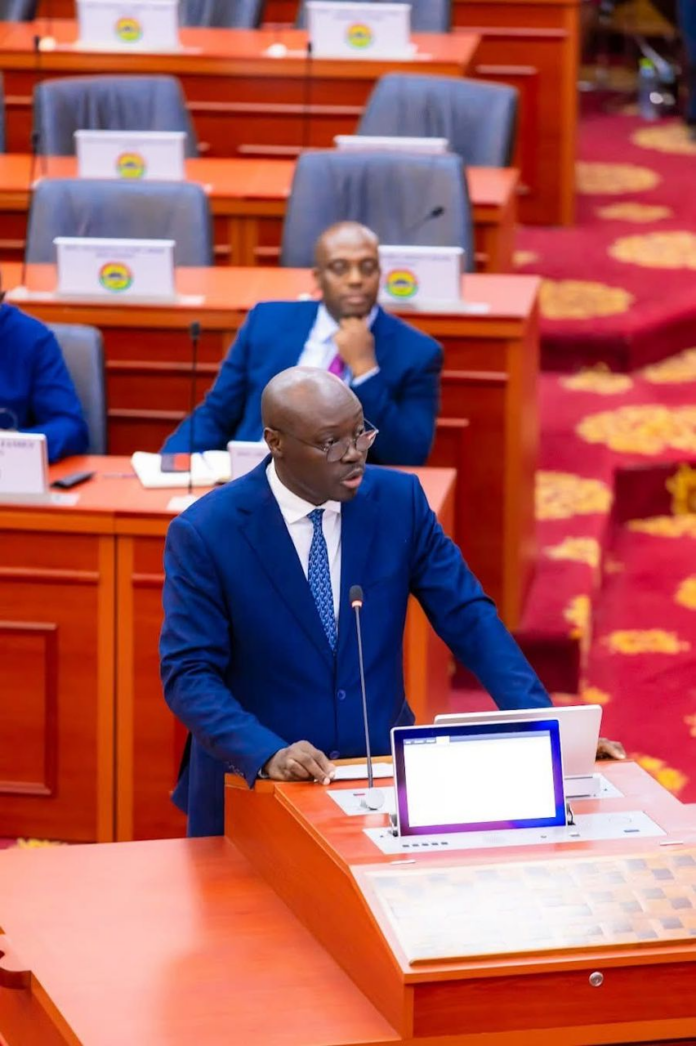

Finance Minister Dr. Cassiel Ato Forson has announced what he described as a “new chapter” in Ghana’s relationship with the International Monetary Fund (IMF), declaring that the country has made substantial progress in restoring macroeconomic stability and debt sustainability ahead of schedule.
Delivering a statement in Parliament on Thursday, Dr. Forson said Ghana was transitioning from “crisis management to stability” and from dependence on financial bailouts to a reform-driven partnership with the IMF under President John Mahama’s Reset Agenda.
“This is a consequential moment in the life of our nation,” the Finance Minister told Parliament. “It signifies Ghana’s passage from crisis management to stability, from dependence on financial bailout to partnership in reform, and from uncertainty to renewed confidence in our economic future.”
The statement marks one of the clearest official declarations yet from the Mahama administration that Ghana’s economy is emerging from the severe turbulence that culminated in the country’s debt default and IMF bailout under the previous administration.
Recounting Ghana’s Economic Crisis
Dr. Forson used a significant portion of his address to recount the scale of the economic crisis Ghana faced beginning in 2022, describing it as “profound, if not traumatic.”
According to him, the previous NPP administration sought IMF assistance on July 1, 2022, after what he called “gross mismanagement” of the economy pushed Ghana into fiscal, balance of payments and debt crises.
He recalled that the cedi came under intense pressure, inflation surged to painful levels, external reserves weakened sharply and investor confidence deteriorated, ultimately causing Ghana to lose access to the international capital market.
The Finance Minister also detailed a series of sovereign credit rating downgrades that hit Ghana in 2022, pushing the country into deep junk territory.
He noted that Moody’s downgraded Ghana to Caa1 in February 2022, while S&P later downgraded the country to CCC+. Fitch subsequently downgraded Ghana twice within months, first to CCC and later to CC.
According to him, Ghana’s Eurobond spreads widened to an unprecedented 3,400 basis points in October 2022, effectively shutting the country out of international capital markets.
“That further deepened the economic and financial crisis,” Dr. Forson said.
COCOBOD, Banks and Pensioners Hit
The Finance Minister painted a grim picture of the ripple effects of the crisis across the financial sector and the wider economy.
He disclosed that COCOBOD was unable to secure its syndicated loan facility for the first time in many years, while some local commercial banks struggled to obtain external funding or establish letters of credit because international banks refused to confirm those instruments.
Dr. Forson also revisited the controversial Domestic Debt Exchange Programme (DDEP) introduced in December 2022 after the previous administration announced Ghana could no longer meet its domestic debt obligations.
He said the programme imposed significant haircuts across the financial sector, affecting the Bank of Ghana, commercial banks, pension funds, insurance companies, non-bank financial institutions, individual bondholders and pensioners.
The Finance Minister further reminded Parliament that Ghana formally requested debt treatment under the G20 Common Framework in December 2022 to restructure more than US$5 billion in bilateral debt before later defaulting on external commercial debt obligations.
“Ordinary Ghanaians Bore the Heaviest Burden”
Dr. Forson argued that ordinary citizens suffered the most during the crisis period.
He cited the rapid depreciation of the cedi, inflation exceeding 50 percent, erosion of incomes and savings, painful bondholder haircuts, soaring interest rates and worsening poverty as some of the harsh realities faced by Ghanaians.
He also criticized what he termed the proliferation of “nuisance taxes,” including the E-Levy, Betting Tax, COVID-19 Levy and Emissions Tax, saying they compounded the hardships faced by households and businesses.
“The consequences were felt across households, businesses, and institutions,” he stated.
The Finance Minister further accused the previous administration of maintaining a bloated and inefficient government structure despite the deepening crisis.
“In the midst of all these hardships imposed on the Ghanaian people, the government of the day remained bloated, purposefully inefficient, and riddled with waste and corruption,” he said.
“Ghana Must Never Return to That Path”
Dr. Forson said the Mahama administration inherited a weakened IMF programme in December 2024 after targets and commitments had been missed.
However, he stressed that recounting the crisis was not intended to dwell on the past, but rather to remind the country of the dangers of fiscal indiscipline and economic recklessness.
“That was the depth of the crisis we inherited,” he said.
“It is important to recount this not to dwell on the past, but to remind ourselves of the heavy price of fiscal indiscipline and economic recklessness, and to affirm our collective resolve that Ghana must never return to that path.”
