
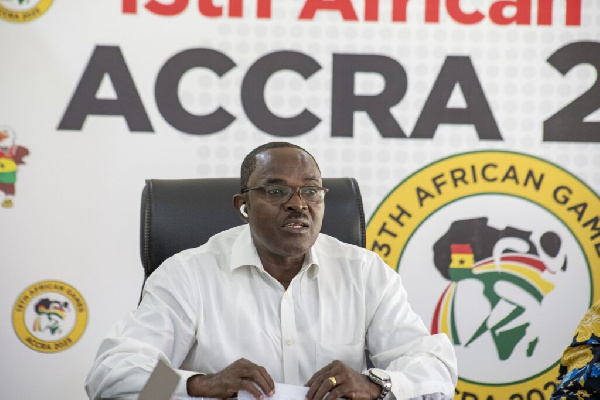

The Auditor-General has recommended sanctions against former senior officials of the Ministry of Sports and the Local Organising Committee (LOC), after uncovering what it describes as deep-rooted procurement breaches, weak financial controls, and unexplained expenditures.
At the centre of the report are former Sports Minister Mustapha Ussif, former Chief Director William Kartey, and former LOC Chairman Dr. Kwaku Ofosu-Asare, who are repeatedly named as the key officials to be sanctioned under Section 92 of the Public Procurement Act, 2003 (Act 663), as amended.
In total, the administrative irregularities flagged in the report amount to approximately GHC1.15 billion (GHC1,149,809,221.50), alongside USD 5.2 million in revenue-related losses and cash control breaches.
The audit concludes that the irregularities were not isolated, but systemic—spanning contract design, procurement approvals, payment structures, cash management, and post-contract accountability.
The strongest sanction recommendations consistently target:
- Mustapha Ussif (former Minister of Youth and Sports)
- William Kartey (former Chief Director, MOYS)
- Dr. Kwaku Ofosu-Asare (former LOC Chairman)
They are cited in multiple breaches, including:
- Uncompetitive procurement approvals
- Single-source contract justifications
- Weak or absent price benchmarking
- Poor contract structuring and oversight failures
- Failure to enforce procurement compliance systems
In addition, Prof. Amin Alhassan (Director-General, GBC) is also recommended for sanctions or liability in relation to broadcast procurement irregularities and staff deployment issues.
Breakdown of key administrative irregularities
GHC18.9 million: Unqualified contractor engagement
The audit found that JDK Travel & Tours, a travel agency without accommodation licensing, was used for hotel services under questionable arrangements.
Auditors also could not independently verify listed hotel partners.
GHC336.63 million: Fixed payments for variable services
Fourteen contracts—including catering, accommodation, transport, and anti-doping services—were structured as fixed lump sums without usage verification systems such as:
- Rooming lists
- Meal registers
- Passenger manifests
- Test documentation
This meant GHC336.63 million was paid without evidence of actual consumption.
GH¢38.82 million: Sports equipment contract misalignment
Equipment not supplied due to schedule changes was still paid for, with no contract adjustment or formal variation orders.
GH¢150.6 million: Related-party contract exposure
A major red flag emerged around JDK Travel & Tours, Delovely Co. Ltd, and Jorninas Co. Ltd, all linked to a single beneficial owner.
The contracts covered:
- Transport and logistics
- Ticketing
- Accommodation
- Sports equipment and medals
Total exposure: GHC150.62 million
GHC55.77 million: Unexplained contract costs
Contracts were executed without itemised pricing or defined scopes, making audit verification impossible.
GHC20.37 million: Cash withdrawals outside GIFMIS
Large cash withdrawals were made without supporting documentation or system traceability, bypassing Ghana’s GIFMIS financial controls.
$247,194: Weak cash reconciliation
Cash received from participating countries was not fully lodged, with $247,194 unaccounted for in proper banking records.
GHC27.23 million: Unaccounted merchandise revenue
Sales of official Games merchandise lacked inventory logs and revenue tracking systems.
Only minimal proceeds were recorded, raising concerns over missing income streams.
GHC3.56 million: Services without contracts (GBC)
Broadcast-related service providers—including TPR, Silicon House, and Broadstem—were engaged without formal contracts.
Prof. Amin Alhassan cited for sanction.
GHC44.35 million: Delayed procurement ratification
GBC broadcast contracts were approved five months after the Games ended, undermining procurement legality.
GHC40.79 million: Misuse of GBC personnel
GBC staff were deployed under third-party contracts without cost recovery or revenue-sharing arrangements.
$4.95 million: Lost broadcast revenue opportunity
Projected broadcast revenue of US$5 million collapsed to just US$45,000 in licensing fees, while the state incurred US$3.6 million in production costs.
Free access was granted to a major broadcaster without approval.
GHC482.52 million: Construction supervision failures
Consultants were found to have certified defective works without proper quality assurance documentation, leading to major infrastructure defects.
GHC45.96 million: Uncompetitive procurement
Seven procurements were executed without documented approval authority or procurement method justification.
GHC18.03 million: “Reluctantly accepted” single-source contracts
Eight contracts were approved by the Public Procurement Authority with reservations, yet still executed.
GHC16.57 million: PPA price reductions not justified
Although contract values were reduced by 5–10%, no supporting negotiation or value-for-money documentation was provided.
55 single-source contracts flagged
The audit also revealed that 55 contracts were single-sourced without justification, supplier vetting, or benchmarking.
The sanction question now moves to enforcement
The audit is explicit: many of the failures require disciplinary sanctions under Ghana’s Public Procurement Act, particularly Section 92.
At the centre of potential accountability are:
- Former Minister Mustapha Ussif
- Former Chief Director William Kartey
- Former LOC Chairman Dr. Kwaku Ofosu-Asare
- GBC Director-General Prof. Amin Alhassan (for broadcast-related breaches)
