

In football, the word treble carries a particular kind of weight. Mention it and the room hushes. Manchester United, 1999.
The Sir Alex Ferguson team that won the Premier League, the FA Cup, and the Champions League in one delirious season, closed in Barcelona by Ole Gunnar Solskjær’s stoppage-time goal that broke a continent’s heart. Barcelona, 2009.
Pep Guardiola’s first season at Camp Nou, with Messi at his most untouchable, lifting La Liga, Copa del Rey, and the Champions League with the kind of stylish authority you only see once or twice in a generation.
Inter Milan, 2010. José Mourinho’s masterclass that swept Serie A, Coppa Italia, and Europe. Bayern Munich did it in 2013 and again in 2020. Barcelona returned to it under Luis Enrique in 2015. Manchester City finally joined the club in 2023.
That is essentially the full roll call in modern European football. A handful of clubs across many decades. The treble stays rare because it asks three different kinds of dominance to land in the same calendar window: the marathon consistency of a league season, the cup-tie nerve to survive single-elimination football, and the elite ceiling to outlast Europe’s best across two-legged ties. Three trophies, three personalities, one window.
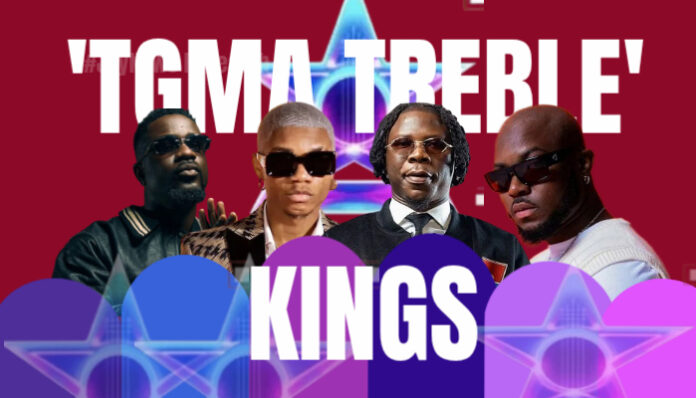
But Telecel Ghana Music Awards has its own version, and it is just as exclusive. The ‘TGMA treble’, as fans and JoyNews Research have come to define it, is the night an artist wins Artiste of the Year, plus Best Genre Artiste of the Year in their own lane, plus Album/EP of the Year. Three plaques that test three different kinds of greatness in one evening at the award ceremony.
In 26 completed editions of the awards from 2000 through 2025, exactly four artists have pulled it off.
The Class of Four
Sarkodie at the 11th edition in 2010 was the first to do it, and his treble remains the most decisive on record.
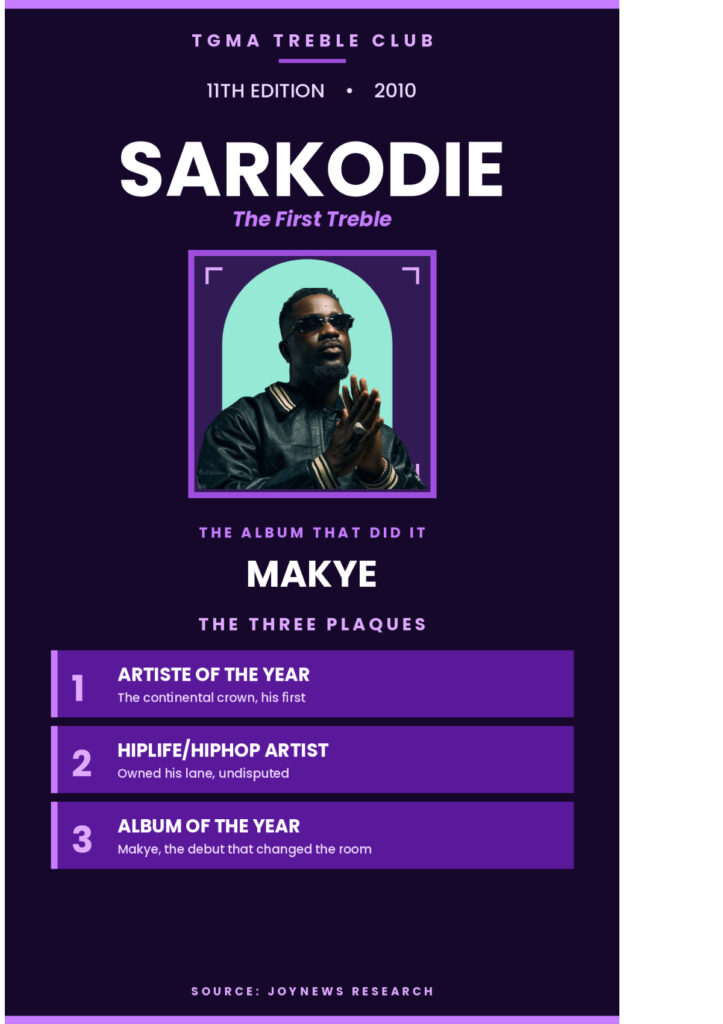
His debut album Makye walked into the 2010 ceremony with eight nominations and the kind of cultural momentum that reshapes the conversation. He took Artiste of the Year, Hip-Hop/Hiplife Artist of the Year, and Album of the Year, with Discovery of the Year and Best Rapper added for emphasis. Five trophies, one debut album, one rapper from Tema, and a record stamped on the awards in his very first appearance.
KiDi at the 23rd edition in 2022 ended a twelve-year treble drought. The Lynx Entertainment frontman then walked in with The Golden Boy and walked out with Artiste of the Year, Best Afrobeats/Afropop Artiste of the Year, and Album/EP of the Year for that exact project.
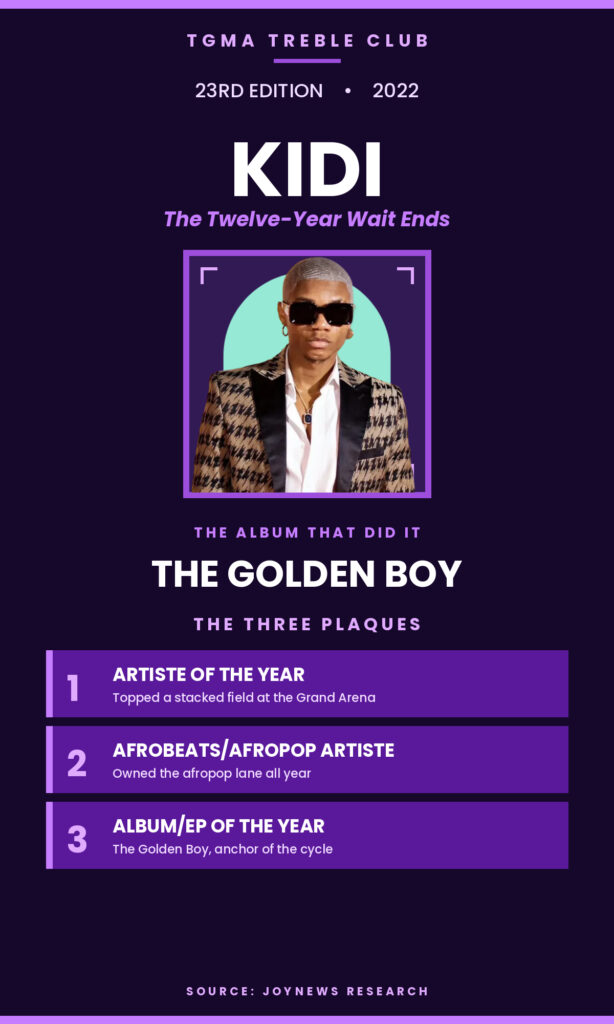
Touch It then added Most Popular Song of the Year and Best Reggae/Dancehall Song to make the cabinet five-deep. The treble was already complete before those last two trophies arrived.
Stonebwoy at the 25th edition in 2024, the silver jubilee of the awards, finally completed the set. He had taken Artiste of the Year back in 2015 but watched Album of the Year leave with Edem that night. The 2024 evening was the rewrite.
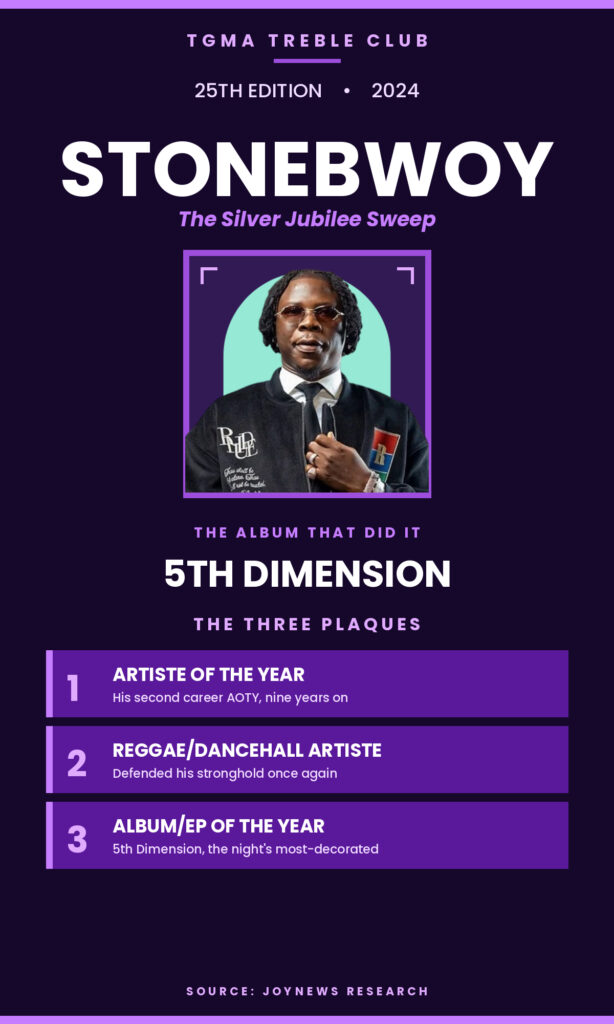
He took Artiste of the Year, defended Best Reggae/Dancehall Artiste of the Year (his eighth career win in that category by then), and lifted Album/EP of the Year for 5th Dimension. He left with seven plaques, the most decorated artist on the night, and a treble that closed a chapter open since 2015.
King Promise at the 26th edition in 2025, the most recent name and the most patient one. He had been nominated for Artiste of the Year in 2022, 2023, and 2024 without ever taking it home.
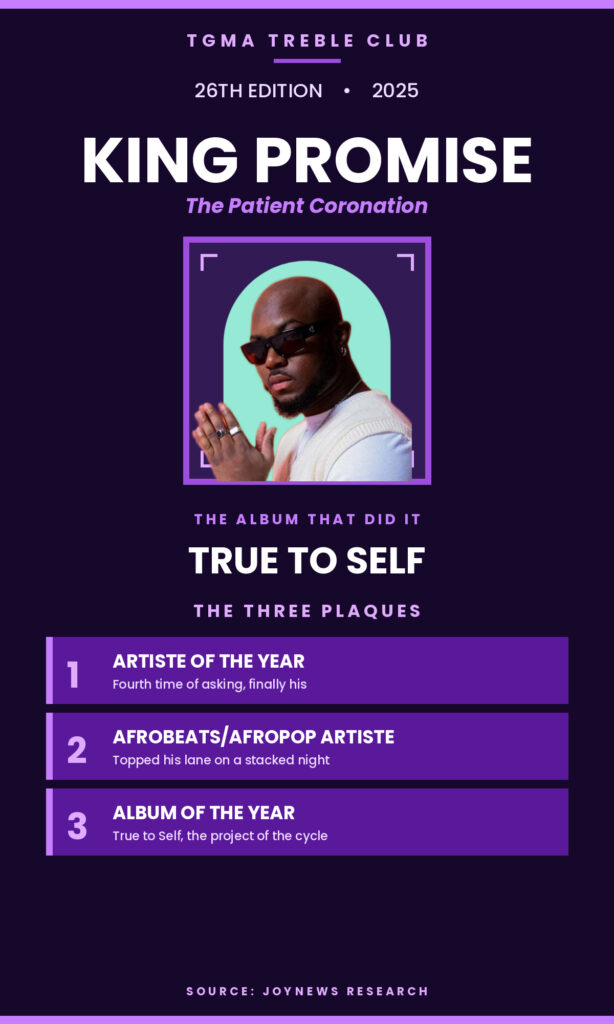
On his fourth attempt the trophy finally moved, and he completed the set in one breath: Artiste of the Year, Best Afrobeats/Afropop Artiste of the Year, and Album of the Year for True to Self, with Paris winning Afropop Song of the Year on the side.
Four artists. Fifteen years separating the first from the latest. Three of them clustered inside the last four editions. That last detail is the most interesting pattern in the entire story, and we will get to it.
So What Does It Actually Take?
Study the four trebles closely and three things are present in every single one. They are not optional. Miss any one of them and you join the close-miss club instead.
One: a defining album released at the right moment. Each treble was anchored by a body of work that the board, and the public could all agree was the album of the cycle. Makye for Sarkodie. The Golden Boy for KiDi. 5th Dimension for Stonebwoy. True to Self for King Promise. Not just a good record. Not just a popular record. A defining one.
A project everyone could point to and say that is the album of the year, with no asterisks and no rivals close enough to spoil the argument. Album of the Year tends to be the hardest of the three plaques to land, because while Artiste of the Year rewards a whole season’s run and Genre Artiste rewards a year’s lane discipline, Album of the Year demands that one specific body of work outshine every other album released by every other artist that calendar. No hiding behind features. No leaning on a viral single. Either the album wins or it doesn’t.
Two: own your lane absolutely. Every treble winner first won their own home category. Sarkodie was the undisputed Hiplife/Hip-Hop Artist of his cycle. KiDi was the undisputed Afrobeats/Afropop Artist. Stonebwoy was the undisputed Reggae/Dancehall Artist. King Promise was the undisputed Afrobeats/Afropop Artist.
The Genre Artiste plaque is, in football terms, the league title. It rewards the artist who was most dominant in their category over the full year-under-review. If you cannot win your home league, you have no real argument for the continental prize.
Sarkodie in 2012 won Artiste of the Year but lost Hiplife/Hiphop Artiste to Kwaw Kese, and the treble slipped. Black Sherif in 2023 won Artiste of the Year but lost Hiplife/Hip-Hop Artiste to Sarkodie, and the treble slipped again. The lane comes first. Always.
Three: crossover, not just core. Every treble winner had at least one record that moved beyond their genre fanbase into the wider pop conversation. Makye had Babe with Mugeez, the song that pulled hiplife into the mainstream.
The Golden Boy had Touch It, a record that refused to be boxed into any one category. 5th Dimension had Manodzi with Angelique Kidjo, a song that pushed Stonebwoy past the dancehall corner and into the room of African pop royalty. True to Self had Paris and Terminator, both of which had been in the air for the better part of two years before the 2025 night. Crossover matters because Artiste of the Year is, by design, the audience-appeal trophy. Without a record the casual listener could hum, a genre champion stays a genre champion. The treble needs both worlds.
Why It’s So Rare
The structural reason is simple to state and brutal in practice. The three trophies are scored on different criteria and weighted by different constituencies. Artiste of the Year blends academy votes, board input, and the public popularity vote, with audience appeal carrying real weight.
Genre Artiste is closer to a peer-and-board judgment about who ruled their lane sonically across the year. Album of the Year is judged on the project as a complete artistic statement: sequencing, production quality, cohesion, and impact. An artist can absolutely dominate one of these dimensions without dominating the others.
Consider Joe Mettle in 2017. He took Artiste of the Year and Gospel Artiste of the Year on a historic night that broke a 17-year barrier for gospel acts at the topmost award. But Album of the Year went to Nacee’s Counsellor. Treble denied. Consider Diana Hamilton in 2021. She took Artiste of the Year and Gospel Artiste with four plaques on the night. But Album of the Year went to Adina’s Araba. Treble denied. Both came as close as it is possible to come. Both fell short of the third leg.
The other reason is competition design. Album of the Year often pits the Artiste of the Year frontrunner against established hitmakers from other lanes who released stronger projects even when they lost the popularity arc. Edem’s Books n Rhymes beat Stonebwoy in 2015. Sarkodie’s Mary beat E.L in 2016. KiDi’s Sugar beat Kuami Eugene in 2020. The category has historically been a graveyard for AOTY frontrunners who simply did not bring the strongest album that calendar.
The Recent Acceleration
Three of the four trebles in TGMA history have arrived in the last four editions. KiDi in 2022, Stonebwoy in 2024, King Promise in 2025. That is striking, and it is not random.
The most credible reading is the rise of the album cycle as the unit of measurement in modern Ghanaian music. Before streaming consolidated audience attention into project-by-project listening, an artist’s “year” was measured in singles, shows, and crossover hits. Albums were a means to an end.
Now, the album cycle has become the centre of gravity of an artist’s year, with deluxe editions, visualiser rollouts, listening parties, sync placements, and tour windows all anchored to one project. When the album is what the calendar revolves around, winning Album of the Year stops being incidental to winning Artiste of the Year and starts becoming the natural same-night sweep.
The treble used to require luck on top of greatness. Now it requires great album planning.
Tonight’s Possibility
The 27th edition begins at 8 PM tonight at the Grand Arena, and a fifth treble is genuinely on the table. Black Sherif walks in with Iron Boy, the album that has shaped the 2025 cycle on essentially every measurable axis. 21 weeks at the top of Apple Music Ghana. A UK Top Debut Albums entry at number 6.
A Billboard World Albums placement. Roughly 2.6 million Spotify monthly listeners. He sits at the top of the JoyNews Research projections in all three of the categories that matter for the treble: Artiste of the Year at 45%, Best Hiplife/Hip-Hop Artiste at 55%, and Album/EP of the Year at 55%. The three pillars are aligned. The data favours all three.
If the night plays out the way the projections suggest, the fifth name goes up before midnight and Iron Boy joins Makye, The Golden Boy, 5th Dimension, and True to Self in TGMA’s smallest, most exclusive trophy room. And if it happens, Black Sherif becomes only the second artist in the history of these awards to land the treble at the very start of his career, fifteen years after Sarkodie did it with Makye in 2010.
That is what the treble takes. A defining album. Undisputed lane dominance. Crossover appeal that reaches every corner of the country at once. Three different forms of greatness, all maturing inside the same twelve-month window. Which is exactly why, in 25 editions, only four artists have ever pulled it off. And why a fifth name tonight would be the kind of plot twist that only Saturdays in May at the Grand Arena can deliver.
Full table (Note: AOTY = Artiste of The Year):
| Year | Edition | AOTY winner | Genre Artiste win same year? | Album of the Year same year? | Treble? |
|---|---|---|---|---|---|
| 2000 | 1st | Daddy Lumba | Pre-2008 split-album era; categories not consolidated | N/A | Not assessable in modern terms |
| 2001 | 2nd | Kojo Antwi | Pre-2008 split-album era | N/A | Not assessable |
| 2002 | 3rd | Lord Kenya | Pre-2008 split-album era | N/A | Not assessable |
| 2003 | 4th | Kontihene | Pre-2008 split-album era | N/A | Not assessable |
| 2004 | 5th | VIP | Pre-2008 split-album era | N/A | Not assessable |
| 2005 | 6th | Bice Osei Kuffour (Obour) | Pre-2008 split-album era | N/A | Not assessable |
| 2006 | 7th | Ofori Amponsah | Pre-2008 split-album era | N/A | Not assessable |
| 2007 | 8th | Samini | Reggae Song won by Samini, but no standalone Reggae Artiste category that year | Album of the Year went to Ofori Amponsah (Emmanuella) | No |
| 2008 | 9th | Kwaw Kese | Hiplife Artiste of the Year ✓ | Hiplife Album of the Year ✓, but consolidated Album of the Year went to Ohemaa Mercy | No under strict reading |
| 2009 | 10th | Okyeame Kwame | Hiplife Artist + Hip Hop Artist ✓ | Album of the Year went to Praye (Roll Call) | No |
| 2010 | 11th | Sarkodie | Hip-Hop/Hiplife Artist ✓ | Album of the Year (Makye) ✓ | YES |
| 2011 | 12th | VIP | Hip Life/Hip Hop Artiste ✓ | Album of the Year went to Samini (C.E.O.) | No |
| 2012 | 13th | Sarkodie | Hiplife/Hiphop Artiste went to Kwaw Kese | Album of the Year did not go to Rapperholic | No |
| 2013 | 14th | R2Bees | Hiphop/Hiplife Artist ✓ | Album of the Year went to E.L (Something Else) | No |
| 2014 | 15th | Shatta Wale | Reggae/Dancehall Song ✓ but Hiplife/Hip Hop Artiste went to Sarkodie | Album of the Year went to Sarkodie (Sarkology) | No |
| 2015 | 16th | Stonebwoy | Reggae/Dancehall Artiste ✓ | Album of the Year went to Edem (Books n Rhymes) | No |
| 2016 | 17th | E.L | Hip-Hop/Hiplife Artist ✓ | Album of the Year did not go to Elom | No |
| 2017 | 18th | Joe Mettle | Gospel Artiste ✓ | Album of the Year went to Nacee (Counsellor) | No |
| 2018 | 19th | Ebony Reigns | No genre artiste category fit; Reggae/Dancehall Artiste went to Stonebwoy and no Afropop Artiste category existed at the time | Album of the Year (Bonified) ✓ | No |
| 2019 | 20th | Annulled | n/a | Album of the Year went to Kuami Eugene (Rockstar) | N/A |
| 2020 | 21st | Kuami Eugene | Highlife Artiste ✓ | Album of the Year went to KiDi (Sugar) | No |
| 2021 | 22nd | Diana Hamilton | Gospel Artiste ✓ | Album of the Year went to Adina (Araba) | No |
| 2022 | 23rd | KiDi | Best Afrobeats/Afropop Artiste ✓ | Album/EP of the Year (The Golden Boy) ✓ | YES |
| 2023 | 24th | Black Sherif | Hiplife/Hip-Hop Artiste went to Sarkodie | Album of the Year went to King Promise (5 Star) | No |
| 2024 | 25th | Stonebwoy | Best Reggae/Dancehall Artiste ✓ | Album/EP of the Year (5th Dimension) ✓ | YES |
| 2025 | 26th | King Promise | Best Afrobeats/Afropop Artiste ✓ | Album of the Year (True to Self) ✓ | YES |
