
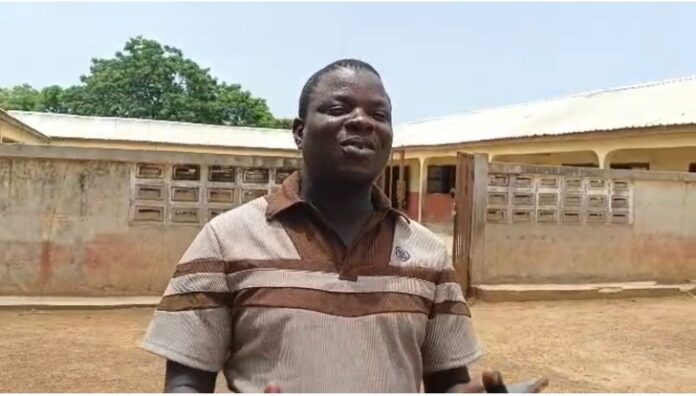

Samuel Donkor is a ‘one-man teacher’ handling 12 classes at at Kakpeni District Assembly School in the Northern Region.
Every morning, before the first bell rings, Samuel Donkor is already at the Kakpeni D/A Primary and Junior High School, preparing for a task many would consider impossible.
He arranges his lesson notes, checks his chalk supply, and braces himself for the day ahead — teaching 12 different classes, from Kindergarten to Junior High School (JHS), entirely on his own.
For more than three years, Samuel Donkor has remained the only government-trained teacher at the school with primary alone with the student population of 448 in the Kpandai District of the Northern Region.
Within the period, he has taken on the combined roles of classroom teacher and headteacher, shouldering the full responsibility of educating an entire school.
When Graphic Online’s Simon Unyan recently visited him, Samuel Donkor explained he handles the workload largely on his own, with only occasional support from two community volunteers whose availability is inconsistent due to low motivation and other personal commitments.
But the cost of this arrangement is becoming increasingly difficult.

A school stretched beyond limits
Each day, Samuel Donkor moves from one classroom to another, teaching core subjects including English Language, Mathematics, Science, and Ghanaian Language across all levels.
To cope, multiple classes have been merged. Kindergarten, Basic One, Basic Two, and Basic 3 share a single classroom. Basic Four and Five are also combined, while Basic Six learns alone despite differences in their syllabi.
The result, residents say, is a compromised learning environment and outcome where many pupils struggle to keep up.
“I do what I can, but I know it is not enough. These children deserve more,” Samuel Donkow told Graphic Online.
He explained that while he teaches one group, others are often left unattended or engage in fun games.
“By the time I reach the last class, the first class has forgotten what I taught them,” he said.
Whenever he leaves the community for official duties, teaching comes to a complete halt.

JHS without classroom
Beyond the teacher shortage, the school faces severe infrastructure challenges.
Some JHS pupils study under trees due to a lack of classrooms, leaving them exposed to harsh weather and frequent disruptions. Furniture and teaching materials are also in short supply.
For Samuel Donkow, the challenges extend beyond the classroom.
Travelling to Kpandai for official assignments requires crossing a river by canoe, often without life jackets, posing serious risks, particularly during the rainy season. He recalled an incident where a canoe he was onboard carrying passengers capsized, though fortunately no lives were lost.
“As we speak, most of my time is spent in the school and community, with little attention to my family and personal life,” he said.
Despite the difficulties, his commitment has earned him the nickname “One Man Contractor” among residents and colleagues.
Some Basic Two and Three pupils said they were missing out on essential lessons such as reading and numeracy due to the lack of teachers.
“There are more days without lessons than days we are taught,” one pupil said, particularly highlighting the situation at the JHS level where final-year students are preparing for the 2026 BECE.
Parents and residents share similar concerns.
“Our children are no less important. They also deserve quality education like children elsewhere,” said Abel Makiwi, a resident.
They warn that prolonged inactivity among pupils is contributing to rising cases of teenage pregnancy and early marriage in the community.
The residents are therefore appealing to the government, the Ministry of Education, and the Ghana Education Service (GES) to urgently post more teachers to the school. They also expressed readiness to accommodate any newly posted staff.
Additionally, they are calling for the inclusion of the school in the School Feeding Programme to improve enrolment and retention.
“Are we not also Ghanaians deserving of our share of national development?” Elisha Manyanbi asked.

Hope on the horizon
Despite the challenges, Samuel Donkor remains optimistic.
He believes the ongoing teacher recruitment exercise could ease the burden, especially if priority is given to underserved rural communities. He also commended efforts to decentralise teacher postings, noting that district directorates are better positioned to identify critical staffing gaps.
The Kpandai District Education Directorate has acknowledged the situation and confirmed that two additional teachers have been posted to the school and are expected to report soon.
Officials say broader recruitment efforts could significantly reduce disparities in teacher distribution across the district.
However, education watchers warn that unless such interventions are sustained, schools like Kakpeni will continue to struggle, deepening inequalities in access to quality education.

