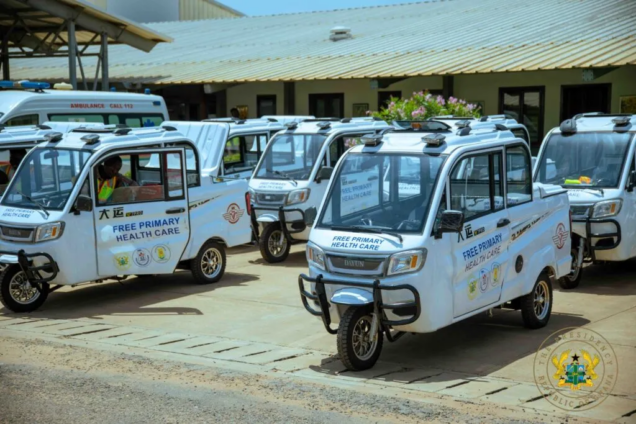

The Ghana Health Service (GHS) has clarified the circulation of viral videos on social media that wrongly depict tricycles procured under the government’s Free Primary Healthcare (FPHC) programme as ambulances.
In a statement issued on Saturday, April 18, the GHS dismissed the claims, stressing that the tricycles are not meant for emergency transport and have been widely misrepresented.
According to the Service, the tricycles form part of the rollout of the government’s flagship Free Primary Healthcare initiative, which seeks to strengthen the delivery of essential health services at the community level, especially in rural and hard-to-reach areas.
GHS explained that the introduction of the tricycles is a deliberate strategy to improve “last-mile” service delivery, enabling health workers to reach remote, peri-urban, and underserved communities where access to healthcare has long been a challenge.
The Service noted that the deployment of tricycles and motorbikes responds to the need for more practical and context-specific transport options for frontline workers, particularly Community Health Nurses (CHNs).
Highlighting their benefits, GHS stated that unlike motorbikes, the tricycles are equipped with cargo compartments, allowing for the safe and efficient transport of vaccines, cold-chain equipment, and other medical supplies.
This design, it said, enhances logistical capacity and enables health personnel to extend services to a larger number of people in remote locations.
Additionally, the Service pointed out that the tricycles offer improved safety and stability, especially on difficult terrains and during adverse weather conditions such as heavy rainfall or extreme heat.
GHS further indicated that the vehicles provide a more inclusive option for a wider range of health workers, including female Community Health Nurses, allowing them to perform their duties with greater comfort and security.
The Service has therefore urged the public to disregard the misleading claims and support efforts aimed at improving access to primary healthcare across the country.