
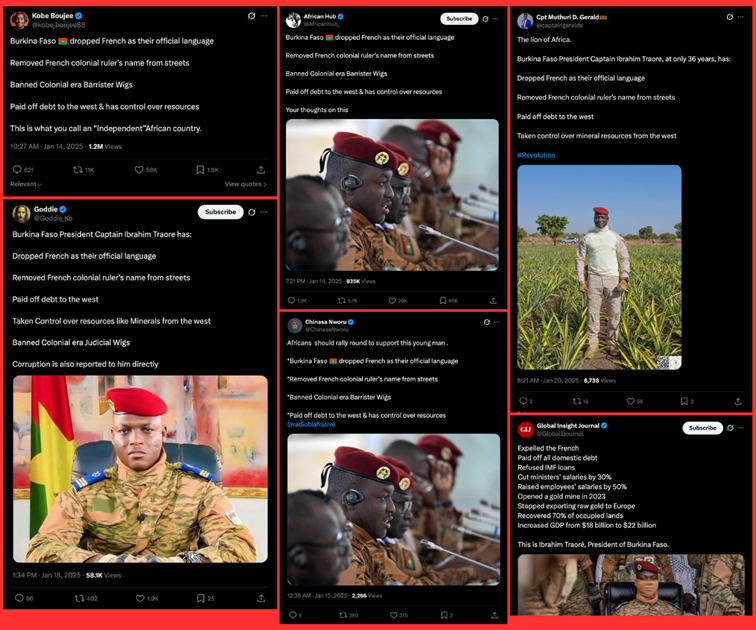
Since 2022, Burkinabe leaders have consistently claimed independence from foreign aid. Official data from their own ministries tells a very different story.
At the 2023 Russia-Africa summit, Ibrahim Traoré, President of Burkina Faso, challenged African leaders when he said, “Why do our heads of state travel the world begging?” About two years later, in September 2025, on the sidelines of the 80th United Nations General Assembly, his Prime Minister Jean Emmanuel Ouédraogo echoed similar sentiments when he said, “We didn’t come to the United States to beg. We’ve moved beyond the dynamic of holding out our hands.”
The country’s leaders have said at different times that it was shameful for African leaders to keep begging the international community for financial assistance, while frowning on foreign debt as one that undermines sovereignty. Yet, Burkina Faso under Traore is now more indebted and dependent on international aid than before the coup.
Burkina Faso experienced a military coup in January 2022, when Lieutenant Colonel Paul-Henri Sandaogo Damiba ousted President Roch Marc Christian Kaboré, citing the government’s failure to contain escalating insecurity and economic strain. A second coup followed in September 2022, bringing Captain Traoré to power. In the aftermath, the military junta pledged to restore security, stabilise the country, and lay the groundwork for economic recovery. It also promised to boost agricultural productivity, improve self-reliance, and create jobs.
However, data from Burkina Faso’s Directorate General of the Treasury and Public Accounting shows that total public debt has been steadily increasing since at least 2021, rising from 5.998 trillion to 8.311 trillion CFA francs as of the second quarter of 2025—a 38.56% increase in four and a half years. According to government projections included in the explanatory memorandum of the 2026 Finance Law, it is expected to reach 8.784 trillion CFA francs by the end of 2025, representing a further increase of 9.4% compared to 2024.
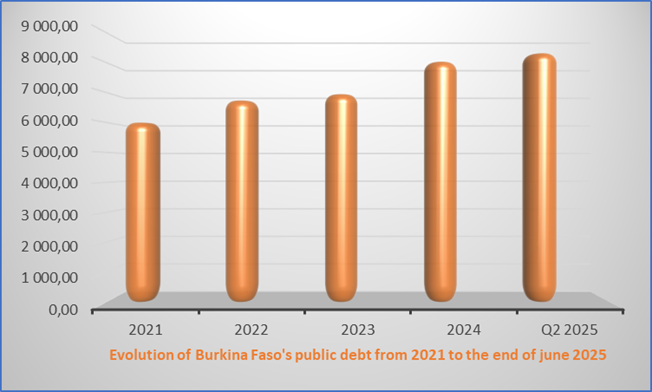
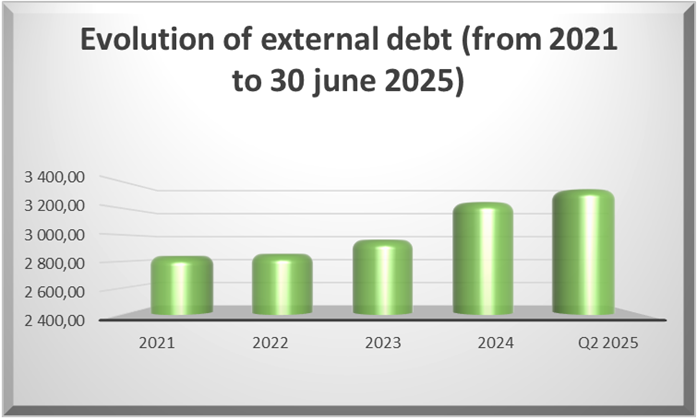
The external share of this debt, which is loans taken from foreign entities, represents 40.3% of the total, or 3.349 trillion FCFA, an increase of 506 billion FCFA since 2021.
Between 2023 and 2024, this external debt increased by 9%, driven mainly by multilateral debt, which now represents 89.4% of the total outstanding external debt.
Domestic debt, representing 59.7% of the total, comprises nearly 80% securities (treasury bills and bonds) issued on the West African Economic and Monetary Union (WAEMU) sub-regional financial market. It amounted to 4.962 trillion FCFA in the second quarter of 2025, compared to 3.155 trillion FCFA in 2021.
According to the debt bulletin data, the debt linked to the Central Bank of West African States (BCEAO) and the International Monetary Fund (IMF) is recorded as domestic debt. Its contributions amounted to 369.21 billion FCFA in the second quarter of 2025.
If international partners were to withdraw funding, “there will likely be shortfalls in wage payments, including those of civil servants,” said Beverly Ochieng, senior analyst at Control Risks, a specialist global risk consultancy. “Social services, particularly education and medicines, are likely to be restricted.”
Ochieng also said it could lead to the introduction of new taxes to cover the shortfalls resulting from any such withdrawal or reduction of foreign aid to Burkina Faso.
Major projects rely on development finance
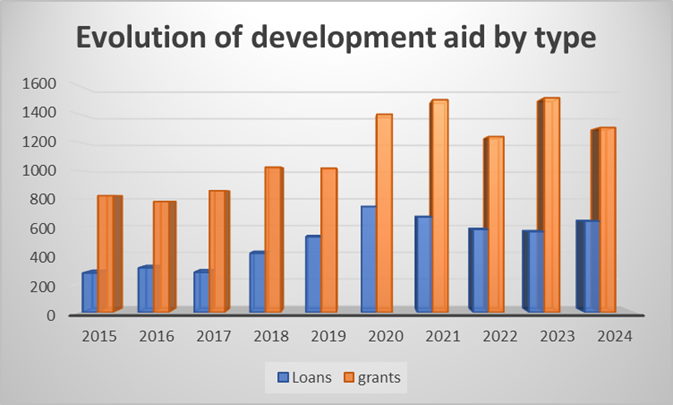
The Burkinabe government’s data also offers some insights into official development assistance (ODA) received between 2021 and 2024. While bilateral aid has declined, multilateral aid has increased.
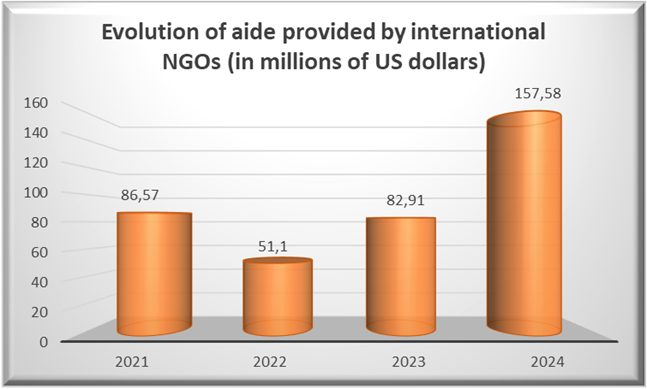
Bilateral aid fell from $699.65 million in 2021 to $269.21 million in 2024, a drop of 48.4%, attributed to the departure or suspension of disbursements by some partners, including France. However, this was offset by other sources. Multilateral aid reached its highest level since 2015, when it rose to $1.518 billion in 2024. Contributions from international NGOs have almost doubled, rising from $86.57 million to $157.58 million between 2021 and 2024.
The names of donors are familiar. The World Bank remains Burkina Faso’s largest multilateral contributor, with $632.85 million in 2024, up from $586.3 million in 2023. The United Nations comes in second with $543 million.
These institutions did not simply finance abstract budget lines. Four major projects launched between 2024 and 2026 illustrate the concrete nature of the cooperation in strategic sectors of the country. For the Water Security Project, 91.2 billion FCFA out of 92 billion is financed by the World Bank. There is also the Urban Mobility and Development Project (with 118.93 billion out of 124.8 billion externally funded), the ECOTEC Entrepreneurship Support Project (with 98.98 billion out of 106 billion externally funded), and an economic infrastructure rehabilitation project financed by the Islamic Development Bank. These four projects alone represent more than 440 billion FCFA, almost entirely financed by foreign partners.
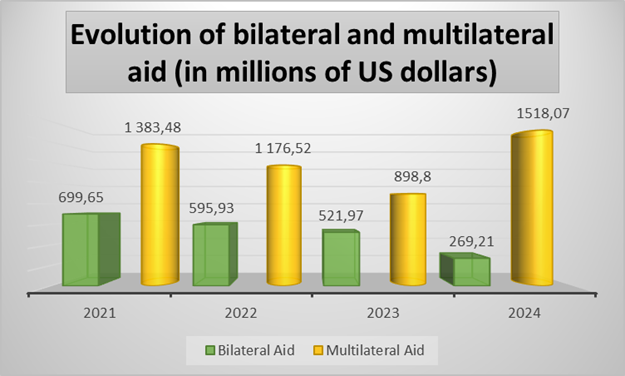
The total amount of published ODA is $1.94 billion for 2024, but it could be higher, as data relating to contributions from the Global Fund and the United States were not available when the document was provided.
The situation is compounded by increasing budgetary pressure as debt servicing reached 1.17 trillion FCFA in 2024.
Humanitarian needs hinge on foreign support
The spiral of insecurity that has plagued the country for many years has inevitably increased reliance on external partners to address the challenges. In 2025, according to the UN Resident Coordinator in Burkina Faso, 155 partners mobilised $271.3 million to assist 1.7 million people. For 2026, humanitarian needs are estimated at 735 billion CFA francs, nearly half (364.68 billion) of which is covered by external partners.
Furthermore, in February 2026, Burkina Faso and the United Nations concluded a partnership amounting to 850.2 billion FCFA, of which 645.7 billion was earmarked for agriculture and water.
Data compiled from official Burkinabe sources is clear: international financial flows to Burkina Faso have not stopped. But its leaders continue to trumpet a sovereignty rhetoric that mocks foreign financial assistance in Africa as a whole.
“The historical cooperation between Burkina Faso and other Western donors is the cornerstone of humanitarian aid,” said Ochieng. “And as long as current partners maintain pragmatic and non-confrontational relations with the military government, this active cooperation will remain in place.”
Internal fund mobilisation continues
Authorities in Burkina Faso continue to mobilise more local finance, even if current outcomes have been insufficient to meet the country’s financial obligations and its quest for sovereignty.
Extraction of resources such as gold has been ramped up. According to the Prime Minister in a speech to the National Assembly on January 30, 2026, the country produced a total of 94 tonnes of gold in 2025. In previous years, total production stood at 60.8 tonnes in 2024 and 57.3 tonnes in 2023. In 2021 and 2022, production was 67.1 tonnes and 58.2 tonnes, respectively, according to the Ministry of Mines.
Then there was the Patriotic Support Fund, financed by voluntary contributions, taxes on consumer goods, electronic communications, imported products, and mandatory deductions from salaries, the mining development fund, and other sources.
Between 2023 and the end of 2025, this fund mobilised nearly 500 billion FCFA, exceeding the initial target of 450 billion. “This means that we have internal capabilities that were not sufficiently exploited,” said Finance Minister Aboubacar Nacanabo in February 2026. But this fund is primarily intended for the support of the Volunteers for the Defense of the Homeland (VDP) and the acquisition of military equipment.
According to Ochieng, Burkina Faso is pursuing its goal of financial autonomy in various ways. “For example, in the mining sector, where the majority of operators are foreign, the country has adopted a policy that facilitates increased participation by local entities, and has allowed local banks to finance the expansion of mining activities,” she said.
For now, though, the country continues to rely on loans and support from international organisations to meet its obligations at home, even though this was not what the current military rulers promised when they said it was time to stop begging for help.
This article was produced with support from the African Academy for Open Source Investigations (AAOSI) and the African Digital Democracy Observatory (ADDO) as part of an initiative by Code for Africa (CfA). Visit https://disinfo.africa/ for more information.