

It is still early. The surroundings of Niamey’s Diori Hamani International Airport are bathed in the pale light of a West African dawn. Yet just a few days prior, this very stretch of tarmac was the scene of an armed attack that sent shockwaves through the capital’s population. On the night of 28 to 29 January 2026, a commando of more than thirty motorcycle-borne assailants, using drones and mortars, launched an assault on Air Base 101 located within the airport grounds. The attack was claimed by the Islamic State. Civilian aircraft were hit, a munitions stockpile caught fire, and four Nigerien soldiers were wounded. The operation reopened, with particular brutality, a wound some had believed was beginning to heal.
Despite the presence of Russian instructors since April 2024, is Niger truly safer than before?
Ever since the men of Africa Corps set foot on Nigerien soil, the junta led by General Abdourahamane Tiani has been lavish in its praise of this new alliance. In official statements, Moscow is now presented as the providential partner, the one stepping in where the West has failed, the one that would honour the country’s sovereignty without humiliating conditions. For example, following the airport attack, General Tiani praised the bravery of the Russian partners, who he said, alongside the Nigerien military, “routed the enemy in the space of twenty minutes”.
And yet, on the ground, armed groups continue to strike. And yet, the contracts remain classified. And yet, no one truly knows what these instructors are doing, or how many of them there are.
The turning point of summer 2023
Everything shifts in July 2023, when the National Council for the Safeguard of the Homeland overthrows Mohamed Bazoum. The coup does not merely trigger a political crisis, it sets off a sweeping diplomatic avalanche. French soldiers pack their bags and leave. The Americans, for their part, abandon their prized drone base in Agadez, where more than 1,000 American soldiers were deployed at the time of the coup. In March 2024, Niger denounces “with immediate effect” the military cooperation agreement with Washington, deeming it had been “unilaterally imposed”.
Within months, Niger finds itself alone, confronting its own demons: the Islamic State in the Greater Sahara pressing from the west, Boko Haram threatening from the southeast, and a state whose security foundations have just been shaken from within.
It is into this vacuum that Russia moves. On 10 April 2024, the first Africa Corps instructors land in Niamey aboard an Ilyushin-76, with military equipment on board. The outfit, partly heir to the Wagner Group’s methods and doctrine, arrives with a three-part pitch: train Nigerien soldiers, strengthen aerial defence, and improve intelligence capabilities. The programme sounds ambitious. The reality proves far more complicated.
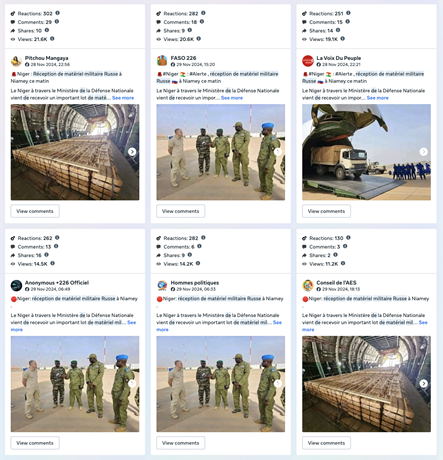
Screenshot of posts on Facebook celebrating the transfer of military equipment to Niger from Russia. The post was copypasted at least 50 times between November 28 and 29, 2024. ‘This important equipment strengthens the defense capabilities of the Republic of Niger and contributes to the consolidation of its sovereignty,’ the report said. Source: CfA through Meta Content Library.
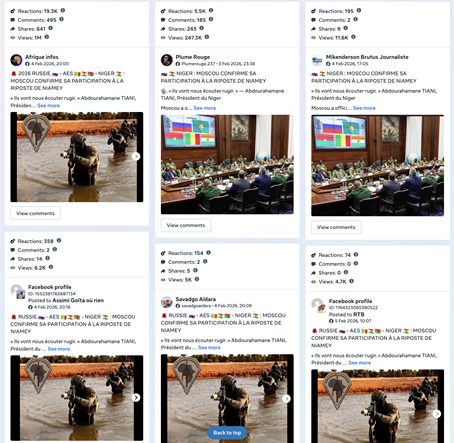
Screenshot of posts on Facebook made in February 2026, reporting the deployment of Russia’s Africa Corps officers alongside the Nigerien army to repel the terrorist attack on Niamey airport. The post was copypasted dozens of times. Source: CfA through Meta Content Library.
Training soldiers, but which ones?
At Niamey’s Air Base 101, training sessions have indeed taken place: drone operation, aerial surveillance, asymmetric warfare tactics, skills the Nigerien armed forces desperately need. Russian technicians are also said to have brought back into service equipment previously acquired but left idle for lack of maintenance.
But therein lies the problem. Of the 100 military instructors deployed in April 2024, military sources cite a gradual return of the majority to operational zones in Ukraine, leaving only around twenty men on the ground, according to the site ActuNiger, Above all, these training programmes remained concentrated in the capital. In the areas where danger is most immediate, the Tillaberi region, the remote stretches of Diffa, Nigerien soldiers still face the same ambushes, with no measurable shift in the dynamics on the ground. According to ACLED, some 1,500 civilians and soldiers died in jihadist attacks from the coup until August 2024, compared to 650 in the year preceding the coup. In 2024, Niger recorded the highest global increase in terrorism-related deaths, with 930 fatalities, a rise of 94%, according to the Global Terrorism Index 2025. Training a handful of battalions in Niamey is simply not enough to alter the face of a war being fought hundreds of kilometres away.
It is precisely this gap between official announcements and field realities that exasperates Moussa Mahamadou, a teacher based in Niamey who has been closely following the security situation for several years. “They talk to us about training, cooperation, and strategic partnership. But I want to see concrete results. Are the people of Tillaberi and Tahoua sleeping better at night? Can the farmers of Diffa go out and tend their fields without fear of being attacked? The answer is no. This cooperation, for now, is nothing but a smokescreen, a political façade that does absolutely nothing to change the daily reality of Nigeriens living under the threat of violence.”
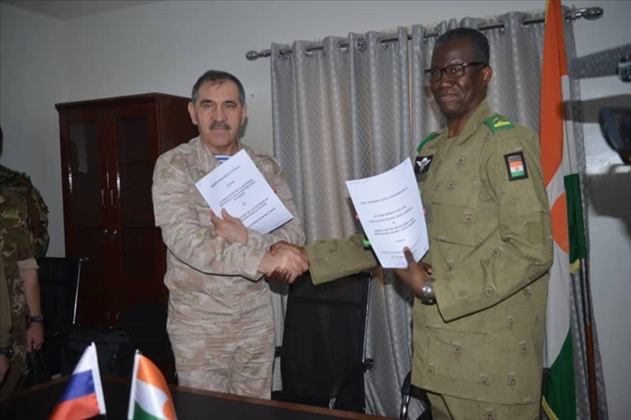
On Monday, December 4, 2023, the Russian delegation led by the Deputy Minister of Defence of the Russian Federation, Colonel General Lunaus-Bek Yevkurov, held fruitful discussions chaired by the Minister of State for National Defence, Lieutenant General Salifou Mody. Photo credit: A Niamey News
A shield for the capital, an illusion for the rest
On the matter of aerial defence, the Russians have delivered concrete results. In less than a month after the arrival of the first instructors, Russia chartered three cargo flights to deliver military equipment to Niamey, radar systems, an anti-aircraft defence platform, and surveillance equipment. The capital is better protected than it once was, according to official narratives.
But that shield stops at the city’s gates. In the border regions, populations have been living in fear for years. According to FEWS NET (October 2025), the Tillaberi region accounts for nearly 60% of the country’s total security incidents, where attacks by the Islamic State in the Sahel and JNIM are most intense and frequent in the far north-west. The Dosso region recorded a 195% increase in security incidents and nearly 600% more deaths in 2025 compared to the previous year. And even Niamey itself is not impregnable. The attack on the airport on 29 January 2026, claimed by the Islamic State, served as a painful and unambiguous reminder: two ASKY civilian aircraft damaged, a munitions stockpile in flames, and satellite imagery showing partially burned areas near the runway.
This geography of protection, everything for the capital, nothing for the periphery, has not gone unnoticed by Adamou Issoufou, an independent analyst specialising in governance and natural resources. In his view, the concentration of security assets around Niamey is no accident whatsoever. “Look at where this equipment is being deployed. Around the capital, around sensitive infrastructure, around strategic corridors. Not in the villages of Tillaberi. Not in Diffa. Why? Because the real objective is to protect the regime and secure access to the country’s mineral wealth. Niger sits atop uranium, oil, and gold.
The Russians did not come here out of idealism. They came to secure a seat at the table. And the junta, in return, gets the guarantee of remaining in power. Ordinary citizens, meanwhile, are nothing more than spectators to this arrangement.”
Intelligence: when promises meet the reality of the Sahel
The third pillar of the partnership, intelligence sharing, is perhaps the most revealing illustration of its underlying fragilities. The episode did not go unnoticed among specialists. In May 2025, the National Council for the Safeguard of the Homeland (CNSP) abruptly terminated technical intelligence cooperation agreements with Russia and Turkey. According to security sources cited by the Zagazola portal, the General Directorate of Documentation and External Security (DGDSE) assessed that “the equipment and operators deployed by both countries did not meet operational standards”, particularly in the domain of telephone interception. This decision forced Niamey to urgently turn to a Moroccan company specialising in communications interception.
The CNSP shocked its Russian partners by cutting short the intelligence cooperation, but promptly signed in 2025, with Mali and Burkina Faso, a regional agreement to use Roscosmos satellite services, Russian high technology for imagery and geolocation, but without Russian agents on the ground.
Alkassoum Tahirou, a merchant long established in Niamey, has a far more direct way of capturing what he feels. His words, delivered with a quiet and settled bitterness, carry the weight of popular wisdom. “Where we come from, we say that one hare has left and another has arrived. France left, Russia came. But both hares are utterly useless to us, the ordinary citizens. Neither one truly cares about our security, our peace, or our social cohesion. These are arrangements made between the powerful. The farmer from my village who can no longer go to market for fear of being attacked, nobody is interested in him. Not Paris, not Moscow, not even Niamey.”
The ghosts of the contract
What does all of this actually cost? No one truly knows. No contract has been made public. No official figures have been released regarding the cost of the equipment delivered or the remuneration of the instructors. And how many of them are there, for that matter? Between 60 and 100 men, according to diplomatic sources, up to 350 according to other estimates. The junta says nothing.
This silence carries a measurable economic cost. According to Africa Defense Forum, the junta has been forced to cut its budget by 40% since the coup, and has accumulated $519 million in arrears on its international debt. The World Bank estimates that Niger’s economic growth in 2024 was 45% lower than it was before the putsch. It is in this context of financial distress that the junta sought, according to analyst Liam Karr of the Institute for the Study of War, “to barter Niger’s natural resources for loans and weapons.”
The most tangible illustration of this opaque barter is the uranium affair. In 2024, the junta revoked the operating licences of Orano, the French company 90% controlled by the state, bringing to an end more than fifty years of nuclear cooperation. By late 2025, according to Le Monde and several French government sources, an agreement valued at an estimated $170 million was reportedly negotiated with Rosatom, the Russian nuclear giant, for the transfer of approximately 1,000 tonnes of uranium yellowcake stockpiled at the Arlit mine.
Niger is the world’s seventh-largest uranium producer. In December 2025, Niger officially signed a memorandum of understanding with Rosatom for the development of new mining sites. This is the probable quid pro quo for a security cooperation whose terms remain unknown.
This silence is far from inconsequential. Specialists in these kinds of security partnerships know all too well that agreements with outfits such as Africa Corps frequently contain deeply uncomfortable clauses, namely legal immunity for foreign personnel, access to natural resources, and discreet economic arrangements operating well below the public radar. In a country where Parliament has been suspended and replaced by a Consultative Council that neither legislates nor holds the executive to account, there is simply no one left to ask the questions that urgently need answering.
The battle of narratives
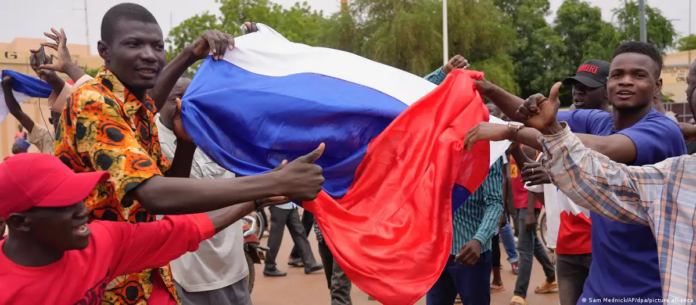
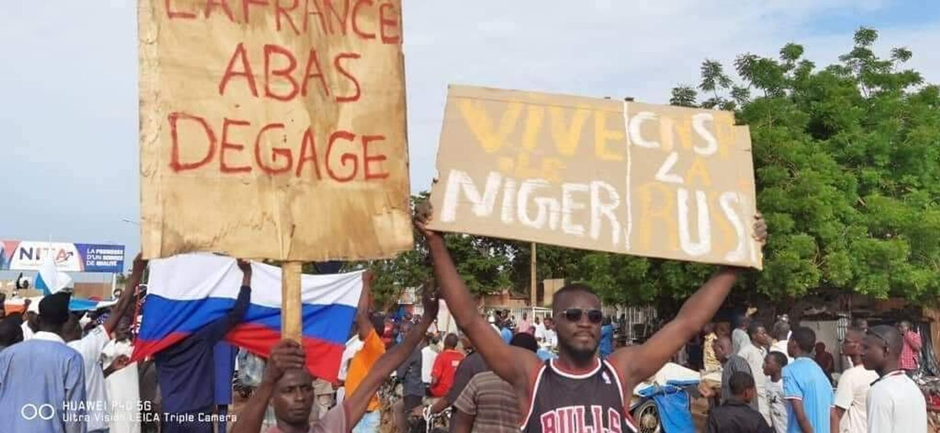
The Russian-Nigerien cooperation is also being fought in the realm of perception and public opinion. On social media, images of Russian cargo planes touching down in Niamey, or of demonstrators waving flags bearing the red star, are multiplying at a striking pace. Media outlets aligned with Moscow hail each equipment delivery as a historic milestone. The communication machine is well-oiled, effective, and omnipresent.
On the other side, international media outlets continue to highlight the grey areas, the ongoing attacks, and the questions that remain unanswered. The result is a public debate torn in two, where hard facts struggle to find their way through the noise of competing narratives.
It is against this polarised backdrop that a more measured voice deserves to be heard. Hama Danda, a retired civil servant and an attentive reader of the national press, firmly refuses to succumb to the prevailing pessimism.
Seated in the courtyard of his home, he chooses his words deliberately. “People are far too impatient. A security cooperation of this scale cannot be built in a single year, or even two. It takes time to train men properly, to master the equipment, for results to become visible on the ground. I listened carefully to the head of state when he spoke. In his major interview, General Tiani was unambiguous that this cooperation is mutually beneficial, conducted in full respect of Niger’s sovereignty and its political choices. These are not empty words. Our authorities do not lie to the people. We must trust them and allow time to do its work. The results will come.”
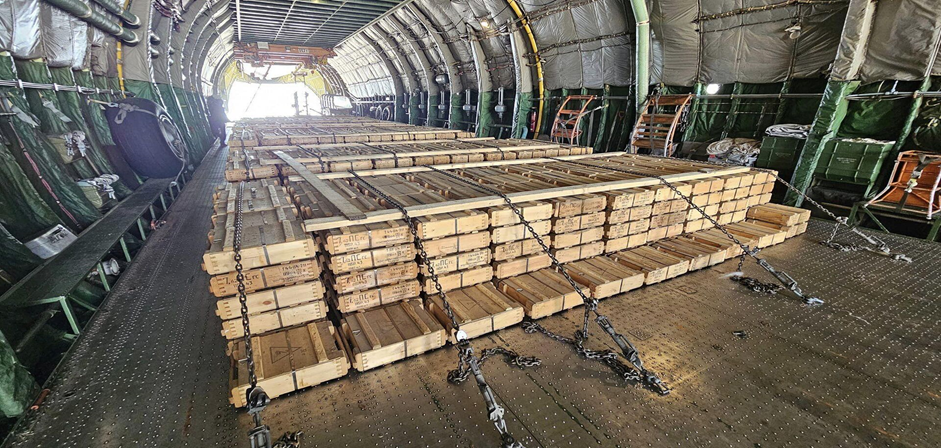
Photo credit: Nigerien Ministry of Defence
An alliance to stabilise the country, or to consolidate power?
Some analysts are raising a question that few dare voice openly: what if this cooperation were serving, first and foremost, domestic political interests? Strengthening the defence of Niamey and its strategic infrastructure also means tightening the regime’s grip on the country. In a context where the junta’s legitimacy remains contested on the international stage, securing control of the airspace above the capital is anything but a trivial detail.
Internal Russian government documents consulted by the BBC reveal that Moscow’s partnerships with African juntas rest on a well-tested model: the security of administrative centres and incumbent regimes, in exchange for mining concessions. This pattern, first tested in Sudan as early as 2017, where Wagner secured gold mining concessions in exchange for training the security forces of the Bashir regime – was then refined in the Central African Republic from 2018 onwards, with control over diamond mines granted in exchange for the personal protection of President Touadéra.
The model was subsequently systematised across the Sahel following successive coups. In Mali, the junta invited Wagner in 2021, culminating in 2023 in the signing of an agreement to build the country’s largest gold refinery. In Burkina Faso, Captain Traoré reportedly ceded a mine directly as payment for the deployment of Russian forces. Niger, sitting atop strategic reserves of uranium, oil, and gold, follows the same logic: the revocation of Orano’s licences and the negotiations initiated with Rosatom in 2025 do not represent a rupture, but rather the faithful reproduction of a model that Moscow has patiently refined from one end of the continent to the other.
An unanswered equation, a people left without certainty
The four voices gathered in the course of this investigation paint the portrait of a society divided in the face of an alliance it does not fully comprehend. Between the scepticism of Moussa Mahamadou, who is waiting for tangible proof on the ground; the distrust of Adamou Issoufou, convinced that the country’s natural resources lie at the very heart of the deal; the disillusionment of Alkassoum Tahirou, who sees in the great powers nothing but actors indifferent to ordinary suffering; and the measured patience of Hama Danda, who places his trust in time and in the authorities: the national sentiment is, at its core, profoundly divided.
Three years on from the coup, the fundamental questions remain entirely unanswered. Have the Russian instructors genuinely altered the balance of power against the armed groups? Or does their presence amount to little more than a geopolitical symbol, with limited operational impact on the ground? And at what price, human, financial, and institutional, has Niger purchased this new form of security?
The only available elements point to a mixed assessment: a capital better protected, yet exposed to the first jihadist attack in its history; forces trained in Niamey, but the countryside of Tillaberi and Diffa still drenched in blood; intelligence systems deemed ill-suited, rejected and replaced in haste; and contracts that have never been made public.
In this war of many faces, military, diplomatic, and informational, sweeping announcements rarely precede decisive victories. Niger has chosen its side. What remains to be seen is whether that choice will succeed in bringing peace back to the villages of Tillaberi, Tahoua, and Diffa, or whether it will merely shift the fault lines in a Sahel that shows no signs of settling.
Cet article a été réalisé avec le soutien de l’Académie africaine des enquêtes sur les sources ouvertes (AAOSI) et de l’Observatoire africain de la démocratie numérique (ADDO), dans le cadre d’une initiative de Code for Africa (CfA). Pour plus d’informations, consultez le site https://disinfo.africa/.
