
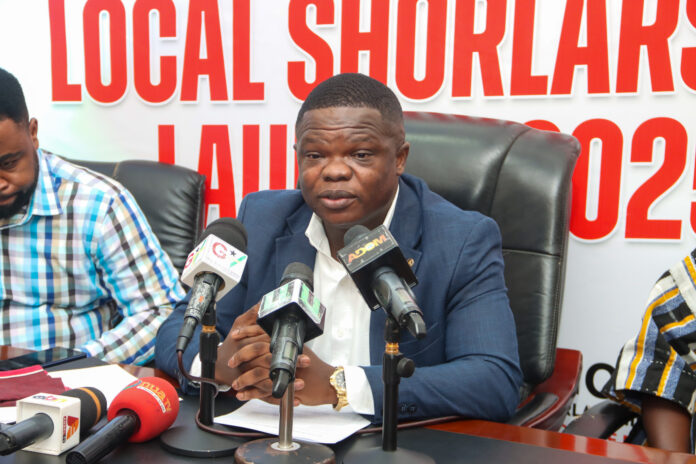

Ghana Scholarship Authority Director-General, Dr. Emmanuel Asafo-Agyei, has dismissed claims that some beneficiaries of Ghana’s scholarship scheme are Canadian citizens, describing the reports as inaccurate and politically motivated.
In a Facebook post on Thursday, March 12, 2026, Dr. Asafo-Agyei clarified that all individuals referenced are Ghanaians by birth and parentage, and fully meet the eligibility criteria of the programme.
“The claim that the beneficiaries in question are Canadian citizens is false. The individuals being referenced are Ghanaians by birth and parentage,” he stated.
Dr. Asafo-Agyei explained that Ghanaian citizenship remains the primary qualification for applicants, adding that the scholarship scheme is not limited to students categorized as “needy but brilliant.” The Authority operates a structured three-tier framework for awarding scholarships: financial need (“needy but brilliant”), national priority for programmes critical to Ghana’s development, and merit-based selection.
“It is therefore intellectually dishonest to create the impression that any beneficiary outside the ‘needy but brilliant’ category is undeserving,” he added.
Providing details on the 2026 scholarship cycle, Dr. Asafo-Agyei disclosed that 5,000 scholarships have been allocated, with 2,000 specifically reserved for the “needy but brilliant” category. The remaining scholarships will be awarded under the merit-based and national priority categories.
He emphasised that family background, social status, or political affiliation do not influence scholarship evaluations.
“The duty of the Authority is straightforward – to determine whether an applicant is Ghanaian and whether the applicant satisfies the established selection criteria. Once those criteria are met, the Authority has no legal or administrative basis to deny an applicant based on speculation,” he said.
Addressing claims that scholarships should only be awarded for programmes unavailable in Ghana, he noted that such arguments reference provisions in the Ghana Scholarship Authority Bill, which only became law in December 2025—after the scholarships in question were awarded.
Dr. Asafo-Agyei also rejected allegations that scholarships are sold or exchanged for money, describing the claims as irresponsible and unsupported by evidence.
“The Ghana Scholarship Authority operates a documented and structured application and evaluation system. Allegations of corruption must be supported by credible evidence and submitted to the appropriate investigative authorities rather than propagated through speculation,” he said.
Reaffirming his commitment to integrity, Dr. Asafo-Agyei stated that the Authority’s operations will continue to be guided by fairness, diligence, and professionalism under President John Dramani Mahama’s administration.
“The days when scholarships were awarded to the politically connected are far behind us,” he added.
He further disclosed that the Authority will soon publish remaining lists of scholarship beneficiaries from 2016 to 2024 to enhance transparency and public access to information on scholarship awards.
ALSO READ:
