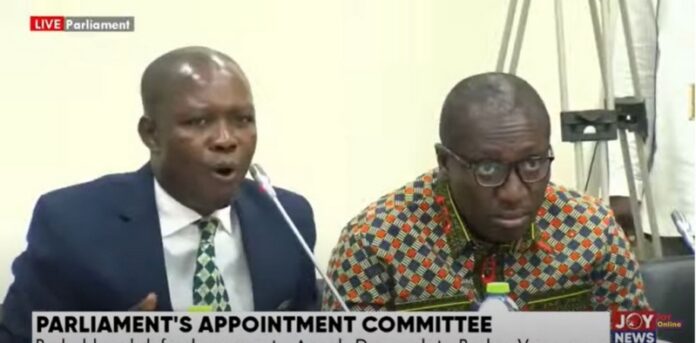

Chairman of Parliament’s Appointments Committee, Bernard Ahiafor, has rejected the Minority’s objection to the vetting of three Supreme Court nominees, describing the grounds raised as “flimsy”, “hollow” and “baseless”.
Minority Leader Alexander Afenyo-Markin had earlier called for the vetting to be postponed, arguing that there was no immediate vacancy on the Supreme Court that required the nominees to be considered urgently.
He also questioned the need to proceed with the vetting at this stage and demanded that the nominations be advertised for 14 days before the exercise.
The three nominees are Justice Sophia Bernasko-Essah and Justice Edward Amoako Asante, both Justices of the Court of Appeal, and private legal practitioner Anthony Forson Jr., a former President of the Ghana Bar Association.
However, Mr Ahiafor dismissed the Minority’s concerns, maintaining that the Appointments Committee could not overturn a decision already taken by the full House.
“Plenary has a right to vary the decision of the committee. However, if the House takes a decision, no committee can vary the decision of the House,” he said.
According to him, any member dissatisfied with a decision of Parliament must follow the procedures outlined in the Standing Orders to seek a reversal.
“If you are aggrieved by the decision of the House, the method available for you to reverse that decision is contained in our own Standing Orders,” Mr Ahiafor said.
He stressed that he would not use his position as chairman of the committee to alter a directive issued by the full House.
“I will not preside over this committee and purport to vary the orders or directions or decision taken at the plenary by the entire House,” he said.
“It is not done in any democracy, and I will not be the first to introduce it in Ghana’s democracy.”
Mr Ahiafor also dismissed calls for the committee to adopt a different approach to the Supreme Court nominees compared with other nominees appearing before Parliament.
He said doing so would amount to discrimination against the judicial nominees.
“I will not also preside over this particular committee and discriminate against the judges, allow the vetting of our colleagues and then reject the vetting of the judges’ nominee,” he said.
“I will not do that today. I won’t do that tomorrow.”
He subsequently dismissed the objection raised by the Minority Leader, describing it as lacking merit.
“I therefore consider all grounds of the Minority Leader as flimsy and hollow,” he said.
“I considered his objection to be frivolous, vexatious, unmeritorious, baseless on the facts, the rules and the law. Therefore, I will accordingly dismiss the objection by the Minority Leader.”
Mr Afenyo-Markin immediately challenged the chairman’s decision, arguing that the committee chair did not have the authority to unilaterally dismiss a preliminary objection brought before the committee.
He insisted that he was entitled to respond to the ruling and that the matter should be subjected to a vote for the committee to determine.
“It is the House that the committee must resolve. That is how we take decisions,” Mr Afenyo-Markin said.
He further maintained that the committee’s Standing Orders did not empower its chairman to independently determine and dismiss the objection.
“If we are talking law, let’s talk law. It is not within your right to say you have ruled,” he said.
Mr Afenyo-Markin also argued that even the Speaker relies on decisions of the House when dealing with contentious matters, rather than taking unilateral decisions.
Also read: