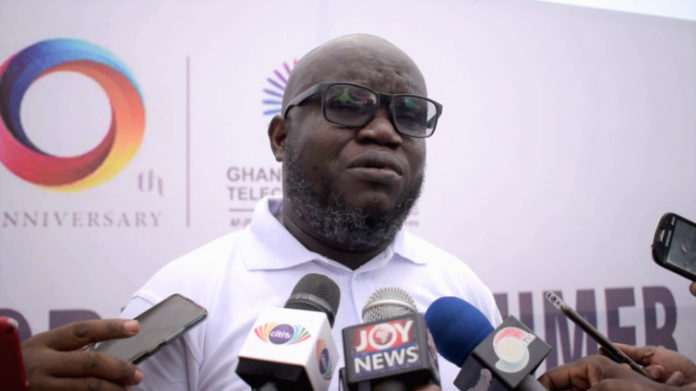

Convener of the Media Coalition Against Illegal Mining, Dr Kenneth Ashigbey, has said he would have preferred the Accra High Court to impose the maximum custodial sentence of 25 years on Ashanti Regional Chairman of the New Patriotic Party (NPP), Bernard Antwi-Boasiako, popularly known as Chairman Wontumi, insisting that those who finance and facilitate illegal mining deserve the harshest punishment available under the law.
Speaking on JoyNews on Monday, July 20, shortly after the Criminal Division of the Accra High Court sentenced Chairman Wontumi to 20 years’ imprisonment over illegal mining activities on the Samreboi concession in the Western Region, Dr Ashigbey welcomed the verdict as a major milestone in Ghana’s fight against galamsey but argued that the sentence should have been even more severe.
Justice Audrey Kocuvie-Tay, who presided over the case, sentenced Chairman Wontumi to two concurrent 20-year prison terms after finding him guilty on charges related to illegal mining.
The court also imposed a fine of 10,000 penalty units, equivalent to GH¢120,000, with a default custodial sentence should the fine remain unpaid.
Reacting to the judgment, Dr Ashigbey said the punishment, though significant, fell short of what he believed was necessary to deter influential financiers of illegal mining.
“I would have wished that the judge would have given the maximum sentence of 25 years, and also added the maximum fine,” he stated.
He explained that Ghana’s mining laws empower the courts to impose fines, custodial sentences or both, and argued that cases involving politically exposed persons who profit from illegal mining should attract the most severe sanctions because of the enormous damage caused to the country.
“The law talks about either the fine or the custodial sentence or both,” he noted, adding that judges should not hesitate to apply the toughest penalties where the evidence justifies such punishment.
Despite his call for a stiffer sentence, Dr Ashigbey described the conviction as a historic victory for Ghana and for organisations that have spent years campaigning against illegal mining.
“This is a good day for Ghana. This is a good day for the Media Coalition Against Galamsey and the Coalition Against Galamsey in Ghana, and for all who want to see the back of this existential threat that confronts all of us as citizens,” he declared.
He disclosed that the Samreboi prosecution originated from a petition submitted by the Media Coalition Against Illegal Mining to the then Attorney-General and the then Inspector-General of Police.
According to him, he personally joined private legal practitioner Martin Kpebu and two other campaigners in petitioning the authorities and had followed the case from its inception until judgment.
“This is one case that the coalition petitioned. The then Attorney-General, the then IGP and personally myself, Martin Kpebu and two others also petitioned. We’ve been following it all this while,” he said.
Dr Ashigbey praised the current Attorney-General for ensuring that the prosecution was pursued to its conclusion and commended Justice Audrey Kocuvie-Tay for what he described as demonstrating courage in delivering judgment in one of Ghana’s most closely watched illegal mining cases.
“I think we need to commend the Attorney-General for seeing this case through. We also need to commend the judge who sat on this case for demonstrating courage,” he remarked.
He also acknowledged the role played by the current Minister for Lands and Natural Resources, recalling that during the Easter holidays in 2025 the minister urgently convened a press conference after reviewing the coalition’s petition and conducting investigations into the allegations.
Dr Ashigbey further commended the former Minister for Lands and Natural Resources for publicly declaring that Akonta Mining Company Limited had engaged in illegal mining within the Tano Nimiri Forest Reserve.
He said the then Chief Executive Officer of the Minerals Commission, Martin Ayisi, subsequently confirmed the findings, but lamented that the Attorney-General and police prosecutors at the time did not proceed with criminal prosecution.
“We kept pushing. It just tells you that if the media continue pushing these issues, we can get somewhere,” he observed.
Although he welcomed the conviction of Chairman Wontumi, Dr Ashigbey stressed that the judgment should not mark the end of Ghana’s campaign against illegal mining.
He questioned the status of investigations involving other politically exposed persons allegedly implicated in galamsey and urged the authorities to pursue all outstanding cases without fear or favour.
“It is great that we are dealing with one campaigner, but what has happened to the other politically exposed persons who were named?” he asked.
He referred to previous allegations involving some Metropolitan, Municipal and District Chief Executives, traditional authorities and Members of Parliament, arguing that accountability must extend to every individual involved regardless of political affiliation or social standing.
“There are several politically exposed persons involved in galamsey. There are MMDCEs demonstrating either complicity or incompetence. There are chiefs who have publicly been accused of involvement. This is just the beginning.”
According to him, Ghana would only succeed in eradicating illegal mining if influential individuals who finance and facilitate the practice are prosecuted alongside those directly engaged in mining activities.
Dr Ashigbey defended his call for the maximum sentence by describing the consequences of illegal mining as comparable to crimes that directly result in loss of life.
“The reason why we need to be drastic in sentencing the big financiers involved in galamsey is that what they do is mass murder,” he asserted.
“If anybody had taken a gun and shot somebody, we would all be asking for the maximum sentence. These people are causing deaths through environmental destruction.”
He argued that illegal mining contributes to flooding, citing the recent flooding in Samreboi as an example of the environmental consequences associated with widespread degradation of forest reserves and river systems.
He also linked galamsey to serious public health concerns, including kidney disease, renal complications, birth deformities and stillbirths, which he said result from pollution of water bodies and environmental contamination.
Beyond its health implications, Dr Ashigbey warned that illegal mining continues to threaten Ghana’s economy by contaminating cocoa farms and other agricultural lands with heavy metals, thereby undermining the country’s agricultural exports and food security.
Describing financiers of illegal mining as ” economic saboteurs” and “nation wreckers”, he insisted that the courts must continue imposing severe penalties on offenders to deter others.
“These nation wreckers are to be punished,” he concluded.
READ ALSO:
Ghanaians react to Chairman Wontumi’s 20-year jail sentence
Wontumi Samreboi Case: Full charges under Minerals and Mining Act