
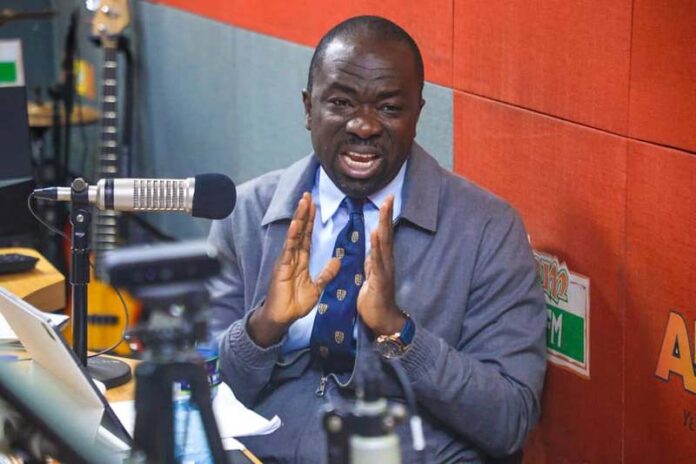

The Member of Parliament for Manhyia South and Vice Chairperson of Parliament’s Subsidiary Legislation Committee, Nana Agyei Baffour Awuah, has clarified that the decision by legal counsel in the ongoing criminal proceedings involving Ashanti Regional NPP Chairman Bernard Antwi-Boasiako, popularly known as Chairman Wontumi, to pursue plea negotiations should not be construed as an admission of guilt.
His comments come in the wake of formal plea bargaining proceedings initiated in connection with an alleged GH¢14.3 million loan fraud case involving the Ghana Export-Import Bank (Exim Bank), currently before the Accra High Court under Docket No. CR/0529/2026.
The development follows a letter dated June 5, 2026, in which Mr Wontumi’s counsel, Mr Andy Appiah-Kubi, requested the commencement of plea negotiations with the Attorney-General.
The Deputy Attorney-General, Dr Justice Srem-Sai, subsequently filed a Notification of Commencement of Plea Negotiation at the High Court on June 11, 2026, pursuant to Section 162C(3) of Act 30, which governs plea bargaining procedures in Ghana’s criminal justice system.
Speaking on JoyNews’ Newsfile, Mr Awuah said the criminal justice process necessarily involves strategic decision-making by both prosecution and defence teams, particularly when considering whether to proceed to full trial or explore negotiated resolution.“We need to appreciate this: when you are a prosecutor, you have choices to make. And when you are a defence counsel, you also have choices to make,” he said.
He suggested that the defence team may have assessed the broader legal landscape, including the number of ongoing cases facing their client, and concluded that plea negotiations offered a practical avenue worth exploring.
“I can imagine that the defence team of Chairman Wontumi, taking cognisance of the enormity of cases that they are having to deal with, decided that let’s take advantage of this option,” he stated.
Mr Awuah further noted that where the underlying transaction involves a loan, its legal character must be properly understood within the context of repayment obligations rather than criminal intent.
“After all, it is a loan. A loan is meant to be paid. And so if anybody is raising issues in the manner in which the loan was procured and you are eventually going to pay it, and there is the option to pursue plea bargain, why don’t you explore it?” he said.
The Manhyia South MP stressed that Ghana’s plea bargaining framework explicitly preserves the presumption of innocence and does not equate participation in negotiations with guilt.
He explained that under Ghana’s criminal procedure framework, including provisions within Act 30 and its amendments, accused persons retain full constitutional protections throughout the process.
“That doesn’t mean there is guilt,” Mr Awuah said. “Because even if you look at plea bargain law, it stipulates that in the process the prosecutor would make it known to you the fact that you are not guilty, particularly when you have not pleaded guilty, and the fact that you have the right to a fair trial.”
He emphasised that defendants remain entitled to proceed to full trial should negotiations fail, reinforcing that plea bargaining is a voluntary legal mechanism rather than a presumption of culpability.
“We need to emphasise within context that the decision to do plea bargaining is not an admission of guilt,” he added.
Mr Awuah also framed plea bargaining as part of broader case management strategy, particularly where an accused person is facing multiple legal proceedings simultaneously.
He said legal counsel must weigh the efficiency and practicality of resolving certain matters while focusing attention on other ongoing cases.
“The decision will be based on choices that you as a lawyer and your client may want to make given the circumstances,” he explained.
He continued: “And if you are in the shoes of Chairman Wontumi, when you are already dealing with three prosecutions and you know that yes, there is no dispute that I took a loan, a loan is a loan, a loan is not the stealing of money, and you know that you will eventually pay it, and there is the option of entering into an agreement whereby you return the money, I would always advise my client, given the circumstance, that look, this is a low-hanging fruit. Let’s take advantage of it and then let’s move to deal with the three other ones pending in court.”
Source: Myjoyonline.com
