

For the past few days, my curiosity in the media, both traditional and social, has been one of the most shocking things to me. I have therefore taken maximum pain to ask myself questions that I have yet to find answers to.
I have been trying to find answers to why, na after sixty solid good years, we are still struggling to make ends meet.
I have read several articles and newsletters about how successive governments have made several policies to put this country on the track of excellent economic growth, yet we still struggle to create jobs for the ever-increasing youth who complete schools every year and troop onto our streets.
We always have challenges with energy, water, education, health, and I imagine how we have failed in using agriculture to our advantage, then I weep for Mother Ghana.
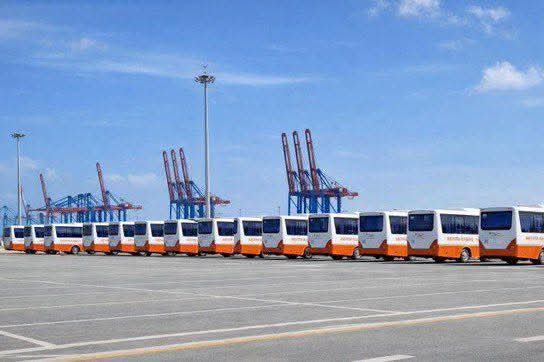
Switching back to what prompted me to write this piece was that, earlier last week, I heard the Ministry of Transport took delivery of a fleet of a hundred new buses aimed at reducing ongoing road transport difficulties across the country.
This struck me to read more about the buses. Upon my further reading, I got to know that the buses were assembled in Egypt. And even the Government of Ghana is in anticipation of receiving two hundred more buses to augment what has arrived.
Frankly, I found this strange and was very dismayed about the procurement of ONLY three hundred buses imported from Egypt, and everyone is happy about it, including government officials.
Ghana, at 69 years, we import assembled buses from Egypt. In 1974, the Ghana Government signed a joint venture with Neoplan Ghana Limited from Germany, which set up an assembly plant in Kumasi, making Kumasi West Africa’s first bus manufacturing plant. Neoplan Ghana Limited was a key bus manufacturing hub in Kumasi, with service facilities in Accra, producing specialised buses for African conditions.
The joint venture sought to ensure that the Ghanaian government had 55% stake in the company, and the German investors owned 45%.
The company was renowned for producing robust “Tropic” buses and was supplying buses to other West African countries. It is on record that the company, throughout its operations, manufactured over 4000 buses to the sub-region, with Nigeria taking the highest procurement.
It is also worthy to take note that Circle Neoplan Station had its name from the luxurious and robust buses that started plying from there to Kumasi.
I remember very well that in the nineties, Neoplan Ghana Limited manufactured more than five hundred buses for GPRTU, which were nicknamed Awudu Issaka. They were named after Ghanaian football legend Awudu Issaka, who was part of the Ghana U-17 Squad that won the World Cup in Ecuador in 1995.
The buses were launched in the very year the Starlets won the world honour, and most of the buses had the colours of Ghana. So, I believed that made Ghanaians nickname the buses as such.
The public patronage of the buses was very high, and it made the GPRTU a much stronger private transport operator from then.
Besides that, the Government of Ghana, through the ministries of Education, Health, Agriculture, and Finance, procured these Neoplan buses for some second-cycle, tertiary institutions, departments and agencies.
Some second-cycle institutions, such as Legon Presec, Suhum Secondary Technical School, Adisadel College, Prempeh College, Accra High School, Accra Academy, University of Ghana Medical School and many others were allocated some of these buses. I strongly believe some schools continue to use theirs.
But, interestingly, the same Ghana Government that had 55% stake in the company was frequently procuring buses from Germany and the Netherlands for the State Transport Company. Buses such as Setra Kassbohrer and Daf were procured in, whilst Neoplan Ghana was still in operation.
Now, the argument is that a company that has the Ghana Government as a majority shareholder, providing direct employment to over 1000 youth and more than 10,000 indirect jobs, the government watched it collapse just like that.
We lost the opportunity to be the first African Country to assemble buses here in Ghana and supplied to the sub-region.
It is also on record that Neoplan Ghana has supplied over 450 buses to Metro Mass Transit since the transport operator was established in 2002.
Even though the company faced stiff competition from giant international bus manufacturers like Hyundai, KIA, Marcopolo and several others, the Ghana Government should under no circumstances watch this company collapse.
Because it would have helped solve our ever-escalating youth unemployment, it would have supported our foreign exchange policy by stabilising the Cedi against major currencies.
My prayer is that we may identify what we need as a country, work towards it to achieve maximum satisfaction for our people.
The story was written by Baffuor Owiredu-Amoh, Senior Journalist/Presenter at Multimedia Group Limited.
READ ALSO:
Immigration Service rescues over 300 in crackdown on street begging networks in Accra
Tano North MCE cuts sod for police station at Susuanso to boost security
