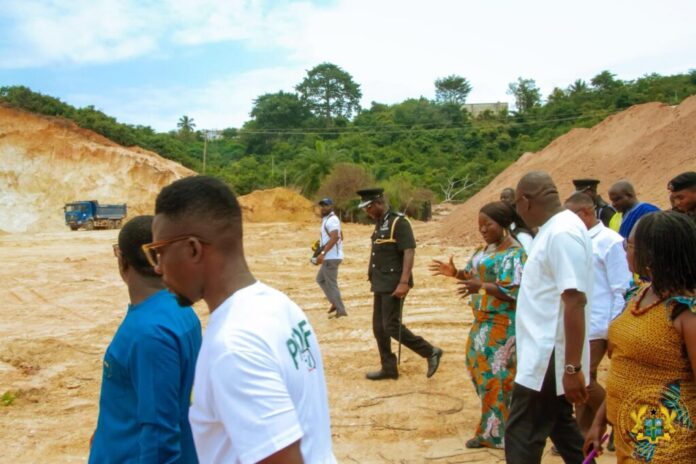

The government’s efforts to expand Ghana’s garment and textile manufacturing sector have received a boost following an inspection of a proposed site for a new garment factory in Cape Coast in the Central Region.
The Minister for Trade, Agribusiness and Industry, Elizabeth Ofosu-Adjare, accompanied by the Chief Director and other officials of the Ministry, visited the proposed site following President John Dramani Mahama’s commitment to establish garment factories in the Central, Eastern and Bono Regions.
The planned facility forms part of the government’s broader industrialisation and job-creation agenda, with the garment and textile industry identified as a key sector for increasing local production and creating employment, particularly for the youth.
During the inspection on Monday, August 31, 2026, Madam Ofosu-Adjare expressed satisfaction with the location, citing its accessibility and proximity to major road networks as factors that would make commuting easier for workers.
She said local chiefs and residents had made land available for the project and had already begun preparatory activities, including excavation.
According to the Minister, the site could be ready within one to two months, depending on the pace of the ongoing preparatory works.
Madam Ofosu-Adjare also welcomed the community’s enthusiasm for the project, saying the factory would create jobs for residents and stimulate economic activity in the region.
“Garment factories create jobs,” she said, citing the recently commissioned Northshore Apparel Hub in Savelugu as an example of the employment and industrial opportunities that could be generated through investment in the sector.
The Northshore facility, commissioned on August 28, 2026, is projected to create about 3,000 jobs in its first phase, with employment expected to rise to 10,000 when fully operational.
The facility is also expected to contribute to Ghana’s export drive, with preparations underway for international shipments.
The Savelugu project is further being presented as an example of how the government’s 24-Hour Economy initiative could drive production and employment through multiple shifts.
The Minister said the government was therefore seeking to replicate similar industrial opportunities in other parts of the country.
She noted, however, that government-backed projects must pass through several stages, including feasibility assessments, procurement and other technical processes, before construction can begin.
“Anytime you are doing a government project, you go through a process,” she said, assuring residents that the required procedures were being followed to advance the project.
Madam Ofosu-Adjare disclosed that transaction advisors had also been engaged for the various proposed garment projects and would support the process towards implementation.
She assured the chiefs and people of Cape Coast that they would be updated once the necessary processes were completed and a firm construction timeline had been established.
Also read: