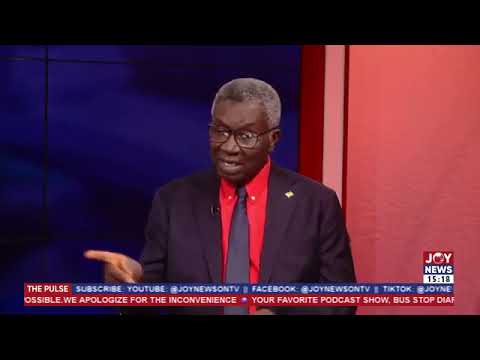

Former Minister for Environment, Science, Technology and Innovation, Professor Kwabena Frimpong-Boateng, has called for the creation of a statutory Environmental Restoration Fund dedicated solely to reclaiming mining-degraded lands and restoring polluted water bodies.
He wants a fixed portion of Ghana’s mineral royalties channelled into the fund and protected from the pressures of the annual national budget.
Prof. Frimpong-Boateng said the fund should operate under independent management, with strict oversight and full disclosure of how the money is spent.
“A defined share of mineral royalties [should go] into a statutory Environmental Restoration Fund, independently governed, spent on river remediation and land reclamation, with site-level accounts published annually,” he proposed.
He explained that keeping the fund outside the regular budget framework would prevent restoration resources from being diverted to other government priorities during periods of financial difficulty.
“Outside the budget cycle, because anything inside it will be raided in the second year of a hard fiscal programme. It always is,” he added.
Prof. Frimpong-Boateng made the proposal while delivering the keynote address at the Fourth Annual Colloquium organised by the Department of Political Science Education at the University of Education, Winneba, on Wednesday, September 2, 2026 on the theme, “Politics, the Environment, and Our Future: Ghana at Crossroads?”
The former minister said Ghana faces an estimated $21 billion bill to restore degraded lands across the country.
According to him, about 10% of Ghana’s land surface, representing approximately 23,853 square kilometres, has already been degraded.
He noted that restoring the Ankobra River alone could cost about $400 million, with additional resources required to rehabilitate other polluted water bodies, including the Pra, Offin, Birim, Anum and Oda rivers, as well as the Black, White and Red Volta rivers.
Prof. Frimpong-Boateng argued that the magnitude of the environmental damage demands a reliable and ring-fenced source of funding, rather than depending on allocations that could be altered or withdrawn by successive governments.
He further proposed that the Environmental Restoration Fund publish annual accounts showing how much has been spent on restoration at each project site.
Beyond dedicated funding, Prof. Frimpong-Boateng called for an annual State of the Environment audit to be submitted to Parliament alongside the national budget.
He said the audit should provide independently verified data on the quality of water in Ghana’s river basins, forest cover, degraded and reclaimed lands, waste management and the extent of wetland loss.
“What is not measured publicly is not governed,” he said.
Prof. Frimpong-Boateng maintained that protecting restoration funds and making their use transparent would ensure that a portion of the wealth generated from Ghana’s mineral resources is channelled back into repairing the environmental damage caused by mining.
Also read: