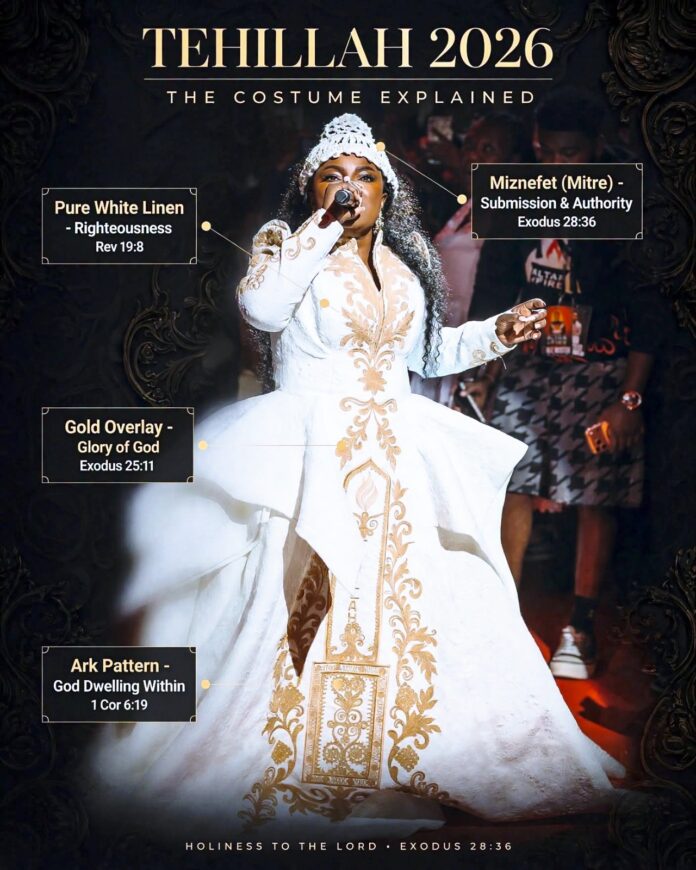

Gospel musician Ohemaa Mercy has offered a biblical explanation of the ceremonial outfit she wore during the 13th edition of the Tehillah Experience, held at The Oil Dome of Royalhouse Chapel.
The event, which was themed “The Altar of Fire,” generated conversations about various aspects of the night, particularly the elaborate costume worn by Ohemaa Mercy as she made her entrance to lead worshippers.
In a Facebook post, the gospel musician described her appearance as more than a stage entrance, saying she made an “altar entry” and that her attire was designed to communicate a spiritual message.
“At this year’s Tehillah Experience, Ohemaa Mercy did not simply mount the stage she made an altar entry. Long before she lifted the microphone, her attire had already delivered a sermon,” she said.
She explained that each element of the costume was carefully chosen to reflect biblical themes of priesthood, sacrifice, consecration and divine presence.
The cap – the priestly mitre
According to Ohemaa Mercy, the most distinct feature of her outfit was the cap, which mirrors the Mitre (Miznefet) worn by the High Priest.
She referenced Exodus 28:36-38, which speaks of a plate of pure gold engraved with the words:
“You shall make a plate of pure gold and engrave on it, like the engraving of a signet: HOLINESS TO THE LORD.”
The symbolism, she explained, was intended to represent priesthood and holiness rather than fashion.
“This was not a fashion statement. It was priesthood.”
Ohemaa Mercy also cited Leviticus 6:13, which states:
“The fire shall ever be burning upon the altar; it shall never go out.”
She said the mitre represented her spiritual office for the night, portraying her not simply as an artiste performing on stage but as a priestess tending the altar and consecrated for holy service.
She added that the cap also symbolised covering and submission to divine authority, referencing 1 Corinthians 11:5.
The Cross
Ohemaa Mercy also explained the significance of the cross that was carried ahead of her during the entrance and covered with white linen.
“The Cross carried ahead with white linen is the heart of our faith.”
She said the cross represented Christ going ahead of believers, while the white linen symbolised His righteousness and resurrection.
“We do not approach the altar by our own strength, but by the finished work of Calvary.”
She referenced John 19:17, which recounts how Jesus carried His cross to the place of His crucifixion.
The cross was also linked to the believer’s death to self, drawing from Galatians 2:20:
“I am crucified with Christ.”
Ohemaa Mercy further cited Colossians 1:20, which speaks of God making peace through the blood of Christ’s cross.
She explained that the positioning of the cross ahead of her was deliberate.
“So the cross had to go first that night to make peace, so that God’s presence could enter the room.”
The garment – fire and royal priesthood
The final major element of the costume was her flowing robe, which featured shades of white, gold and crimson.
Ohemaa Mercy said the garment was designed to reflect themes associated with fire and royal priesthood, complementing the symbolism of the mitre and the cross.
The white, gold and crimson hues formed part of the visual representation of holiness, glory, sacrifice and the fire of God, in keeping with the overall theme of the night.
Through the outfit, Ohemaa Mercy sought to communicate that her entrance at Tehillah Experience 2026 was not merely a ceremonial or artistic presentation.
Rather, she described it as a visual sermon intended to direct worshippers’ attention to God, the cross, holiness, sacrifice and the altar of fire.