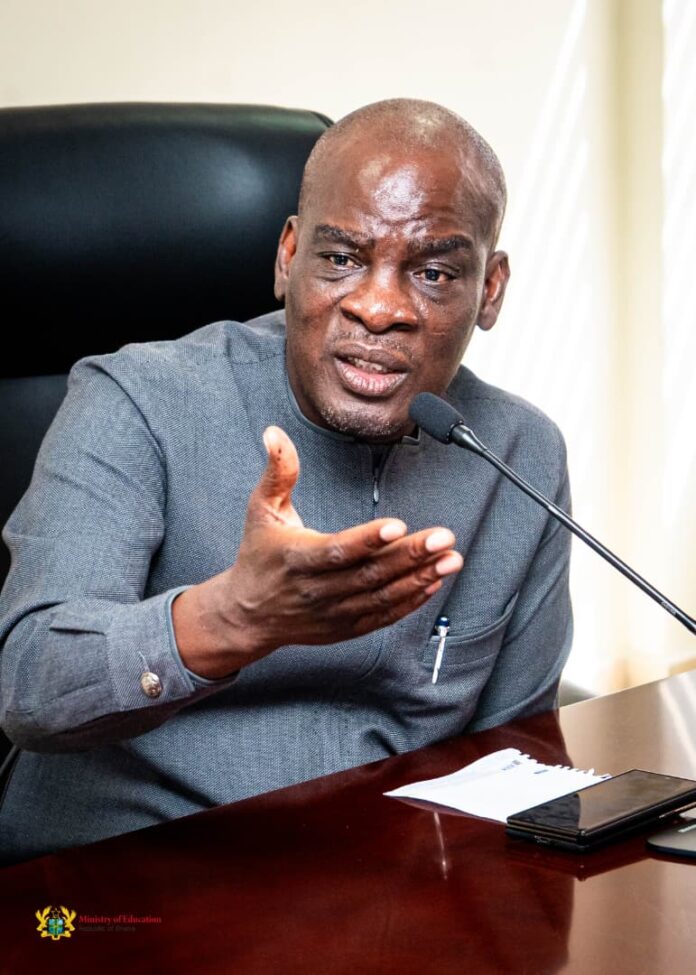

The New Patriotic Party (NPP) has called on President John Dramani Mahama to either apologise to Ghanaians or dismiss Education Minister Haruna Iddrisu over the controversy surrounding the introduction of Arabic and Chinese into Ghana’s school curriculum.
In a statement issued by the party’s Education Sector Policy Committee, the NPP said the President’s recent denial that his government had approved any new policy to introduce Arabic and Chinese into Ghanaian schools had created a serious contradiction within the government.
The committee said the President had two options depending on whether the Education Minister acted with or without presidential and Cabinet approval.
“If the Minister announced and pursued this policy without presidential and Cabinet approval, the President must sack him. If, however, the Minister acted with the authority or knowledge of the President or Cabinet, then the President must apologise to the Ghanaian people for denying a policy his Government had already set in motion,” the statement said.
According to the NPP, Mr Iddrisu announced on April 24, 2026, that Chinese and Arabic would become compulsory foreign languages at the secondary school level, attributing the policy to President Mahama’s vision for education.
The party said the announcement was subsequently followed by steps taken by the National Council for Curriculum and Assessment (NaCCA) to develop the relevant curriculum.
It said about 160 writers and reviewers were engaged over several months to work on the revised curriculum, which included Arabic and Chinese among foreign-language options.
The NPP further stated that the revised curriculum was presented to the Education Minister on July 22, 2026.
According to the committee, rather than rejecting the document, the Minister referred it to the Ghana Education Service (GES) and directed the service to bring it to “full implementation readiness” and prepare for its execution in schools.
The party said subsequent government clarification that Arabic and Chinese would be optional at the basic school level did not adequately address the Minister’s earlier announcement that the languages would be compulsory at the secondary school level.
It also cited a September 3, 2026, training programme organised by NaCCA, with support from the Confucius Institute at the University of Cape Coast, to train teachers to implement the new Chinese language curriculum.
The NPP argued that these actions gave the impression that the policy had received official government backing.
“When the Minister responsible for education publicly attributes a policy direction to the President and advances it through the institutions under his authority, the reasonable conclusion is that he is acting with the authority of Government,” the statement said.
The party therefore questioned the President’s subsequent assertion that there was “absolutely no new policy”, arguing that the position raised concerns about policy coordination and decision-making within the Executive.
NPP questions public expenditure
The Education Sector Policy Committee also raised concerns about public funds allegedly committed to the curriculum development and implementation process.
It questioned why writers, reviewers, technical personnel and other resources were deployed if there was no approved policy to introduce the languages.
“If there was ‘absolutely no new policy’, why were public resources committed to developing the curricula, preparing the system for implementation and training teachers?” the statement questioned.
The party also pointed to the President’s concern about the availability of Chinese language teachers, particularly at a time when Ghana already faces shortages of French teachers.
It questioned why implementation preparations and teacher training had advanced if teacher availability remained unresolved.
The NPP, however, stressed that Arabic and Chinese should not be treated as identical cases.
It noted that Arabic was already offered as an optional subject at the junior high school level before the current government assumed office, while Chinese was part of what it described as a new 2026 process involving curriculum development, ministerial review, implementation preparation and teacher training.
The party said the controversy raises broader questions about ministerial authority and government accountability.
“If the Minister acted without authority, he must be relieved of his position. If he acted with the authority or knowledge of the President or Cabinet, the President must apologise to the nation and provide a full account of the policy, the expenditure incurred and why the public was told otherwise,” the statement said.
The NPP maintained that parents, teachers, school administrators and taxpayers deserve clear and consistent communication from government.
It concluded by insisting that the matter should not simply be declared settled, and repeated its call for the President to either apologise to the nation or sack the Education Minister.