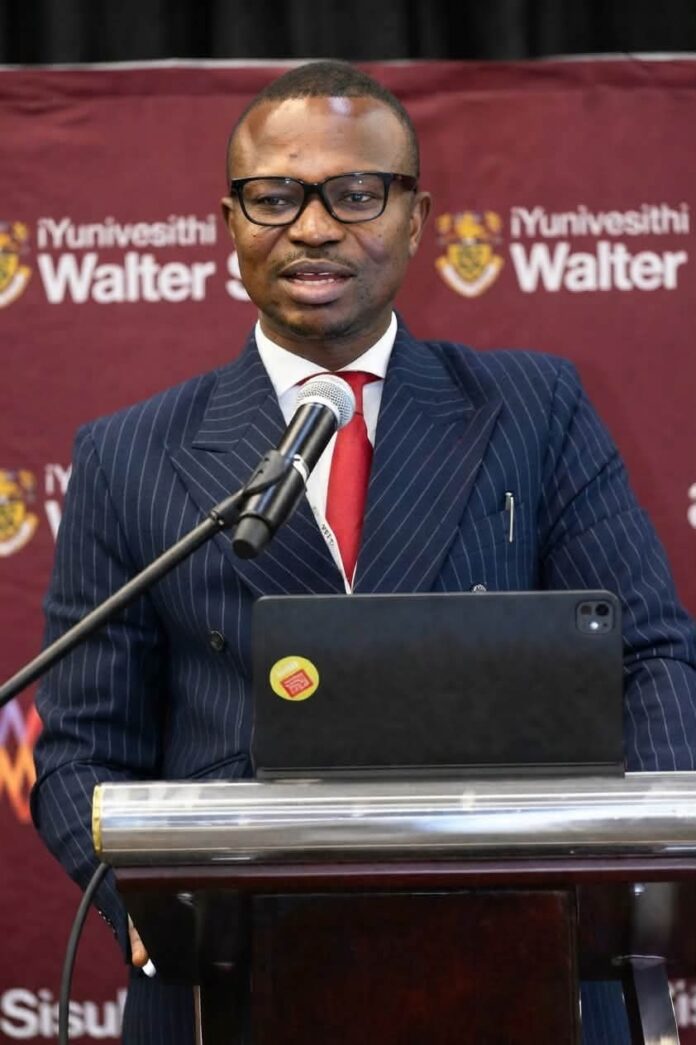

The National Entrepreneurship and Innovation Programme (NEIP) is set to transition into a dedicated Ghana Startup Agency as part of efforts by the government to strengthen the country’s entrepreneurship and innovation ecosystem.
Chief Executive Officer of NEIP, Eric Adjei, Esq., disclosed this on Thursday, October 1, 2026, when he addressed the International Conference on Business Innovation and Incubation in South Africa.
According to him, the transition will transform NEIP from a government special-purpose vehicle responsible for implementing flagship entrepreneurship programmes into an institution with dedicated funding and legislative backing to develop and implement tailored interventions for startups and innovative businesses.
Mr. Adjei said the move was not simply a change in the name of an institution but represented a broader commitment to redefining Ghana’s entrepreneurship and innovation ecosystem.
He explained that the proposed Ghana Startup Agency would help strengthen the national startup pipeline, improve coordination among ecosystem actors, enhance investment readiness, promote the commercialisation of research and strengthen links between startups, venture capital firms and private investors.
Adwumawura supports 10,887 entrepreneurs
The NEIP CEO also highlighted the progress of the government’s flagship Adwumawura Programme, which is designed to support at least 10,000 young entrepreneurs annually through entrepreneurship training, mentorship, technical assistance, funding, market access and business advisory services.
He disclosed that the first cohort of the programme had already supported 10,887 young entrepreneurs with capacity building, business advisory services and mentorship.
Out of that number, 3,625 beneficiaries received grants through what Mr. Adjei described as a transparent and competitive process managed by an independent Grant Management Committee.
The committee, he said, comprises academics, seasoned entrepreneurs, representatives of financial institutions, the Ministry of Finance, the Ministry of Youth Development and Empowerment and other government agencies.
NEIP establishes financing mechanism with VCTF
Mr. Adjei further disclosed that NEIP, in partnership with the Venture Capital Trust Fund (VCTF), had established a fund to provide debt and equity financing to high-impact businesses.
He said the initiative was intended to give promising businesses access to patient and growth capital to enable them to expand, create jobs and scale their impact.
He stressed that entrepreneurship support should go beyond the provision of grants, arguing that entrepreneurs require an integrated ecosystem that combines training, incubation, mentorship, technology, financing, market access and strategic partnerships.
«“An entrepreneur does not need money alone; an entrepreneur needs a robust, coordinated and integrated ecosystem to build a sustainable business,” he said.»
5,000 students to benefit from SEED programme
The NEIP CEO also announced plans under the Students Entrepreneurship and Enterprise Development Programme (SEED) to train 5,000 students annually, beginning with a pilot involving 36 tertiary institutions.
The programme is being implemented in partnership with the National Union of Ghana Students, university innovation hubs under the THINK Network and the National Service Authority.
Mr. Adjei said the initiative was designed to strengthen the relationship between entrepreneurship education, innovation support and Ghana’s university ecosystem.
He said the vision was to transform tertiary institutions into environments where students could not only acquire academic qualifications but also develop businesses, test ideas, build prototypes and identify markets for their innovations.
Young Africa Innovates creates 4,823 jobs
Mr. Adjei also highlighted the Young Africa Innovates (YAI) Programme, implemented in partnership with the United Nations Development Programme and funded by the Mastercard Foundation.
He said approximately 1,500 innovators had been trained under the programme, contributing to the creation of about 4,823 jobs.
According to him, the programme demonstrates the potential of inclusive innovation initiatives to convert entrepreneurial skills into tangible economic opportunities.
He argued that innovation programmes should deliberately extend beyond major cities and prestigious institutions to identify talented young people in communities where opportunities may be limited.
Focus on women and youth
The NEIP CEO also cited the Ghana Women and Youth Employment and Social Cohesion Programme (GWYESCO), implemented by NEIP and other government agencies, including the Social Investment Fund, with funding from the African Development Bank.
He said the programme focuses on market-driven skills development, entrepreneurship, access to finance, business development and market linkages, particularly for women and young people.
Mr. Adjei said the initiative reflected the need to treat youth employment, entrepreneurship, skills development, access to finance and social cohesion as interconnected issues.
Ghana looks to African collaboration
Speaking on the broader African entrepreneurship landscape, Mr. Adjei cited initiatives in Kenya and Nigeria as examples of different approaches to strengthening startup ecosystems.
He referenced Kenya’s Presidential Innovation Challenge and Award, which seeks to identify, recognise and commercialise promising innovations, as well as Nigeria’s Startup Act framework, which provides institutional structures for startup development.
He said although African countries have different policies and institutions, their strategic objectives were increasingly similar: identifying talent, building entrepreneurial capacity, providing financing, connecting innovators to markets and creating conditions for businesses to scale.
‘Africa’s greatest resource is its young people’
Mr. Adjei called for greater collaboration among African governments, universities, industry, financial institutions and young innovators to build an integrated continental innovation ecosystem.
He said Africa’s growing youth population should be viewed as a productive asset rather than solely as a demographic challenge.
“Africa’s greatest resource is not beneath the ground. It is not only in our oil, gold, cocoa, lithium, or other natural resources. One of Africa’s greatest resources is the human imagination of its young people,” he said.
He called for an African ecosystem in which research conducted in one country could find markets in another, technology developed in one African city could solve problems elsewhere on the continent, and African capital could increasingly finance African innovations.
Mr. Adjei said Ghana’s partnerships with universities, development partners, private-sector institutions, innovation hubs, and international organisations would be critical to achieving that objective.
He stressed that Africa could not build its innovation economy institution by institution or country by country alone but must increasingly develop a connected continental ecosystem.
“The young African entrepreneur will become a producer, an employer, an innovator, an investor, and ultimately a driver of Africa’s transformation,” he said.
Also read: