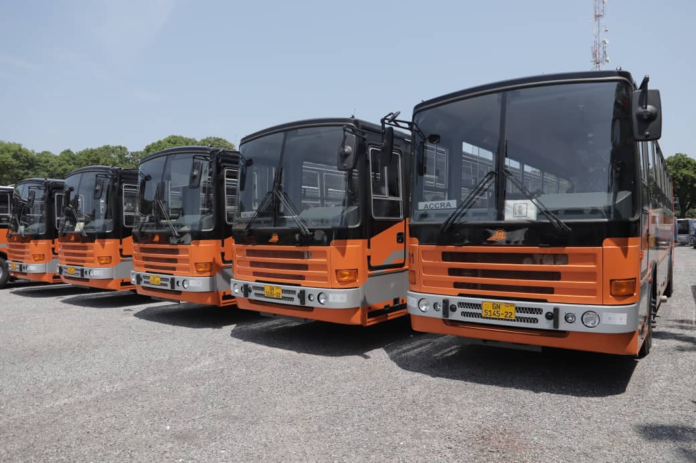

Metro Mass Transit Limited (MMTL) returned to profitability in 2025 after recording higher ticket sales and increased revenue from hiring and school bus services.
According to the 2025 State Ownership Report by State Interests and Governance Authority (SIGA), the company posted a net profit of GH¢4.48 million in 2025, reversing a net loss of GH¢2.52 million recorded in 2024.
Operating profit also increased from GH¢530,000 in 2024 to GH¢5.07 million in 2025.
The turnaround was supported by a 16.87 per cent increase in operating revenue, which rose by GH¢23.36 million from GH¢138.49 million in 2024 to GH¢161.85 million in 2025.
Total revenue, including non-operating income, increased from GH¢142.56 million to GH¢162.65 million.
The report attributed the revenue growth primarily to a 17.38 per cent increase in ticket sales. Revenue from hiring and school bus services also grew by 13.17 per cent.
MMTL’s net profit margin consequently improved from negative 1.82 per cent in 2024 to 2.75 per cent in 2025, while its operating profit margin increased from 0.37 per cent to 3.12 per cent.
Passenger numbers increase
The company transported 2.51 million passengers in 2025, up from 1.93 million in 2024, representing an increase of about 30 per cent.
Its average daily passenger boarding rate rose from 5,297 to 6,866 over the period.
MMTL buses covered a combined distance of 12.09 million kilometres in 2025, compared with 9.56 million kilometres in the previous year.
The improved revenue and passenger numbers were achieved despite a reduction in the company’s workforce from 1,696 employees in 2024 to 1,483 in 2025.
Employee productivity, measured by revenue generated per worker, increased from GH¢80,000 to GH¢110,000.
The company’s cost recovery ratio also improved from 97.5 per cent to 102.7 per cent, indicating that operating revenue was sufficient to cover its operating expenses during the year.
Return on assets rose from a marginally negative position in 2024 to 1.4 per cent in 2025, reflecting the company’s return to profitability.
Return on equity, however, remained negative because the company continued to have a shareholders’ deficit.
Government spends GH¢39.1m on electric buses
The report disclosed that Metro Mass Transit invested GH¢39.1 million in the operation of electric buses in 2025.
The investment was financed entirely by the Government of Ghana as part of efforts to support environmentally sustainable public transportation.
The company also introduced an electronic ticketing system and a smart workplace initiative intended to reduce paper use and improve operational efficiency.
However, MMTL did not report any other major events during the financial year.
Below-market fares cost GH¢378.38m
Metro Mass Transit continued to undertake quasi-fiscal activities by charging passengers fares below those of other transport operators.
The report estimated the cost of the below-market fares at GH¢378.38 million in 2025.
Quasi-fiscal activities are public policy or social obligations undertaken by state-owned enterprises without necessarily receiving full commercial compensation.
MMTL was established to provide safe, affordable and reliable public transportation, meaning its fare structure is partly influenced by its social mandate.
The Government of Ghana holds a 45 per cent interest in the company, with the remaining shares held by state-linked institutions, including SSNIT, SIC, NIB, Agricultural Development Bank and GOIL.
Cash generation weakens
Despite returning to profit, Metro Mass Transit’s operating cash flow weakened considerably.
Net cash generated from operating activities declined from GH¢13.34 million in 2024 to GH¢2.37 million in 2025.
Its operating cash flow-to-revenue ratio consequently fell from 9.63 per cent to 1.46 per cent, indicating that only a small proportion of revenue was converted into operating cash.
Cash used in investing activities declined significantly from GH¢153.01 million in 2024 to GH¢5.39 million in 2025.
The company ended the year with GH¢4.14 million in cash and cash equivalents, down from GH¢7.16 million in 2024.
Liabilities exceed assets
Metro Mass Transit continued to face considerable financial pressure despite its improved operational performance.
Its total assets declined by 9.73 per cent, from GH¢344.66 million in 2024 to GH¢311.12 million in 2025.
Non-current assets also decreased from GH¢299.99 million to GH¢259.79 million.
Total liabilities declined from GH¢491.77 million to GH¢453.75 million but remained substantially higher than the company’s assets.
MMTL consequently ended the year with negative equity of GH¢142.63 million, although this was an improvement from the GH¢147.11 million shareholders’ deficit recorded in 2024.
The company’s debt-to-assets ratio increased from 1.4 to about 1.5, meaning liabilities were approximately one-and-a-half times its total assets.
The report said this indicated greater reliance on liabilities to finance the company’s asset base and confirmed that MMTL remained financially constrained.
Short-term liquidity remains weak
Metro Mass Transit’s current ratio improved from 0.3 in 2024 to 0.4 in 2025.
Although this represented modest growth in short-term liquidity, the ratio remained below the benchmark of 1.0, suggesting that the company could face difficulties meeting short-term obligations with its current assets.
MMTL’s payables stood at GH¢123.03 million at the end of 2025, while its government-related domestic loans amounted to GH¢124.09 million.
The report said the company’s improved profitability marked important progress, but weak cash generation, negative equity and liabilities exceeding assets continued to pose risks to its financial sustainability.
READ ALSO:
GOIL profit rises to GH¢90.67m despite 9% revenue decline
Youth Employment Agency records GH¢110.45m surplus after 2024 deficit