
Financial irregularities uncovered in the accounts of Ghana’s Ministries, Departments, and Agencies (MDAs) more than doubled in 2025, with the Auditor-General flagging GH¢5.27 billion in questionable transactions and unpaid obligations, largely driven by tax infractions.
According to the Report of the Auditor-General on the Public Accounts of Ghana—Ministries, Departments, and Other Agencies for the year ended December 31, 2025, the value of irregularities rose from GH¢2.06 billion in 2024 to GH¢5.27 billion in 2025, representing a 156% increase.
The report further states that the entire amount is recoverable, meaning government institutions and individuals responsible could be compelled to refund the money or face a surcharge and legal action.
The surge was overwhelmingly driven by tax irregularities, which accounted for GH¢4.8 billion, representing more than 91% of the total amount flagged by the Auditor-General.
The report attributes this largely to outstanding tax liabilities identified during a review of debt stocks at the Ghana Revenue Authority’s Large Taxpayers Office.
Among the major findings were GH¢3.02 billion in accrued but unpaid taxes owed by ten state institutions as of the 2024 year of assessment, alongside GH¢701.8 million in unpaid Value Added Tax (VAT) and related levies owed by 7,970 VAT-registered taxpayers in the Greater Accra Region. Auditors also identified GH¢8.3 million in unpaid Growth and Sustainability Levy (GSL) owed by 813 companies and institutions.
In another case, Enclave Power Ghana Limited, a Free Zones company, was cited for failing to pay duties and taxes on local sales and services worth US$19.36 million between October 2024 and June 2025.
The Auditor-General has directed the Commissioner-General of the Ghana Revenue Authority to strengthen supervision, intensify tax recovery efforts, and apply the sanctions provided under tax laws to recover the outstanding amounts.
Beyond tax-related infractions, the report identified GH¢410.7 million in cash irregularities, making it the second-largest category. These involved unsupported payments, unaccounted revenue, missing payment vouchers, unapproved disbursements, and unretired imprests across several public institutions.
The most significant case involved the Ministry of Energy, where auditors found GH¢285.8 million relating to 34 transactions that were not supported by payment vouchers or any relevant documentation. The Auditor-General has directed the Ministry’s Chief Director to account for the expenditure or personally refund the amount into the Auditor-General’s Recoveries Account.
The report also uncovered persistent weaknesses in other areas of public financial management.
It recorded GH¢29.3 million in irregularities relating to loans and advances, including GH¢10.7 million owed by 596 employees of the Ministry of Health and the Ghana Health Service under the Vehicle Hire-Purchase Scheme.
Payroll irregularities amounted to GH¢19.9 million, including GH¢7.5 million paid to four deceased pensioners between February 2019 and March 2026. The Auditor-General has recommended that the funds be recovered with interest from the beneficiaries’ next of kin.
In procurement and stores management, auditors flagged GH¢1.13 million, including advance payments made by health facilities for vehicles that had not been delivered as of the end of 2025.
Contract irregularities totalled GH¢3.35 million, with one notable case involving GH¢2.3 million paid as mobilisation for the supply of a patrol boat to the Fisheries Commission, despite the vessel not being delivered by year-end.
The report also highlighted rent irregularities amounting to GH¢44,940, including unauthorised rental income collected by a former Regional Meteorological Director in the Western Region after renting out official government bungalows without approval.
The Ministry of Finance recorded by far the highest irregularities for the year, accounting for GH¢4,809,329,211, driven almost entirely by unpaid taxes, VAT, and levies under the Ghana Revenue Authority and representing over 91 per cent of the GH¢5.27 billion flagged across all MDAs.
The Ministry of Energy followed in a distant second with GH¢378,903,277, largely tied to the unsupported cash transactions at the Ministry level, ahead of the Ministry of Works and Housing at GH¢35,664,295 and the Ministry of Health at GH¢31,256,217.
The Ministry of Fisheries and Aquaculture Development (GH¢4,010,004) and the Ministry of Food and Agriculture (GH¢3,899,011) rounded out the higher-value cases, while ministries such as Communications, Local Government, Tourism, and Environment each recorded irregularities under GH¢200,000. indicating how concentrated the 2025 spike was in a small number of MDAs, with Finance and Energy alone accounting for nearly 99 per cent of the national total
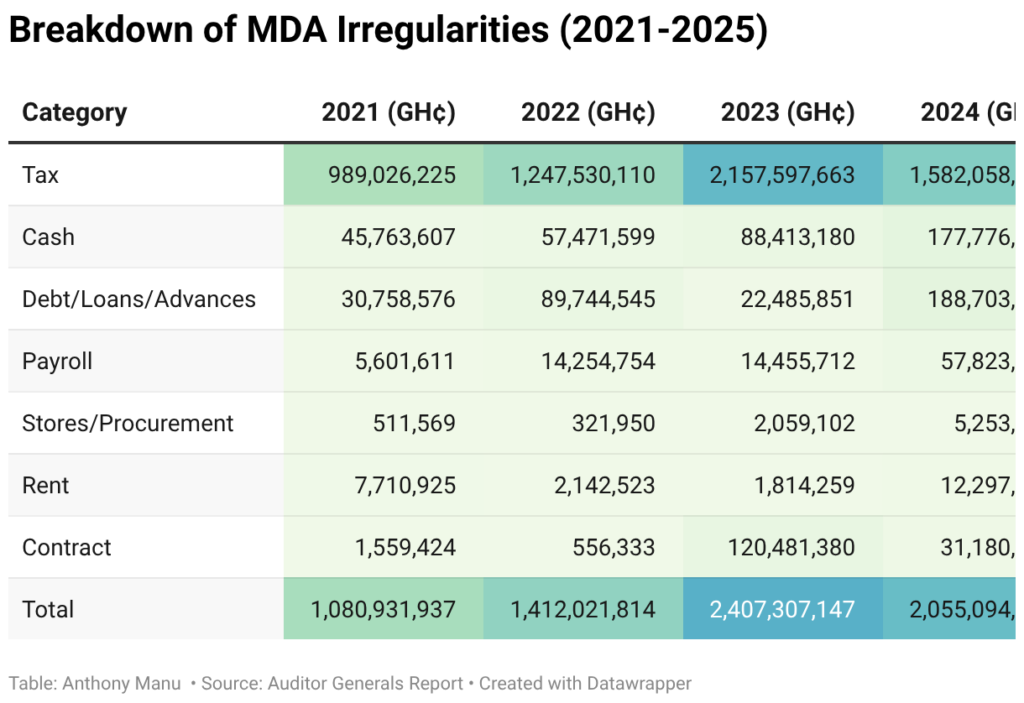
The Auditor-General’s five-year trend analysis shows that financial irregularities within MDAs have risen steadily over time.
Total irregularities increased from GH¢1.08 billion in 2021 to GH¢5.27 billion in 2025, representing more than a fourfold increase over the period. Tax irregularities alone have recorded the steepest growth, emerging as the dominant source of financial infractions in the public sector.
With the report now expected to be referred to Parliament’s Public Accounts Committee (PAC), heads of the affected institutions are likely to be summoned to explain the irregularities and outline measures to recover the funds.
The Auditor-General maintains that the full GH¢5.27 billion is recoverable and has urged the relevant authorities to enforce existing laws to prevent further losses to the state.
ALSO READ: