
In the rural stretch linking Apinkra, Behenase, Nuaso and Kokrobikro in the Bosomtwe District of the Ashanti Region, the journey to advanced medical care is as daunting as the emergencies that demand it. The roads are rough and uneven, turning every referral into a test of endurance for both caregiver and child.
At the St. Mary’s Anglican Clinic in Apinkra, where these communities resort for maternal and newborn care, the challenges begin long before a baby is placed in a vehicle.
For years, the facility operated under severe constraints.
In 2016, when midwife Margaret Ako Tsakle was posted there, she was the only midwife on duty, attending deliveries, managing complications and handling referrals, sometimes while caring for her own six-month-old baby.
But it is during referrals that the system shows its deepest cracks.
The Bosomtwe District relies largely on a single ambulance. When it is unavailable or already in use elsewhere, midwives must quickly improvise. A driver is called. A taxi is arranged. And within minutes and sometimes hours, a newborn in distress must be moved to an urban facility for treatment.
There has been no specialized neonatal transport equipment, no incubator, no secure system for carrying both baby and medical supplies. Instead, babies were placed on laps.
“I started work here in 2016 as the only midwife. Every referral, we placed the baby on our laps with the necessary items. Sometimes, we even forgot some of the things in the car while in a rush,” Margaret recalls.
On those bad roads, inside taxis not designed for emergency care, the situation became even more precarious. A fragile newborn on a midwife’s lap, medical items scattered on car seats and the constant jolt of the journey made even basic care difficult.
“The baby on my lap plus my things, sometimes you need to suction the baby, change the diaper, and in some cases give oxygen. With all these things on your lap, how can you do it?”
This question lingered until she decided to find an answer.
An Idea Shaped by the Road
In 2019, after years of navigating referrals under these conditions, Margaret began working on a solution, one shaped by the realities of rural healthcare and the physical strain of those journeys.
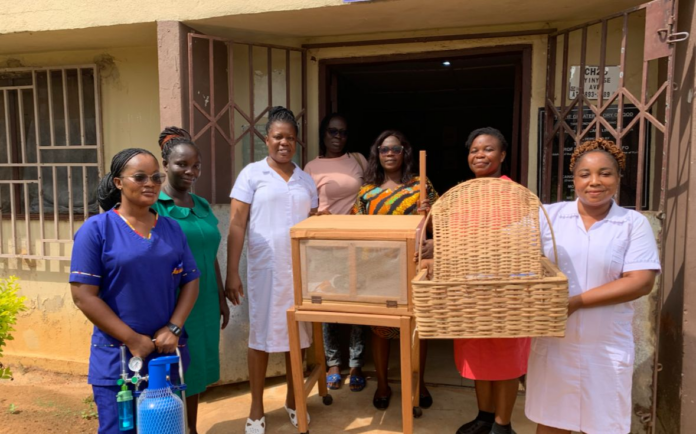
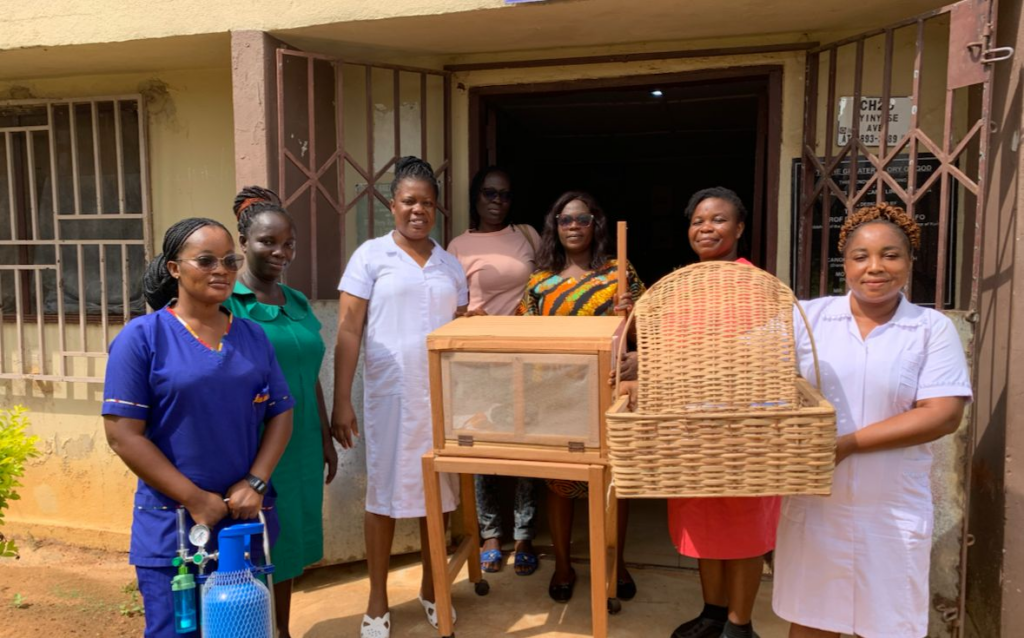
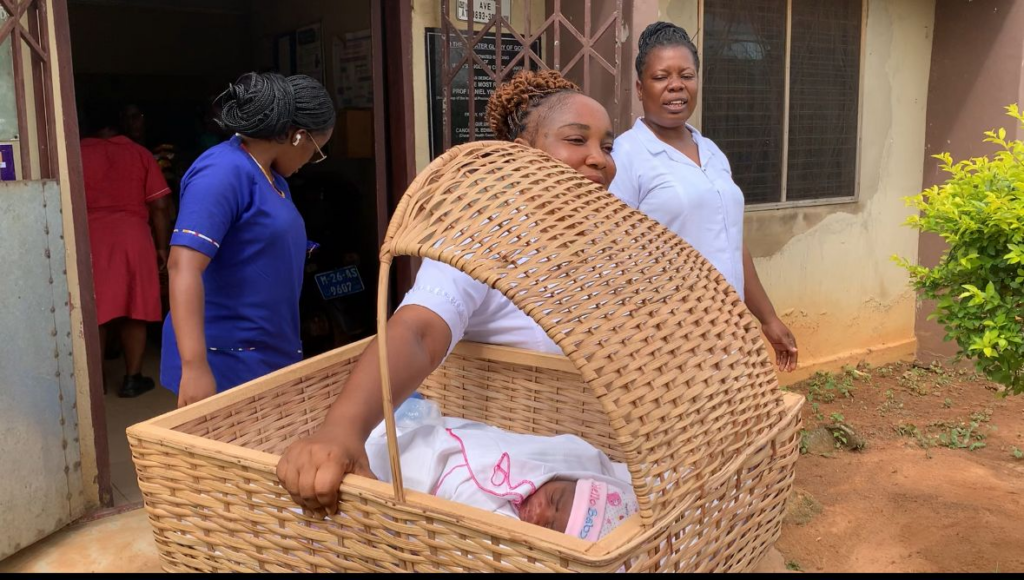
What she created is now known simply as the Emergency Traveling Basket.
Handmade and rectangular in form, the basket is designed to securely hold a newborn during transfers, but more importantly, to withstand the realities of movement along rough, unpredictable roads.
Inside it, everything has its place. There is room for the baby to lie safely, reducing the constant shifting that occurs when held on a person’s lap over bumpy terrain. A provision allows for an intravenous infusion to be hung directly onto the basket, ensuring that babies who require fluids can continue receiving them even while the vehicle is in motion. A cord clamp is included for emergencies such as bleeding, alongside a thermometer for monitoring temperature.
It also accommodates essential items often forgotten in the rush like referral notes, the maternal record book, diapers, clothing and a cot sheet all organized within reach.
And for journeys that stretch into the evenings, the design allows a mosquito net to be fixed over the basket, offering added protection.
For other midwives at the clinic, the change has been immediate.
“At first, during referrals, the mothers used to help hold the baby. Sometimes the mother had an episiotomy and couldn’t help, so the midwife had to care for both mother and baby. With the emergency traveling basket, it has become easier to care for the babies,” a colleague midwife explained.
A Simple Solution Facing a Familiar Barrier
Despite its impact, the innovation remains largely grassroots.
Margaret does not sell the basket. Instead, she has shared the design with other health facilities across the district, even demonstrating it at a meeting of facility heads in Kuntanase. The response has been positive, but adoption is slow.
“The major challenge is the money to go and buy the basket. You have to use your own money or wait for the hospital authorities to approve,” she said.
In a system where even basic logistics are strained, scaling a simple solution still requires support.
Now, with backing from her superiors, she is seeking assistance to expand its reach.
“We are looking for help to produce at least a hundred baskets to demonstrate and distribute to rural areas. If we get that, a lot of rural facilities can benefit,” she added.
At St. Mary’s Anglican Clinic in Apinkra, a midwife looked at the weight she carried on her lap, in her hands, and along unforgiving roads and chose to change it.
The basket does not fix the road nor does it replace the ambulance. But it works within those limitations that turn a difficult journey into a more controlled one.
MPs’ children should not benefit from Free SHS – Akrofuom MP
Me Boafo Foundation impacts over 800 lives in Adiembra through Easterfest…