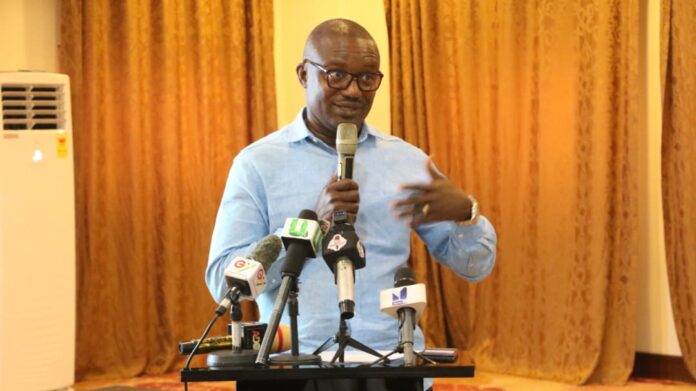

The Minister for Energy and Green Transition, Dr John Abdulai Jinapor, has warned board chairpersons and chief executives of state-owned energy institutions against toxic working relationships, cautioning that even officials who deliver results could lose their positions if they fail to work effectively with their colleagues.
He said mutual respect, teamwork and accountability were critical to improving institutional performance and achieving the government’s energy sector objectives.
Dr Jinapor gave the warning at the 2026 Energy Sector Performance Review Retreat, organised by the Ministry of Energy and Green Transition at Volta Seren Hotel in Ho from October 7 to 10.
Addressing board chairpersons and chief executives, the Minister reminded them that their appointments were temporary and that no official was above accountability.
He urged all appointees to support President John Dramani Mahama’s development agenda and work collaboratively to improve the performance of their respective institutions.
“Anybody who thinks he’s untouchable, please, you are making a big mistake,” Dr Jinapor cautioned.
He explained that executive authority rested with the President, who appoints ministers and, through the appropriate processes, board members and chief executives to implement government policies.
The Minister warned that disagreements between board chairpersons and chief executives, as well as tensions between executives and their deputies, could undermine institutional performance.
He urged chief executives to respect their boards and seek approval before making major financial commitments, while board members were expected to provide effective oversight and ensure that government policies were properly implemented.
He also advised deputies to support their superiors rather than undermine their authority, stressing that teamwork was essential to achieving institutional goals.
Dr Jinapor said he hoped the government would not have to dissolve any more boards during his tenure, urging appointees to improve their working relationships and remain focused on delivering results.
Power sector challenges
Touching on electricity supply, Dr Jinapor commended the Ghana Grid Company Limited (GRIDCo) and the Volta River Authority (VRA) for restoring power in record time following the August 1 incident, which resulted in the loss of approximately 1,000 megawatts of electricity.
He said the incident exposed weaknesses in the transmission system and highlighted the need for investment in modern infrastructure to prevent similar disruptions.
According to him, work is underway to establish an interim containerised substation while plans progress for an ultra-modern transmission infrastructure and control centre.
The Minister also disclosed that the Electricity Company of Ghana (ECG) had faced a shortage of about 600 transformers, contributing to electricity distribution challenges.
He said the government had facilitated the procurement of approximately 3,000 transformers, some of which had already been deployed to improve power distribution.
Dr Jinapor further revealed that the government was working with the Ministry of Finance to mobilise US$500 million for investment in the transmission network.
On electricity generation, he cautioned against excessive investment that could place unnecessary financial pressure on the country, insisting that future decisions must be guided by actual demand, available capacity and affordability.
He said the government was also collaborating with the VRA to restore idle power plants to service to strengthen electricity supply.
Jinapor urges ECG to improve revenue collection
The Minister highlighted improvements in payments to Independent Power Producers (IPPs), saying most were now receiving nearly 100 per cent of their bills, compared with about 40 per cent when the current administration assumed office.
He argued that greater investment in locally owned power generation companies could help retain more revenue within Ghana and reduce pressure on the cedi.
Dr Jinapor also urged ECG to improve its billing and revenue collection efficiency.
He welcomed plans to engage private sector operators in meter reading and billing, with payments made electronically, as part of efforts to improve revenue mobilisation and strengthen the financial position of the electricity distribution company.
TOR commended for turnaround
The Minister singled out the Tema Oil Refinery (TOR) as an example of the results effective leadership and teamwork could deliver, commending its management for reviving the facility without seeking financial support from the government.
He said TOR’s turnaround demonstrated that state-owned enterprises could overcome significant challenges through commitment, innovation and cooperation.
Dr Jinapor also expressed optimism about the petroleum sector, saying the decline in production recorded in previous years had been halted.
He attributed the improved outlook to renewed investor interest and agreements with companies expected to undertake further exploration and drilling activities.
The Minister urged stakeholders to sustain the momentum and work together to build an energy sector that delivers reliable, affordable, sustainable and resilient power to support Ghana’s economic transformation.