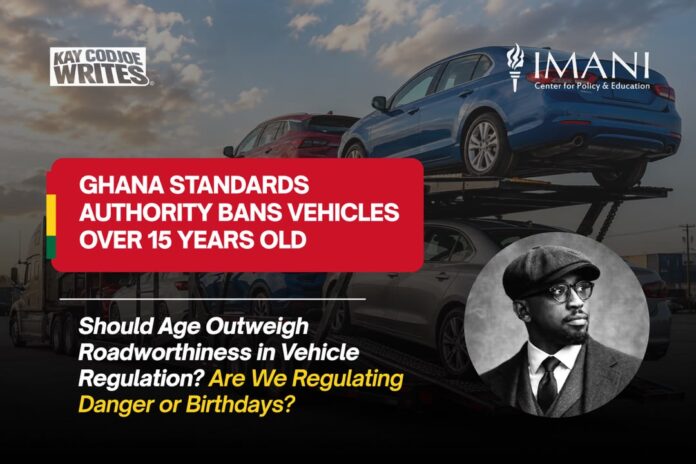

IMANI Center for Policy & Education has questioned the Ghana Standards Authority’s ban on vehicles older than 15 years, arguing that roadworthiness and mechanical condition should matter more than age alone.
While supporting tougher controls on unsafe, flood damaged and structurally compromised vehicles, IMANI says the blanket restriction under GS 4510:2022 raises legal, economic and consumer concerns.
Its central question is simple: if a 16 year old vehicle is roadworthy, properly maintained and emissions compliant, why should it be rejected while a younger but poorly maintained vehicle may still qualify?
IMANI also warns of possible effects on dealers, mechanics, clearing agents, consumers, Customs revenue and vehicle affordability.
The argument is not against regulation. It is for regulation that distinguishes danger from age, safety from convenience and industrial policy from affordability.
Below is the full article:
GSA’S BLANKET BAN ON 15 YEAR OLD VEHICLES — KAY CODJOE WRITES
Should Age Outweigh Roadworthiness in Vehicle Regulation? Are We Regulating Danger or Birthdays?
Ghana has every right to stop dangerous vehicles at its borders. A flooded car dressed in fresh paint does not become safe because somebody polished the dashboard. A wreck reconstructed for resale does not acquire structural integrity because Customs stamped its papers.
On that principle, the Ghana Standards Authority deserves support.
But that is precisely where the real argument begins.
The central question is not whether Ghana should regulate dangerous vehicles. It should. The question is whether age should outweigh roadworthiness in deciding which vehicles may enter the country.
From October 1, Ghana proposes to prevent the importation of used vehicles older than fifteen years under the GS 4510:2022 conformity regime. That means a vehicle may be mechanically sound, structurally intact, properly maintained and emissions compliant, yet still fail at the border because of its birthday.
Before we applaud, government must answer a fundamental question:
Are we regulating danger or regulating birthdays?
The Customs (Amendment) Act, 2020, Act 1014, already addressed age restrictions. Section 154(3) provides that the Finance Minister, in consultation with the Trade Minister, may by Legislative Instrument specify when vehicles over ten years shall no longer be imported.
That is Parliament speaking.
Today we are hearing fifteen years.
Fine. Fifteen may even be economically more realistic than ten. But administrative convenience cannot perform plastic surgery on an Act of Parliament. Produce the Legislative Instrument. Identify the statutory bridge between Parliament’s ten year architecture and GSA’s fifteen year rule.
A press conference is not subsidiary legislation.
Neither is a PowerPoint presentation wearing a government logo.
This is precisely why concerns from the Vehicle and Assets Dealers Union of Ghana deserve serious attention rather than dismissal as traders protecting their pockets. Its President General, Bernard Ntrakwah, supports GSA’s intervention to sanitise the industry and keep dangerous vehicles out. His objection is to the blanket fifteen year exclusion and its consequences for dealers, consumers and the wider automotive value chain.
That distinction matters because it exposes the false choice at the heart of this debate.
One can support tougher safety standards without accepting that age is the best measure of safety.
A sixteen year old Toyota with an impeccable service history, sound chassis, functional airbags, good brakes and acceptable emissions does not become a public menace at midnight on its birthday. Meanwhile, a seven year old vehicle can be abused, badly repaired and mechanically dangerous.
If danger is the disease, test for danger.
Do not diagnose a vehicle by its birth certificate.
The economic implications are even harder to ignore.
The used vehicle sitting in a garage feeds an ecosystem. Someone imports it. Someone clears it. Someone transports it. Someone services it. Someone sells tyres for it. Someone repairs its electrical system. Someone sells replacement parts. Someone sprays it. Someone drives it commercially.
Industrial policy cannot count jobs inside an assembly plant while treating livelihoods outside its gates as statistical litter.
And then there is the Ghanaian consumer.
If government removes the cheaper end of the vehicle market, where is the affordable credit that allows the buyer to climb upward?
You cannot legislate a man into a newer car.
If he cannot afford the replacement, he does not magically become richer because GSA changed the standard. He may simply keep the twenty five year old vehicle he already owns running for another five years.
That creates a dangerous paradox.
A policy designed to modernise Ghana’s fleet could end up keeping even older vehicles on the road for longer.
There is also the question of local assembly.
Ghana should support the development of a domestic automotive industry. But that industry deserves protection because it creates measurable Ghanaian value, not merely because imported competition has been administratively weakened.
Show us the numbers. How many vehicles are actually assembled in Ghana each year? How many permanent Ghanaian jobs have been created? How much genuine local content exists? How many components are manufactured here? How much does the State sacrifice in tax incentives to assemblers? Then compare those benefits with the Customs revenue, businesses and livelihoods potentially displaced across Ghana’s used vehicle economy.
Patriotism is not an exemption from arithmetic.
And PVoC introduces another question.
If a Ghanaian importer must pay an approved third party abroad before his vehicle may enter Ghana, tell us who owns the inspection companies, how they were selected, what they charge, who audits them and where an importer appeals when they get it wrong.
A compulsory certificate can become a private tax wearing a safety vest.
Keep the prohibition on flooded vehicles. Keep out fire damaged wrecks. Reject compromised chassis. Stop fraudulent conversions. Verify vehicle histories. Strengthen emissions standards. Make roadworthiness testing merciless.
But if a fifteen year old vehicle passes rigorous structural, mechanical, emissions and history tests, government must demonstrate why age alone should pronounce the final sentence.
That is the heart of the matter.
A good vehicle policy should punish defects, not dates.
Ghana should not have to choose between becoming a dumping ground for dangerous vehicles and pricing ordinary citizens out of mobility. That is a false choice.
The real test is whether the restriction is lawful, the safety evidence is compelling, the economics are survivable and the burden imposed on citizens is proportionate.
Safety must be proved. Regulation must be lawful. Policy must survive arithmetic.
Because if a roadworthy car can be rejected solely because it is fifteen years old, Ghana must answer the question this policy keeps avoiding:
Are we regulating danger or birthdays?
If the answer is birthdays, then the problem is not the car.
It is the policy.
By Kay Codjoe