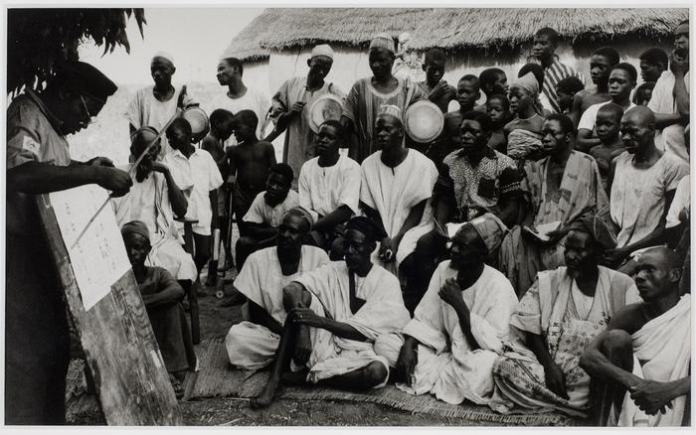

Long before English became the language of Ghanaian classrooms, offices, newspapers and public life, learning to speak it looked remarkably different.
And now, a glimpse of that forgotten world has resurfaced.
A piece of footage from 1954, when Ghana was still known as the Gold Coast, takes viewers inside an English lesson for adults and reveals a teaching method that was surprisingly simple: listen, repeat, observe and practise.
Shared by Ghana Facts & History (@GhanaianMuseum), the footage offers more than an old language lesson. It captures a moment in Ghana’s history when English was still a language many people were learning, rather than one they had grown up speaking.
What did an English lesson look like 72 years ago?
Forget smartphones, language apps, projectors and computer screens.
There were no fancy teaching aids.
Instead, the teacher relied on something far more basic — words, repetition and everyday objects and actions.
A word was introduced. The learners listened. The word was repeated. The teacher demonstrated its meaning, and the learners followed.
See it. Hear it. Say it. Repeat it.
Simple as it sounds, the method was designed to help adults connect unfamiliar English words with things they could see and experience in everyday life.
For learners encountering English as a new language, that practical approach could make the difference between simply hearing a word and actually understanding it.
Learning a new language in the Gold Coast
The year was 1954.
The Gold Coast was still under British colonial rule, and independence was three years away.
English had already become firmly established in formal education, colonial administration and other areas of public life. But that did not mean everyone could speak it fluently.
For many adults, learning English was an opportunity to communicate in spaces where the language was increasingly important.
So, behind the statistics and historical accounts of colonial Ghana were ordinary people sitting in classrooms, listening carefully, repeating unfamiliar words and trying to master a language that would eventually become a major part of everyday life.
That is what makes the footage so fascinating.
It allows us to see the learning process rather than simply read about it.
No technology. Just teacher and learner
Perhaps one of the biggest surprises for today’s generation is how little the classroom appears to need.
No computers.
No internet.
No headphones.
No language-learning applications.
Just a teacher demonstrating and learners paying attention.
The footage is a reminder that before technology transformed education, teaching depended heavily on patience, repetition and human interaction.
And interestingly, some of those principles have survived.
Modern language teachers still encourage students to say words aloud, repeat phrases, associate vocabulary with objects and practise language in everyday situations.
The tools may have changed.
The basic idea hasn’t.
But this was about more than English
At first glance, the footage may seem like nothing more than an old language class.
Look closer, however, and it becomes a snapshot of a society in transition.
These were adults learning a language that had become increasingly important in education, administration and public life.
They were not simply learning words.
They were acquiring a skill that could open doors to communication, employment and participation in institutions where English was the dominant language.
And over time, something even more interesting happened.
Ghanaians did not simply learn English.
They made it their own.
From the Queen’s English to Ghanaian English
Today, English is deeply woven into Ghanaian life.
It is heard in classrooms, newsrooms, courtrooms, offices, churches, radio studios and homes across the country.
But Ghanaian English is not simply a carbon copy of British English.
Over generations, Ghanaians have adapted the language, giving it distinctive expressions, rhythms, meanings and ways of speaking.
Some of the phrases that sound completely natural to a Ghanaian may leave a foreign English speaker wondering what exactly was meant.
That evolution is part of the fascinating journey that began, in part, with generations of Ghanaians learning the language in classrooms like the one captured in this footage.
Seventy-two years later…
There is something strangely powerful about watching people learn a language in 1954.
The lesson itself may appear ordinary.
But 72 years later, it has become history.
The faces, the voices, the teaching style and the simple demonstrations offer today’s generation something that textbooks cannot quite provide — a chance to witness an ordinary moment from the Gold Coast with our own eyes.
It raises questions that go beyond language:
What did education feel like before independence?
How did our parents and grandparents learn?
What was life like for adults trying to navigate a changing society?
And perhaps the biggest question of all:
How did a language once associated with colonial rule become such an unmistakable part of Ghanaian identity?
This 1954 footage does not answer all those questions.
But for a few minutes, it opens a door into the past — and lets us watch a generation learn, one simple word at a time.
The 1954 footage may be brief, but it preserves a moment that would otherwise exist only in photographs, written records and the memories of those who lived through the period.
Watch the rare footage shared by Ghana Facts & History here:
Rare Footage: How English Was Taught in the Gold Coast, 1954 🇬🇭 | Part 1
— GHANA FACTS & HISTORY (@GhanaianMuseum) August 11, 2026
Adults were taught spoken English through simple words, repetition and everyday demonstrations. pic.twitter.com/KzGgCetoXN
Part 1 offers only a glimpse. But even in these few moments, the lesson is clear: sometimes, the simplest classrooms leave behind the most fascinating stories.
ALSO READ:
Ghana’s children with special needs left waiting for trained teachers