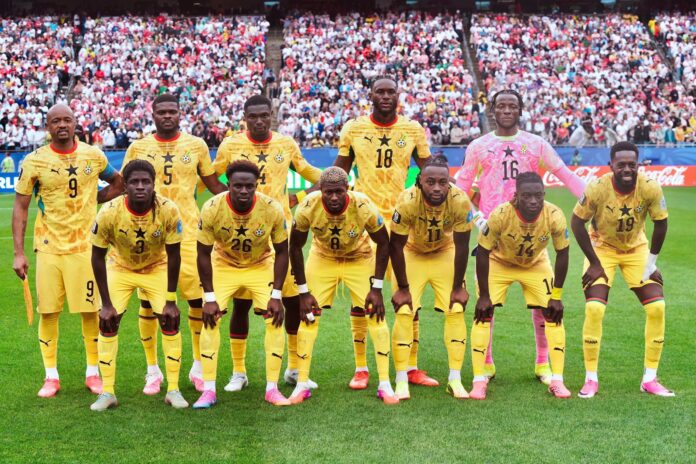

There was a time when the mere mention of Ghana commanded respect across world football.
Opponents feared the Black Stars. European scouts flocked to youth tournaments in Accra and Kumasi.
Ghana was the nation that consistently unearthed elite footballers, from Abedi Pele to Michael Essien, Sulley Muntari, Asamoah Gyan and André Ayew.
It became the first African country to win the FIFA U-17 World Cup, reached the quarter-finals of the 2010 FIFA World Cup, and was regarded as one of Africa’s most reliable football powers.
Today, the conversation has changed.
When Ghana exits major tournaments early, the debate usually centres on coaching decisions, player selection or tactical mistakes. Those issues matter, but they are symptoms—not the disease.
The deeper crisis lies beneath the surface. Ghanaian football is suffering from years of structural neglect, inconsistent leadership and the gradual erosion of the systems that once made the country a continental powerhouse.
The illusion of endless talent
Ghana continues to produce gifted footballers.
Players such as Mohammed Kudus, Antoine Semenyo, Ernest Nuamah, Kamaldeen Sulemana and Abdul Fatawu Issahaku prove the talent pipeline has not dried up.
European clubs remain eager to recruit Ghanaian youngsters because of their technical quality, athleticism and mentality.
Yet individual success has increasingly masked institutional failure.
Too often, Ghana relies on extraordinary individuals to compensate for ordinary systems. When those exceptional players are unavailable—or fail to deliver—the weaknesses of the entire structure become obvious.
Modern football rewards systems more than isolated brilliance.
The broken pathway
Perhaps the greatest concern is the disconnect between Ghana’s youth teams and the senior national side.
The country that once dominated youth football has struggled to convert age-group success into sustained senior excellence. Coaches change regularly. Youth programmes are redesigned before they mature. Promising generations are rarely developed together over multiple cycles.
Veteran coach Karim Zito has repeatedly argued that Ghana lacks continuity, saying talented youth teams are assembled only to be dismantled instead of forming the backbone of future Black Stars squads.
Compare that with Spain, France or Morocco, where players often progress together through every national age group before reaching the senior team.
Football development is no longer about producing talented teenagers.
It is about producing complete professionals.
Governance without continuity
Every disappointing tournament produces the same response.
A coach leaves.
A new technical team arrives.
Committees are formed.
Promises are made.
Months later, the cycle begins again.
Leadership changes have become so frequent that long-term planning rarely survives beyond a single tournament.
Successful football nations separate football decisions from political cycles. Ghana, however, has often struggled to maintain strategic continuity, creating uncertainty for coaches, players and administrators alike.
Without stability at the top, sustainable progress becomes almost impossible.
The decline of the Ghana Premier League
The domestic league should be the engine of Ghanaian football.
Instead, it has become one of its greatest concerns.
Low attendance, financial instability, inadequate television revenue, inconsistent sponsorship and ageing infrastructure have reduced the league’s competitiveness.
Many clubs struggle to retain their best players beyond a single season.
Young talents leave before completing their development.
Experienced professionals depart because salaries cannot compete with leagues elsewhere in Africa.
The consequence is clear.
A weaker domestic competition produces fewer players fully prepared for international football.
Infrastructure still matters
Elite football begins long before match day.
It begins on quality training pitches.
It begins with modern gyms.
It begins with medical departments, sports science, video analysis and professional academies.
Many Ghanaian clubs continue to operate without these essentials.
Poor playing surfaces affect technical development from childhood. Limited recovery facilities increase injuries. Outdated training environments slow tactical education.
Football has evolved dramatically over the last decade.
Infrastructure has become a competitive advantage—not a luxury.
Grassroots football is disappearing
One of Ghana’s greatest historical strengths was street football.
Children developed naturally in schools, parks and community grounds before entering academies.
That culture is gradually fading.
Former Black Stars defender Sammy Kuffour has warned that shrinking recreational spaces and reduced investment in grassroots football threaten the country’s long-term future.
When access to football becomes dependent on private academies, countless talented children are inevitably excluded.
No academy system can replace millions of children simply playing football every afternoon.
The African gap is widening
Perhaps the clearest evidence of Ghana’s stagnation is the rise of its competitors.
Morocco invested heavily in the Mohammed VI Football Academy, coaching education and elite facilities long before reaching the 2022 World Cup semi-finals.
Senegal strengthened youth development while maintaining continuity across its national teams.
Ivory Coast rebuilt patiently before lifting the Africa Cup of Nations on home soil.
These successes were not accidents.
They were products of long-term planning.
Ghana possesses comparable football talent.
The difference increasingly lies in organisation.
Accountability beyond the touchline
Supporters naturally judge results.
Managers receive criticism.
Players face public scrutiny.
But genuine reform requires asking harder questions.
How are coaching appointments made?
How effective are youth development programmes?
Why does infrastructure improve so slowly?
How sustainable is club financing?
How are football decisions evaluated beyond tournament outcomes?
Until these questions become central to public discussion, Ghana risks repeating familiar mistakes.
The road back
The decline of Ghanaian football is neither permanent nor irreversible.
The ingredients for recovery already exist.
A football-loving population.
World-class talent.
A proud football history.
An international reputation for producing elite players.
What remains missing is alignment.
A clear football philosophy.
Stable leadership.
Serious investment in grassroots development.
Modern infrastructure.
Professional club administration.
Long-term planning that survives changes in coaches and administrators.
Because Ghana does not have a talent problem.
It has a systems problem.
And history shows that systems—not moments of brilliance—are what separate nations that occasionally compete from those that consistently win.
Until Ghana rebuilds those foundations, every new generation of gifted footballers will carry the weight of expectations built by previous generations, while trying to succeed inside structures that no longer give them the best chance to do so.