
The government has accepted the Constitutional Review Committee’s recommendation to abolish the death penalty, paving the way for life imprisonment to replace capital punishment as part of a wider package of constitutional and human rights reforms.
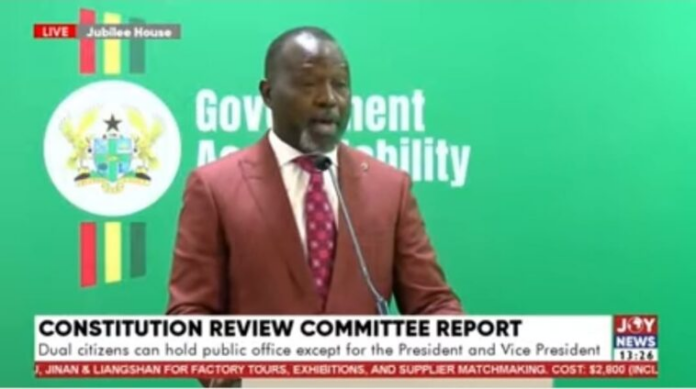
Presenting the government’s position on the Constitutional Review Committee’s recommendations on Thursday, July 30, Attorney General and Minister for Justice Dr Dominic Ayine said the decision reflects the government’s commitment to aligning Ghana’s legal framework with constitutional principles and international human rights standards.
He noted that the recommendation is not entirely new, as Parliament is already considering a Private Member’s Bill sponsored by Francis-Xavier Sosu that seeks to remove the death penalty from Ghana’s laws. The government’s acceptance of the proposal, he said, strengthens the ongoing legislative efforts to end capital punishment.
To give effect to the decision, Dr Ayine announced that the government will amend Articles 3, 13, 19 and 72 of the 1992 Constitution. Offences that currently attract the death penalty will instead be punishable by life imprisonment.
He maintained that keeping the death penalty on the statute books is incompatible with the constitutional right to life and with Ghana’s obligations under international human rights treaties.
“The death penalty is inconsistent with the constitutional right to life and with Ghana’s international human rights obligations under the UN conventions to which we are parties,” Dr Ayine stated.
On the broader human rights recommendations, Dr Ayine explained that the Constitutional Review Committee had proposed the inclusion of new rights under Chapter Five of the Constitution — including the rights to healthcare, housing, food, a clean and healthy environment, as well as enhanced protections for women, children, persons with disabilities, older persons and the youth. However, because Chapter Five is entrenched, amending it through a referendum would be lengthy and cumbersome.
Rather than pursue multiple constitutional amendments, the government will rely on Article 33(5) of the Constitution, which recognises rights inherent in a democracy beyond those expressly listed in Chapter Five, to introduce a new Human Rights Act.
According to Dr Ayine, the proposed legislation will incorporate Ghana’s obligations under international human rights conventions and establish clear legal mechanisms for the enforcement of those rights, including access to the High Court for victims seeking redress for human rights violations.
He expressed confidence that the new law would strengthen Ghana’s human rights framework and ensure that constitutional protections continue to evolve in line with the country’s democratic development and international commitments.
The Constitutional Review Committee, chaired by Professor Henry Kwasi Prempeh, submitted its report to President John Dramani Mahama on December 22, 2025.
The committee proposed wide-ranging reforms to Ghana’s constitutional, governance and democratic systems.
Also read: