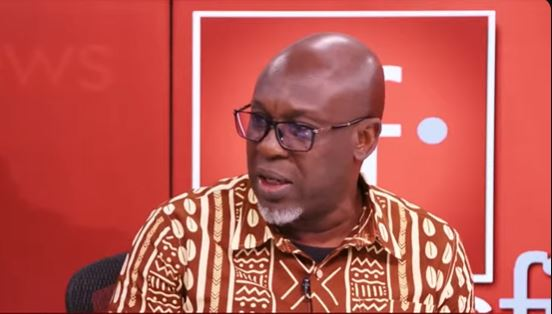

Lawyer and Senior Vice-President of IMANI Africa, Kofi Bentil, has defended the establishment and operations of the Ghana Gold Board (GoldBod), describing the institution as the best approach Ghana has so far adopted to manage its gold resources.
However, Mr Bentil cautioned that GoldBod is still evolving and should not be presented as a flawless institution.
Speaking on JoyNews’ Newsfile, he said GoldBod represented an improvement over an earlier arrangement under which the Bank of Ghana (BoG) was directly involved in gold trading and bore the financial consequences of the transactions.
“GoldBod is the best we’ve done so far but it is not perfect,” he said.
Mr Bentil explained that, under the previous arrangement, the Bank of Ghana was responsible for trading gold through GoldBod, with the resulting gains or losses ultimately reflected on the central bank’s balance sheet.
“At that time, it was Bank of Ghana that was trading gold through GoldBod,” he said.
He argued that the structure created problems because the central bank, whose primary responsibilities include monetary and financial stability, was also carrying the risks associated with commercial gold trading.
“The losses belonged on the books of Bank of Ghana,” he said, adding that the arrangement created challenges for the central bank.
According to Mr Bentil, concerns over that structure were among the reasons for calls for a different model in which the commercial risks associated with gold trading would be separated from the central bank.
“They created problems for Bank of Ghana and we said that wasn’t a good thing to do,” he explained.
Mr Bentil said Ghana is now transitioning towards a system in which GoldBod will have its own capital and operate more independently from the Bank of Ghana.
“Today as we speak, there is a transition from that position for GoldBod to have its own capital, to do its own buying, to do its own trading, and keep the losses or the benefits on its own books,” he said.
Under this model, GoldBod would assume the commercial risks and rewards associated with its gold purchasing and trading activities.
Losses from trading would therefore no longer be placed directly on the books of the Bank of Ghana, while profits or other benefits would accrue to GoldBod.
Despite his strong defence of GoldBod, Mr Bentil acknowledged that the institution still has areas that need improvement.
“We have not reached the point where we are perfect yet,” he said.
He argued that public discussion should focus on identifying and correcting weaknesses rather than concluding that the entire GoldBod concept is fundamentally flawed.
Mr Bentil rejected suggestions that the establishment of GoldBod was itself a policy mistake.
“Anybody trying to suggest that GoldBod is a mistake is wrong,” he said.
He maintained that Ghana’s experience with gold trading and the challenges associated with the previous arrangement demonstrate the need for an institution capable of managing the commercial side of the country’s gold resources.
“GoldBod is the best we have done with our gold resources yet,” he added.