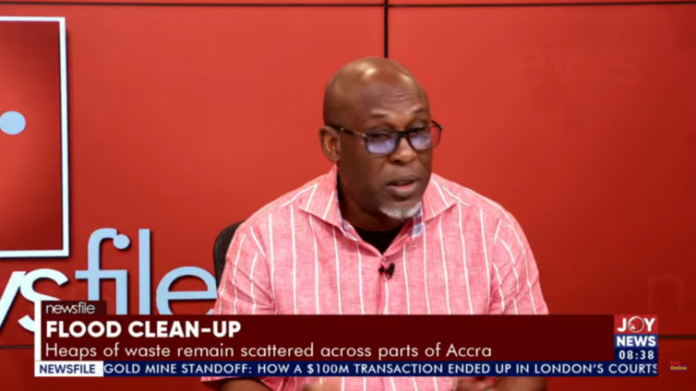

Senior lawyer and Vice President of IMANI Africa, Kofi Bentil, has criticised Ghana’s approach to sanitation management, describing it as reactive and lacking long-term planning, while urging the government to pursue sustainable solutions instead of temporary interventions.
Speaking on JoyNews’ Newsfile, Mr Bentil argued that the country’s sanitation challenges continue to be addressed without a clear strategic direction, despite recurring floods and persistent waste management problems, particularly in the capital.
“When it comes to sanitation, Ghana is on auto-pilot; nobody is thinking about a proper solution to our sanitation problems,” he said.
According to Mr Bentil, successive efforts to improve sanitation have failed to address the structural causes of poor waste management, leaving the country trapped in a cycle of flooding, emergency clean-up exercises and environmental degradation.
“When it comes to sanitation, Ghana is on auto-pilot. What will be, will be,” he remarked.
Mr Bentil also expressed concern over what he witnessed during a recent clean-up exercise in parts of Accra following heavy rains.
He recounted travelling to work on Friday, July 10 and observing what he described as confrontational scenes in Accra’s Central Business District, where traders and members of the public were allegedly being compelled to participate in sanitation activities.
“I went to work and I was very worried when I saw people almost brutalising people who were working,” he said.
According to him, some traders informed officials that the designated clean-up exercise was intended for government agencies and Metropolitan, Municipal and District Assemblies (MMDAs), questioning why private individuals conducting their normal business activities were being forced to participate.
Mr Bentil also referred to reports circulating on social media suggesting that a commercial bank had been temporarily shut down during the exercise, saying such actions raised concerns about how sanitation enforcement was being carried out.
The IMANI Vice President stressed that his comments should not be interpreted as political criticism but rather as constructive observations intended to improve governance.
Addressing the National Democratic Congress (NDC)-led government, Mr Bentil urged public officials to distinguish between criticism and genuine feedback.
“Not every information is criticism,” he said. “I am trying to tell this to the NDC and the government. Not every information is criticism.”
He explained that constructive public feedback should be welcomed as part of efforts to strengthen policy implementation and improve service delivery.
Mr Bentil further questioned aspects of the clean-up operation itself, arguing that some of the methods employed could inadvertently worsen sanitation conditions.
According to him, silt and refuse removed from drainage channels were left on nearby streets instead of being immediately carted away for proper disposal.
“I was worried about what I saw. They littered the city. They took the mud from the gutters and put them on the streets, and we were driving through them.”
He said the situation created discomfort for motorists and pedestrians, adding that the odour from the exposed waste made movement through parts of the city unpleasant.
“You couldn’t drive without your air conditioner on,” he stated.