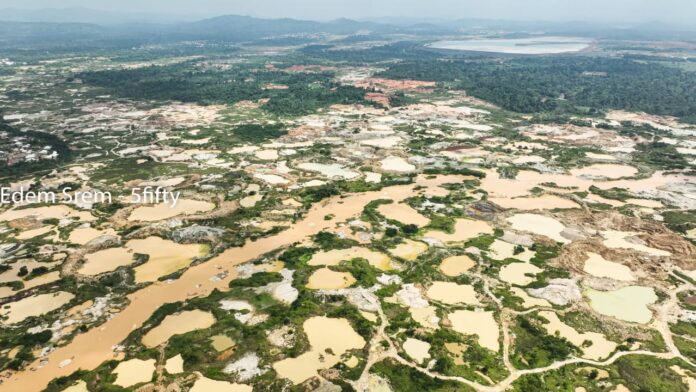

Why I chose Sustainability Reporting
I stepped into journalism with eager eyes, full of energy and curiosity. Everyday reportage on social life and political controversy was routine. Then came 2011.
An exposé by Anas Aremeyaw Anas on illegal mining (galamsey), titled “Ghana’s Gold”, shook me. Ghana was losing its fertile lands, its water bodies, and its environment to this relentless activity.
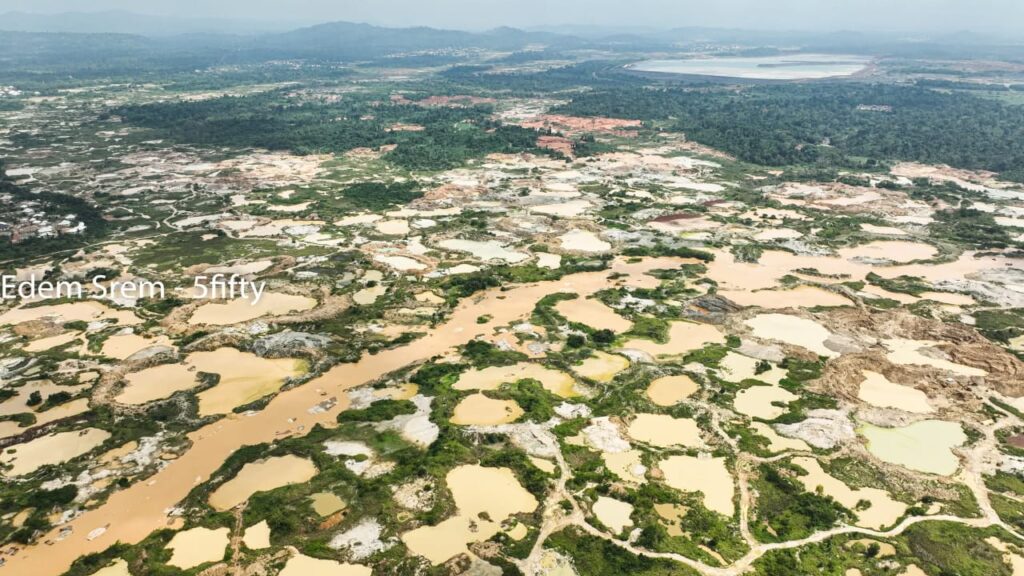
I watched the footage, jaw clenched. Men wielding makeshift guns. Forests turned to moonscapes. I told myself: Someone must continue this work.
But I did not act until 2019. Confined at home during COVID-19, I asked myself: If a pandemic we cannot control can wreak such havoc, why should we watch idly as humans ruin our own livelihood?
The Brazen Cancer
Strangely, by then, galamsey was no longer a hidden secret. It was being practised brazenly, even along major roadsides.
I recall driving the Accra-Kumasi highway and seeing excavators clawing into the earth just fifty meters from the asphalt.
When I asked a local chief why no one stopped them, he laughed bitterly. “Their bosses sit in Accra, my son.”
The secrecy was gone. Only the threat remained.
Tarkwa, First Warning: Bullets In The Bush
Deep in a thick Forest in Tarkwa, leading a crew of four, we flew a drone to uncover the damage. Devastated land. Forest. Dead trees. A river turned the colour of rust. Then the miners spotted it.
One of them pulled a short gun and began pursuing the drone. Pop—pop—pop. The echoes bounced off the trees. But for the experience of the drone pilot, I wouldn’t be here.
Three miners in pickups chased the drone, firing shots. Instead of flying it toward us, which would have given away our coordinates, the pilot flew it in the opposite direction.
For nearly 20 minutes, they chased shadows. That decision saved our lives.
When they realized they had been fooled, we heard: “Block the road!”
We split up. One man fled on a motorbike with the cameras and other gadgets in a backpack. The rest walked out with nothing.
When the driver got to the town with the car, the miners searched our car thoroughly, under the seats, in the boot, but found nothing.
This was because one bolted with the gadgets, two of us travelled by foot, and one drove the car alone. Without evidence, even armed men must step back.
We drove through. That is how close we came.
Osino: When Officials Go Missing
At Osino, a top-level government official at the Municipal office who had assured us of protection was nowhere to be found.
We called the official more than twenty-five times. Not one answered. Yes, you read right, we called him more than 27 times.
It was a group of illegal miners who escorted us to some sites. “You are walking where angels fear to tread,” one told us. “The people funding us? They are not in the forest. They are in Accra.”
The Miners’ Hotel
A known galamsey kingpin owned the hotel that accommodated our crew. Its manager was also an illegal miner, and approximately 85 per cent of the guests were miners themselves.
Even the restaurant where we dined was owned by a galamsey operator. Most of the patrons we encountered there were miners, taking their meals before heading into the forests for their shifts.
This reality served as a stark illustration of how deeply the illegal mining enterprise had infiltrated every layer of community life.
In the hotel courtyard, we learned from some of the miners that several journalists had received threats for their coverage of galamsey. Others, they said, had paid the ultimate price.
“You think police will help you?” one asked me pointedly. I had no response.
Souls Of the Fallen
Anytime I head toward a mining site, the death of Ahmed Suale hits me. He was murdered for investigative work of a different kind.
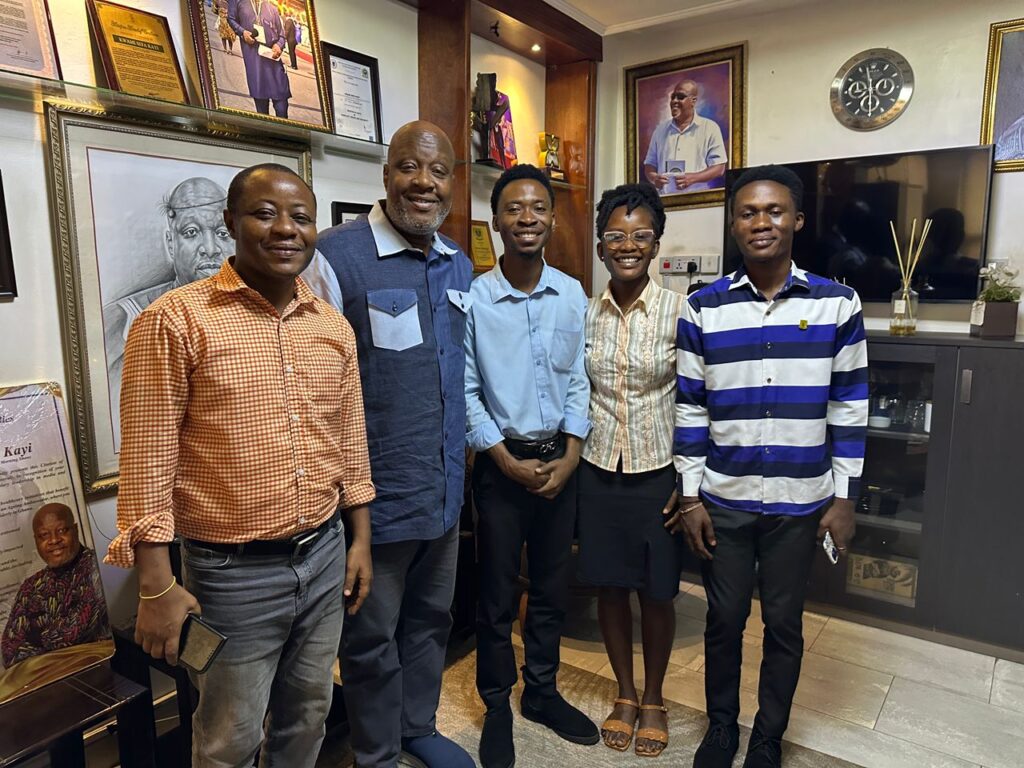
If they kill a journalist for exposing sports corruption, what will they do to me for exposing a billion-cedi criminal enterprise? Mr Kwame Sefa Kayi revealed to me in an interview “a friend of mine died in the line of duty while fighting galamsey”
Experienced videographers now turn down every offer.
“I want to see my children grow,” one told me. Their deaths may go undocumented. Nobody. No case. Just a missing person’s report, no one follows.
“Reporting threats to the police is often useless. Some officials are accomplices. They take bribes. They tip off the miners,” – Another reporter told me.
When the Field Follows You Home
I still go to the field. It is what I signed up for. But the peace I once knew has faded. A knock on my hotel door at night sends a chill through me.
An unfamiliar car or bike lingering outside my home makes me instinctively glance toward the back exit.
This is not cowardice. It is the residue of what I have witnessed.
I have seen what these men are capable of, and that knowledge does not easily leave you.
What troubles me most is the silence from those in power.
The protection journalists deserve seems elusive, and the impunity of the miners grows bolder by the day. I continue my work, but I do so with the weight of uncertainty on my shoulders and the quiet hope that someone, somewhere, will finally act.
About the author:
Andrew Pratt-Quainoo is a lecturer, Documentary film maker and online journalist.