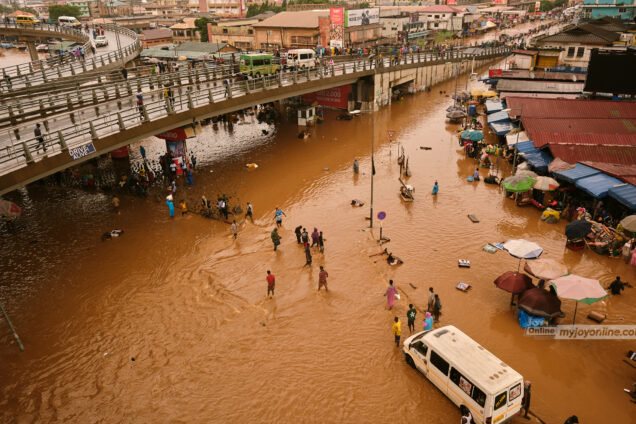

Every rainy season, Ghana’s capital goes underwater, and every rainy season the rains take the blame. Three decades of evidence point somewhere far less comfortable.
A city that drowns on schedule
The choreography of an Accra flood is now so familiar that residents could stage it from memory. The first serious downpour of the season arrives, usually in May or June. Within hours, the Kaneshie First Light interchange is a brown lake, traders at Kwame Nkrumah Circle are hauling goods onto rooftops, and the Odaw channel, the drain that carries most of the city’s stormwater to the sea, has burst its banks into Alajo, Adabraka and Avenor. The National Disaster Management Organisation (NADMO) issues casualty figures. A minister arrives in gumboots. An excavator is photographed dredging a drain. Promises are made. Then the sun comes out, and the city forgets until the next time.
The rains invariably take the blame, which is odd, because by global standards Accra is not a wet city. Its coastal savanna location gives it roughly 800 mm of rainfall a year, which is less than rainfall in Amsterdam (838 mm), and barely a third of what drenches Singapore (2,166 mm). Cities that absorb double or triple Accra’s rainfall do not routinely lose lives to it. In 1976, disaster researchers writing in Nature urged “taking the naturalness out of natural disasters”, arguing that hazards are natural but catastrophes are made. Accra proves the point every June. Rain causes floods. Decisions, accumulated over thirty years of building, dumping, permitting and postponing, turn them into disasters.
Thirty years of warnings
The pattern was set early. On 4 July 1995, a downpour paralysed the capital and killed at least 17 people; a committee was formed and a report written. Serious floods returned in 2001 and 2002, and again through the late 2000s. In October 2011, at least 14 people died and tens of thousands were displaced; the president of the day, Prof. John Evans Atta Mills, toured the wreckage, and officials promised that structures on waterways would come down. Few did.
Then came 3 June 2015, the night that should have changed everything. Torrential rain met blocked drains, and floodwater spread across Kwame Nkrumah Circle, where hundreds of commuters sheltered at a GOIL filling station. Fuel leaked into the water; a fire ignited and raced across it. More than 150 people died in a single night, a catastrophe equal parts flood, fire and failed urban management. The government declared three days of national mourning and vowed, once more, to dredge the Odaw and clear the waterways. Within weeks, bulldozers had flattened part of Old Fadama, the informal settlement sprawled along the Korle Lagoon, rendering thousands homeless, and then the momentum dissolved into court injunctions, protests and an election year.
The decade since has followed the script. In 2017, a new president, Nana Addo Danquah Akuffo Addo, pledged to make Accra “the cleanest city in Africa” and created a sanitation ministry. In 2019, the World Bank approved $200m for the Greater Accra Resilient and Integrated Development programme, targeting flooding in the Odaw basin. In 2022 Parliament established a Hydrological Authority. Yet the city flooded in 2018, 2020, 2022 and virtually every year since; in 2024 and 2025 the waters returned on cue to Kaneshie and Adabraka, while spillage from the Weija dam overwhelmed communities downstream. Thirty years of flooding is not a sequence of misfortunes. It is one failure, repeating.
The anatomy of a man-made flood
Let’s begin with the arithmetic. Greater Accra held about 1.4m people at the 1984 census; the 2021 census counted 5.4m, and the built-up area has expanded faster still. Savanna, farmland and marsh that once soaked up rainfall have been sealed beneath concrete and asphalt, so a storm the landscape once absorbed now runs off almost entirely, and faster, into channels never enlarged to receive it.
Where the water goes is not mysterious. The Odaw and its tributaries, the Onyasia, the Nima and Kaneshie drains among them, have followed the same courses for centuries, and their floodplains are part of the river, occupied only at the occupier’s peril. Yet Accra has permitted, or failed to prevent, construction directly on watercourses, wetlands and floodplains. Ghana does not lack rules: a 2011 national buffer-zone policy prescribes setbacks of 10 to 60 metres along waterways, and the Land Use and Spatial Planning Act of 2016, alongside building regulations dating from 1996, sets out an orderly permitting regime. But planning officials have conceded that most structures in the city were built without approved permits. The problem is not an absence of law. It is an absence of consequence.
Enforcement fails for reasons as much political as administrative. District assemblies are underfunded and inspectors few; permits can be negotiated. When authorities mark illegal structures for demolition, injunctions follow, then telephone calls from the powerful, then an election. Buildings marked in red paint routinely outlive the officials who marked them.
Maintenance fails too. Desilting of major drains is treated as an emergency contract awarded when the clouds gather rather than a routine budget line, and much of the network consists of unlined channels that erode and silt within a season. Meanwhile, the drains double as the city’s default waste-disposal system. Accra generates roughly 3,000 tonnes of solid waste a day, and collection does not reach everyone; sachet plastics, mattresses and even furniture go into the gutters, and the first storm flushes them into culverts, which choke. Water that cannot move forward backs up into homes. No drain, however well engineered, functions when it is full of furniture.
The city has simultaneously destroyed its natural insurance. The Sakumo lagoon and the Densu delta, both Ramsar wetlands designated in the early 1990s, have been steadily nibbled away by housing estates, and satellite studies suggest the metropolis has lost the great majority of its wetland cover in three decades. Wetlands are sponges; tile and tarmac are not.
Rivers turned into gutters.
To stand on a bridge over the Odaw is to see the consequence. What was once a stream is a grey-black conveyor of sewage, industrial effluent and plastic, its surface in places so densely carpeted with sachets and bottles that it looks solid. It empties into the Korle Lagoon, which researchers have described as among the most polluted water bodies anywhere; successive dredging and restoration projects since the late 1990s, costing tens of millions of dollars, have been overwhelmed by the silt and refuse that keep arriving. Ghana produces an estimated 1.1m tonnes of plastic waste a year and recycles perhaps 5% of it. The drains, in effect, are the recycling system.
None of this is destiny, as cities with far worse hydrology demonstrate. Singapore receives nearly three times Accra’s rainfall yet rarely suffers catastrophic flooding: its water agency polices drainage reserves ruthlessly, requires developers to detain stormwater on site, and under its Active, Beautiful, Clean Waters programme has turned drains into assets; a three-kilometre concrete canal was remade in 2012 as a meandering river through Bishan-Ang Mo Kio Park, doubling as a floodplain in storms.
Seoul demolished an elevated motorway to resurrect the Cheonggyecheon stream in 2005, turning a covered sewer into a flood channel that doubles as its most beloved public space. Munich spent a decade renaturalising eight kilometres of the Isar, widening its floodplain through the heart of the city. Zurich has “daylighted” some 20 kilometres of buried brooks since the late 1980s, and Swiss hazard maps carry the force of law: in the red zone, nobody builds, however well connected. Copenhagen, swamped in July 2011 by a cloudburst that caused around $1bn of damage, responded not with a committee but with a 300-project Cloudburst Management Plan that is redesigning streets as channels and parks as reservoirs, funded across political cycles. In the Netherlands, elected water boards have levied their own taxes since the Middle Ages, so maintenance never loses a budget fight, and Amsterdam, with more rain than Accra, keeps its feet dry.
No city is flood-proof: Seoul lost lives to basement flooding in 2022, and Copenhagen’s plan was born of its own disaster. The difference lies in what happens next. These cities respond to floods by rebuilding systems rather than reciting promises, and they treat rivers as public assets; property values rise along restored banks, rather than as dumps. Wealth helps, but sequencing matters more: enforcement and maintenance cost a small fraction of what disasters do. Accra pays in relief and reconstruction what it declines to pay in prevention.
The courage deficit
Why, then, does the crisis persist? Because every genuine remedy is politically expensive. Demolishing structures in waterways means confronting not only poor settlers but wealthy developers whose gated estates sit on wetlands; it means absorbing court battles, compensation claims and lost votes. Prosecuting the officials who approved unlawful developments means the political class disciplining itself. For three decades it has proved easier to dredge a drain for the cameras.
There is a genuine equity problem, and honesty requires acknowledging it. Ghana’s housing deficit, estimated at around 1.8m units, pushes the poor onto land nobody else wants, which is often land the water wants. Bulldozers without alternatives are cruelty; enforcement paired with notice, resettlement and compensation is governance. Both halves are necessary; both cost money and nerve.
There are flickers of resolve. Within weeks of taking office in January 2025, a new administration moved against structures encroaching on the Sakumono Ramsar site, precisely the sort of operation governments usually announce and abandon. History counsels scepticism: the post-2015 clearances died in injunctions and electoral arithmetic. The real test is not one demolition but consistency, whether enforcement applies to the mansion as readily as to the kiosk, and whether it survives the next election. Copenhagen’s most transferable lesson is not hydrological but political: its plan was designed to outlast governments. Floods ignore electoral calendars; flood policy must too.
What must be done
The agenda is not obscure; most of it already sits in official reports. First, information and enforcement: publish legally binding flood-risk maps for the entire metropolis, Zurich-fashion, and refuse permits in high-risk zones without exception; digitise and audit the permit system; fund inspectors; and create fast-track courts for planning and sanitation offences. A single conviction of an official who signed an unlawful approval would achieve more than ten committees of inquiry.
Second, clearance and restoration: remove structures from primary waterways with due process and resettlement support; restore the Odaw-Korle corridor as a linear park on the Seoul and Munich template; give the remaining Ramsar wetlands absolute protection; and convert the 2011 buffer-zone policy into enforceable law.
Third, infrastructure and waste: complete the World Bank-financed drainage and detention works, then fund their upkeep through a ring-fenced annual maintenance levy, Dutch-style, rather than episodic emergency contracts; require new developments to retain stormwater on site, as Singapore does; extend waste collection to every neighbourhood, impose producer responsibility on the plastics industry, and enforce dumping penalties, paired with public education that links duty to service, because residents stop dumping when the trucks actually come. Finally, accountability: an annual flood-mitigation report to Parliament, naming the works completed, the money spent and the officials responsible.
The choice
Climate change will make West African downpours sharper and less predictable. That strengthens, rather than weakens, the case that governance is decisive, because the margin for self-inflicted error is shrinking. Everything about Accra’s next flood is already known: where the water will go, roughly when, and who will suffer. Ghana does not lack laws, plans or studies; it lacks execution and consequence. The Cheonggyecheon was once a slum-covered sewer beneath a motorway, and the Isar a sterile canal: cities choose their rivers, and can choose again. The rain is the only natural thing in this story. Nature will keep sending water to Accra every June; whether it arrives in a city designed to receive it, or one arranged to be ruined by it, is a human decision deferred for thirty years. The water, unlike the politicians, always keeps its appointments.